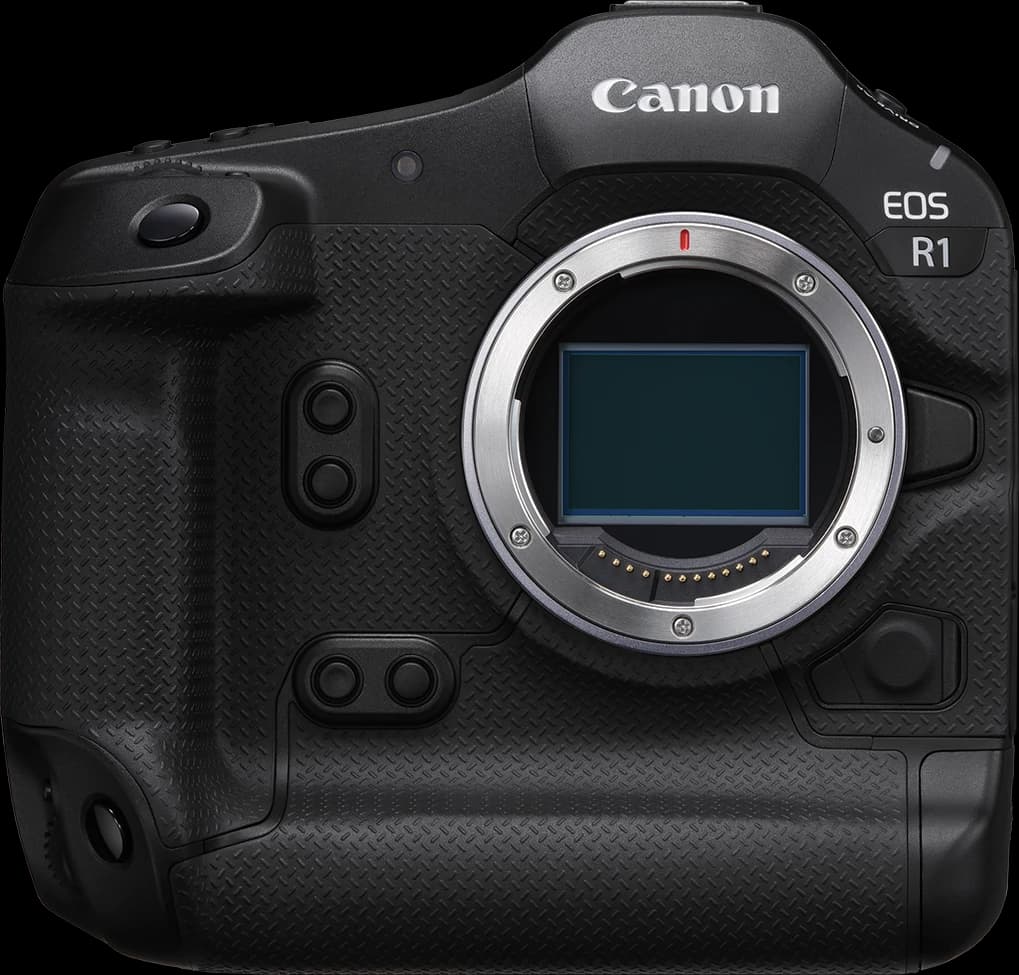
Canon
EOS R1
2024
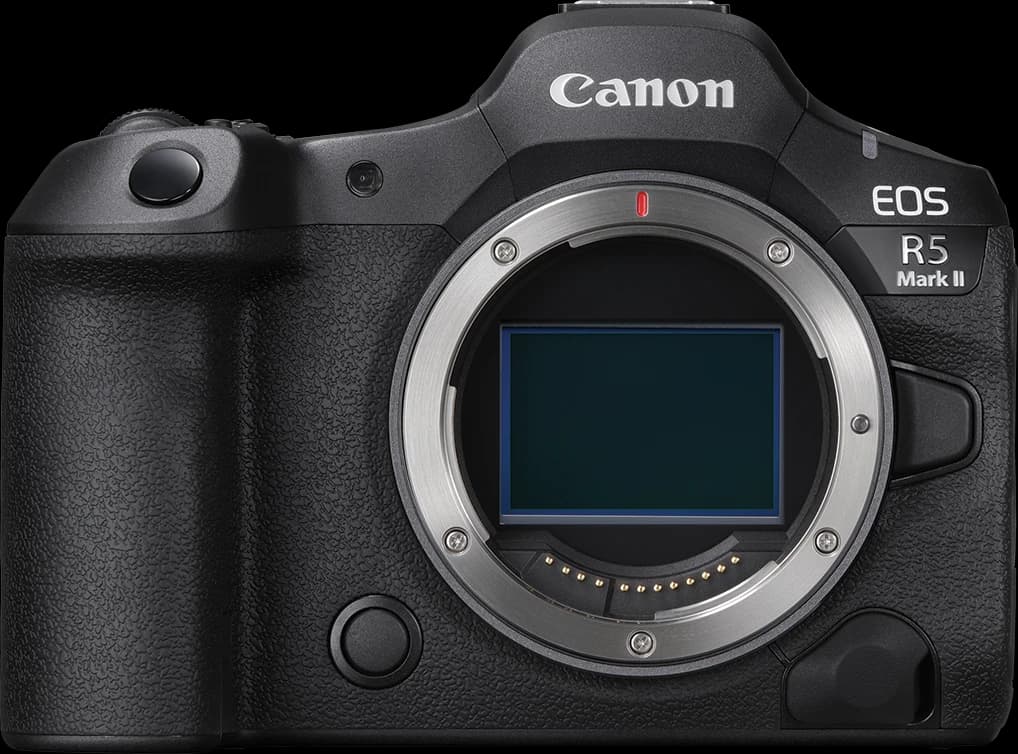
Canon
EOS R5 Mark II
2024
Canon EOS R1 vs EOS R5 Mark II: which justifies its price according to your usage?
Visual summary
— Reads in 5 seconds
Canon
EOS R1
Canon
EOS R5 Mark II
Where to buy
— Live merchant price comparator


You'll find the best prices on the market here, updated daily — and by going through these partner links, you support Camera Duel without paying a cent more.
The arbitration in brief
The R1 is the choice for sports and demanding reportage; the R5 Mark II is the best versatile hybrid under 5 000 USD for everything else.
Canon released these two bodies in the same year. They share the RF mount, the full-frame Stacked CMOS sensor and weather sealing. Yet, they target different photographers.
The EOS R1 is the flagship of the Canon range. It succeeds the EOS-1D X Mark III and targets professionals in sports, reportage and events. Its launch price is 6 299 USD. The EOS R5 Mark II is positioned one step below, at 4 299 USD, but it is no compromise: it is a high-resolution hybrid designed for portraits, weddings, video and travel.
The 2 000 USD gap between the two bodies is the first trade-off to consider. It determines everything else. The R1 justifies its premium with a mechanical burst of 40 fps, a native max ISO of 102 400 and an EVF with 9,44 million dots. The R5 Mark II counters with 45 megapixels, 8K 12-bit video with unlimited recording and a weight of 746 g versus 1 115 g for the R1.
This comparison addresses four concrete questions: does the R1's burst speed alone justify its extra cost? Is the R5 Mark II's resolution an asset or dead weight? Which holds up better in professional video? And for weddings or versatile reportage, which offers the best performance-to-mobility ratio? You will find quantified answers here, without vague qualifiers.
Standout strengths
— Where each camera shines
Canon
EOS R1
Top advantages
- 409 600Extended ISO max4× vs Canon EOS R5 Mark II
- 102 400Native ISO max2× vs Canon EOS R5 Mark II
- 40 fpsElectronic burst+33 % vs Canon EOS R5 Mark II
- 230RAW buffer2,5× vs Canon EOS R5 Mark II
Canon
EOS R5 Mark II
Top advantages
- 45 MPMegapixels1,9× vs Canon EOS R1
- 746 gWeight+49 % vs Canon EOS R1
- OuiUnlimited recordingAbsent sur Canon EOS R1
- 8KMax video resolutionvs 6K
Detailed spec-by-spec
— Round by round, the eight categories
Sensor
Autofocus
Speed & burst
Video
Stabilisation
Build
Ergonomics & screen
Connectivity & battery
Detailed analysis analysis
— Strengths, trade-offs and ideal user
Canon EOS R1: what it does well, what it concedes
The R1 relies on a full-frame Stacked CMOS 24-megapixel sensor. The resolution is deliberately contained. This allows faster buffer clearing and maintains a 40 fps rate in both mechanical and electronic modes. In practice, 170 RAW images in buffer represent about 4.25 seconds of continuous burst at full speed. That is enough to cover a short action, but the R5 Mark II holds 230 images at 30 fps electronic, for a longer sequence before saturation.
Native ISO reaches 102 400 without extended mode. DPReview and Photons to Photos confirm a measured dynamic range of 10.8 EV at base 100 ISO. This figure is slightly below the 11.5 EV of the R5 Mark II. The gap is real but modest: it translates to marginally less flexible highlight recovery in landscapes or studio work. In nocturnal sports or high-ISO reportage, the R1's high native ISO more than compensates.
The EVF reaches 9.44 million dots with 0.9× magnification. It is the best viewfinder in the Canon RF range to date. For a sports photographer framing at 40 fps, viewfinder fluidity and precision are functional criteria, not cosmetic. The R1's trade-offs are clear:
- 1 115 g body only, 369 g more than the R5 Mark II.
- CIPA autonomy of 370 shots versus 540 for the R5 Mark II.
- Video recording limited to 360 minutes per session, versus unlimited on the R5 Mark II.
The R1 is a specialist's tool. It excels in a precise domain and does not aim to do everything.
For whom
The R1 suits the professional photographer whose income depends on capture speed and reliability in extreme conditions. High-level sports photographer, travelling photojournalist, wedding photographer covering the ceremony in tricky light and decisive moments at high cadence. They accept the 1 115 g weight because robustness and responsiveness trump mobility. They do not need 45 megapixels: their images are destined for press, web or standard prints, not large formats. Their budget exceeds 6 000 USD and they know why.
Canon EOS R5 Mark II: what it does well, what it concedes
The R5 Mark II packs 45 megapixels on a full-frame Stacked CMOS sensor. This resolution changes two concrete things: it allows aggressive cropping in post-production without loss of usable detail, and it opens the door to large prints beyond 60 × 90 cm. Measured dynamic range reaches 11.5 EV at base 100 ISO, 0.7 EV more than the R1. The advantage is noticeable in high-contrast landscapes or portraits in mixed light.
Electronic burst tops out at 30 fps with a 230 RAW image buffer. That is 10 fps less than the R1 in electronic, but the continuous sequence is longer. In mechanical, the gap is stark: 12 fps versus 40 fps. For top-level sports, this difference is a deal-breaker. For weddings, portraits or versatile reportage, 30 fps electronic is more than enough.
Video is where the R5 Mark II pulls ahead most clearly:
- Max resolution 8K versus 6K for the R1.
- Colour depth 12 bits versus 10 bits.
- Recording unlimited versus 360 minutes per session.
- External Blackmagic RAW compatibility, absent on the R1.
IBIS compensates 8.5 stops, on par with the R1. The real gap sits elsewhere: 45 MP here against 24.2 MP, and 30 fps electronic against 40 fps. The gap is small but measurable. The 746 g weight and 138 × 98 × 88 mm dimensions make it a body you can carry all day without fatigue. The EVF displays 5.76 million dots, 3.68 million fewer than the R1. The difference is visible in use, but it does not penalise non-sports applications.
For whom
The R5 Mark II suits the hybrid photographer who alternates photo and video in the same day. Wedding photographer delivering 4K or 8K films, portraitist cropping images for multiple output formats, independent videographer shooting in C-Log3 or internal RAW. They appreciate the contained 746 g weight for long sessions. Their budget is 4 299 USD and they seek the best performance-versatility ratio in the RF range. They do not need 40 fps mechanical, but they do not want to sacrifice resolution or video either.
Our verdict
Which one to buy, and why
The R1 and R5 Mark II share the same base technical platform. Their divergence is a matter of priorities, not quality.
On pure speed, the R1 has no rival in the Canon range. 40 fps mechanical and 40 fps electronic with 4 897 AF points over 100 % of the sensor: it is the only RF body capable of top-level sports without compromise. Native ISO at 102 400 reinforces this position in low light. If your dominant use is sports, wildlife or photojournalism in tough conditions, the R1 is the only rational choice in this ecosystem.
For everything else, the R5 Mark II is superior or equivalent, for 2 000 USD less. It offers:
- 45 MP versus 24 MP, a decisive edge for portraits, landscapes and large formats.
- 8K 12-bit video with unlimited recording, versus 6K 10-bit limited to 360 minutes.
- 746 g versus 1 115 g, a 369 g gap that matters on a day of reportage or travel.
- Autonomy of 540 shots versus 370.
The R1's deal-breaker for non-sports uses is its weight and price. The R5 Mark II's deal-breaker for top-level sports is its 12 fps mechanical burst: it rules out situations where every fraction of a second counts.
On the used market, the R5 Mark II trades around 3 200 to 3 500 USD in excellent condition. It is a smart entry for a wedding photographer or videographer wanting the RF platform without new price. Used R1s remain rare and hold value well: professionals who buy it keep it.
My view is clear: choose the R5 Mark II in 80 % of cases. It is lighter, more versatile, better in video and cheaper. The R1 justifies itself only if your main activity generates direct revenue tied to capture speed, i.e. professional sports, photojournalism or wildlife in extreme conditions. For any other use, paying 2 000 USD more for 40 fps mechanical is unjustified.
Frequently asked questions
Before you buy, the questions we get
Which to choose for wedding photography?
The R5 Mark II is the logical choice for weddings. Its 45 megapixels allow cropping group shots without loss. Its 30 fps electronic burst covers decisive moments. Its 746 g weight is bearable over a 10-hour day. Unlimited 8K 12-bit video recording is a strong argument if you also deliver films. The R1 brings nothing decisive here, and its 2 000 USD premium is not justified for this use.
Does the R1's 40 fps burst really make a difference versus the R5 Mark II's 30 fps?
In electronic, the gap between 40 fps and 30 fps means one extra image every 33 milliseconds. In a sprint or jump, that can be the difference between the peak action shot and the one just after. In mechanical, the gap is far more significant: 40 fps versus 12 fps. The R5 Mark II cannot compete with the R1 in top-level sports using mechanical shutter. For any other use, 30 fps electronic is sufficient.
Should you go for 8K video if you mainly shoot in 4K?
The R5 Mark II's 8K resolution is not just marketing if you deliver in 4K. Shooting in 8K and exporting to 4K provides cropping and stabilisation headroom in post without final quality loss. The R5 Mark II's 12-bit depth also beats the R1's 10 bits for colour grading. If your post-production pipeline can handle 8K files, the R5 Mark II is clearly superior for video.
Does the 2 000 USD gap between the R1 and R5 Mark II justify itself?
Only for very specific uses. The R1 costs 6 299 USD versus 4 299 USD for the R5 Mark II. For that premium, you get 40 fps mechanical (versus 12 fps), native ISO at 102 400 (versus 51 200) and an EVF with 9.44 million dots (versus 5.76 million). If your main activity is professional sports or photojournalism, these specs translate to images you cannot get otherwise. In all other cases, the 2 000 USD gap is better spent on RF lenses.
Which body will age better in the Canon RF range?
Both bodies launched the same year and benefit from the same Canon firmware support. The R5 Mark II has a structural edge: its 45-megapixel resolution and unlimited 8K 12-bit video match evolving delivery standards. The R1, as flagship, will likely get priority firmware updates. On resale, Canon flagships hold value better than versatile bodies. Both stand the test of time, but the R5 Mark II's versatility better shields it from functional obsolescence.