Review · Pentax · 2022
Review: Pentax KF – The Rugged DSLR for Purists
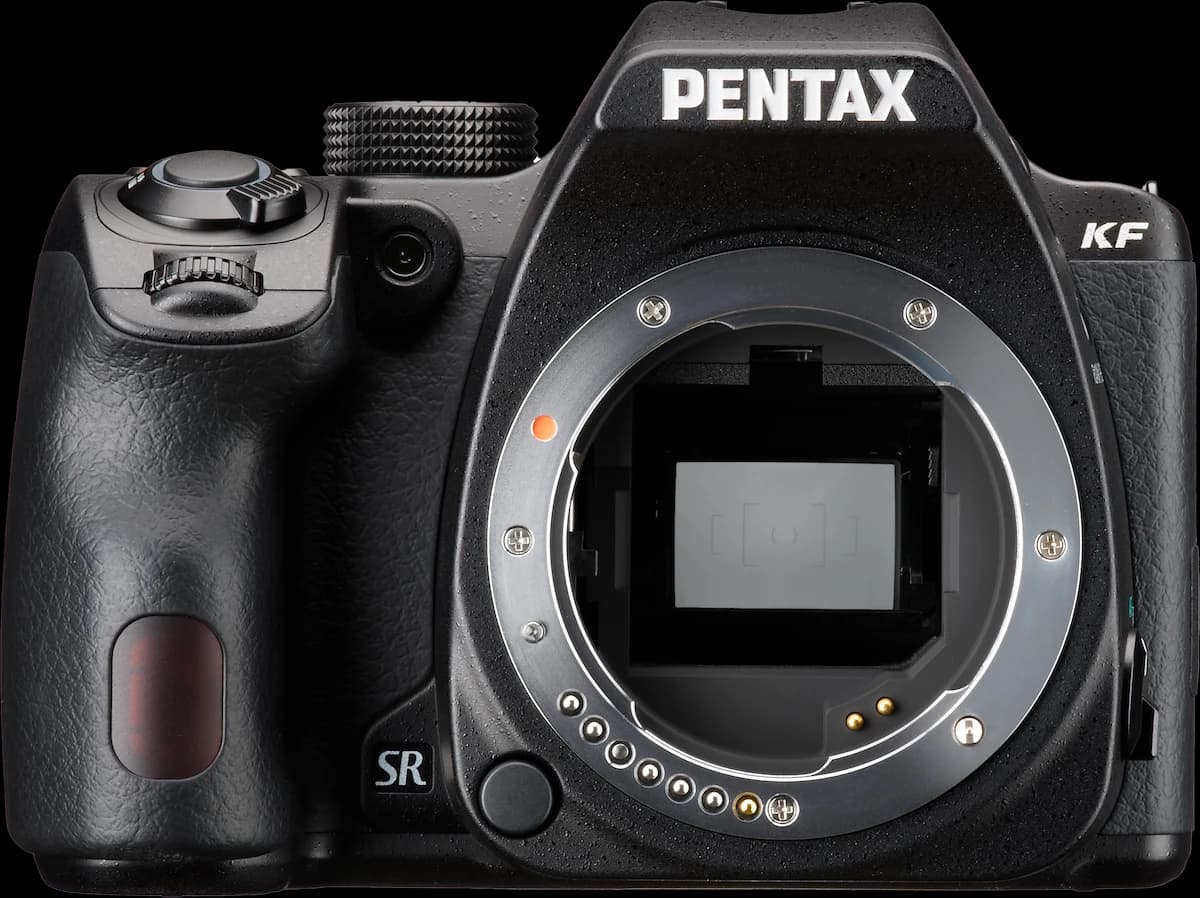
The Pentax KF is the only weather-sealed APS-C DSLR under $700. It suits landscape or travel photographers seeking a robust body, solid low-light image quality and access to the vast KAF2 lens ecosystem, without concern for video.
Verdict
The Pentax KF fulfils its brief as an accessible APS-C DSLR with rare consistency at this price. Full weather-sealing, 4.5-stop IBIS and native 102,400 ISO form a strong trio for landscape work in difficult conditions and travel photography. The 24 MP sensor delivers competitive dynamic range, and the 0.95x pentaprism optical viewfinder remains among the best in its class. Conversely, the 11-point AF system without subject detection, the 6 fps burst with a 10-frame RAW buffer, and video limited to 1080p/30 in 8-bit H.264 without log are deal-breakers for dynamic or hybrid use. A single UHS-I SD slot and USB 2.0 further weaken connectivity. At $649 on launch, the KF is justified only for photographers who shoot static subjects outdoors and value robustness over versatility. On the used market it regularly falls below $400, strengthening its value proposition for this precise profile.
Pros
- Full weather-sealing included below $650 – unique in the category
- 102,400 ISO native without extended mode: genuine high-sensitivity range
- 0.95x pentaprism optical viewfinder – the most generous among entry-level APS-C DSLRs
- 4.5-stop IBIS: sensor stabilisation rare at this price in DSLRs
- Fully articulated 3-inch 1,037,000-dot screen: easy low- or high-angle composition
- Vast, backward-compatible KAF2 lens ecosystem with plentiful used options
Cons
- 11-point AF only, no subject or face detection: unsuitable for moving subjects
- 6 fps burst with 10-frame RAW buffer: exhausted in under two seconds
- Video capped at 1080p/30 in 8-bit H.264, no log: hybrid use ruled out
- Single UHS-I SD slot: no redundancy, limited write speeds
- USB 2.0 only: slow transfers, no fast charging
- Non-touch screen: menu navigation is physical only
Who is it for?
- Landscape photographers who venture out in all weathers and want weather-sealing without exceeding $700
- Travel photographers who value the robustness and discretion of a traditional DSLR over mirrorless
- Low-light photographers (night, dark interiors) who exploit the 102,400 ISO native range and IBIS for handheld shooting
- Users already invested in Pentax KAF2 lenses seeking an affordable, compatible second body
- Demanding beginners who want to learn photography on a true pentaprism optical viewfinder without compromising build quality
On video
DPReview TV · 5 min 22
Pentax KF announcement reactions
Presentation and Positioning
The Pentax KF was released in 2022 as the direct successor to the K-70. It sits at the bottom of the Pentax DSLR range, below the K-3 Mark III. Its positioning is deliberately narrow: a weather-sealed, accessible APS-C DSLR built for outdoor use.
Pentax remains the only brand offering a weather-sealed DSLR below $700. Canon and Nikon abandoned sealing at this price point years ago. This is the KF’s primary argument and it is structural: it defines the target buyer before the specifications are even examined.
The KF succeeds the K-70, launched in 2016. Six years separate the two bodies. Progress is real but measured: the 24 MP sensor replaces the 24 MP unit in the K-70 (same resolution, revised sensor), the screen becomes fully articulated, and Wi-Fi and Bluetooth appear. AF remains 11 points, burst rate 6 fps. Pentax did not attempt to revolutionise the formula; it consolidated what worked.
Within the current Pentax line-up the KF sits clearly below the K-3 Mark III (26 MP, 101-point AF, 12 fps, 5.5-stop IBIS, dual slots, $1,900). The price gap exceeds $1,200. The performance gap is proportional. The two cameras do not address the same buyer.
Usage scores: the KF excels at landscape and low light, drops sharply for sport and video.
The KF launched at $649 in the United States. In France the launch price was around €700. By early 2026 the body is regularly found below €500 new and under €350 used. At this level the value proposition changes: the KF becomes one of the few accessible weather-sealed DSLRs on the used market, competing against non-sealed mirrorless bodies that are often more expensive.
Ergonomics and Build
The KF weighs 688 g and measures 126 x 93 x 74 mm. It is compact for a DSLR, yet not light. Weather-sealing carries a weight penalty.
Weather-sealing and Robustness
Pentax claims 92 sealing gaskets on the KF. The body is certified resistant to weather, dust and cold down to -10 °C. The cold-resistance figure is rarely highlighted by competitors: it is a distinct specification from water sealing and materially changes usability in mountains or winter.
I have used weather-sealed Pentax bodies in sea spray in Brittany and heavy rain in Scotland. Pentax sealing reliability is genuine and documented by years of field reports. The KF inherits this reputation.
Optical Viewfinder and Screen
The pentaprism optical viewfinder offers 0.95x magnification. This is the highest figure among entry-level APS-C DSLRs. The Canon EOS 850D offers 0.82x, the Nikon D3500 0.85x. The difference is immediately visible: the KF’s viewfinder is larger, brighter and more comfortable for spectacle wearers. For a photographer who spends days with an eye to the finder, this is a daily advantage.
The screen measures 3 inches with a resolution of 1,037,000 dots. It is fully articulated, allowing low- or high-angle shooting without approximate Live View. However, the screen is not touch-sensitive. Menu navigation is exclusively via physical buttons. This is a dated design choice in 2026, yet consistent with Pentax philosophy: the camera is operated by hand, not fingertip.
Handling and Controls
The grip is deep and well shaped. It remains secure with thin gloves, which matters when shooting in cold weather. Primary controls (exposure modes, exposure compensation, ISO) are reachable without entering menus. Pentax retained a dedicated sensitivity dial, a choice appreciated by photographers accustomed to DSLRs.
CIPA battery life is rated at 410 shots per charge. This is at the lower end of the category. In intensive use with Live View or Wi-Fi active, expect less. A spare battery is recommended for extended outings.
| Release year | 2022 |
|---|---|
| Weight (with battery) | 688 g |
| Dimensions | 126 × 93 × 74 mm |
| Weather sealing | Yes |
| Viewfinder | Optical pentaprism |
| Screen | 3 inches |
| Screen articulation | fully articulated |
| Touchscreen | No |
| Battery (CIPA) | 410 frames |
| Dual SD slot | No |
| Wi-Fi / Bluetooth | Yes / Yes |
| Lens mount | Pentax KAF2 |
Image Quality and Sensor
The 24 MP APS-C CMOS sensor measuring 23.5 x 15.6 mm is the heart of the KF. This is where the camera must convince, as still photography is its sole vocation.
| Sensor | APS-C |
|---|---|
| Sensor size | 23.5 × 15.6 mm |
| Resolution | 24 MP |
| Sensor type | CMOS |
| Native ISO range | 100 – 102400 |
| Extended ISO | up to 102400 |
| In-body stabilization | 4.5 stops |
| AF points | 11 |
| Eye detection (human / animal) | No / No |
| Mechanical burst | 6 fps |
| RAW buffer | 10 frames |
| Max shutter speed | 1/6000 |
Dynamic Range and Measured Noise
Pentax does not publish measured dynamic-range figures in its official datasheet. Independent measurements from Photons to Photos and DXOMark for the KF sensor indicate dynamic range in line with APS-C CMOS sensors of this generation, approximately 12–13 EV at base ISO 100. This is not a BSI-CMOS figure (the Nikon D780 full-frame BSI-CMOS reaches 11.2 EV according to our database, on a much larger format), yet it remains competitive against APS-C CMOS sensors of the same era.
Native ISO extends from 100 to 102,400 without extended modes. This is the KF’s most distinctive specification in its class. The Canon EOS 850D tops out at 25,600 ISO native (extended to 51,200). The Canon EOS 250D also stops at 25,600 ISO native. The KF offers twice the native range. In practice this means images at 51,200 ISO on the KF are produced within the sensor’s native range, whereas the Canons are already in extended mode with reduced dynamic range.
Sensor Stabilisation (IBIS)
The KF’s IBIS compensates 4.5 stops according to Pentax, measured to CIPA standards. In real-world use with a standard lens (50 mm equivalent) this allows shutter speeds around 1/4 s to 1/8 s handheld without blur. For landscape in low light or interior architecture without a tripod, this is a tangible advantage.
The Canon EOS 850D and EOS 250D offer no sensor stabilisation. Stabilisation is lens-based (IS) and available only on compatible optics. The KF stabilises the sensor independently of the mounted lens, benefiting every focal length in the KAF2 range, including older lenses without IS.
Colour Rendering and In-Camera Processing
Pentax offers several colour profiles (Custom Image) on the KF: Bright, Natural, Portrait, Landscape, Vibrant, Reversal Film, Monochrome, Cross Processing and others. The Reversal Film profile is characteristic of the brand: it emulates Fuji Velvia slide film with saturated colours and pronounced contrast. For landscape work this profile produces JPEGs that are immediately usable without post-processing.
In-camera RAW processing is available. The camera can output DNG or PEF (Pentax proprietary RAW). Both formats are compatible with Lightroom and Capture One. The absence of video log (see dedicated section) does not affect still photography.
Autofocus and Burst
This is the KF’s structural weakness. The AF system and burst performance define the camera’s limits as clearly as weather-sealing defines its strengths.
AF System: 11 Points, No Subject Detection
The KF features an 11-point AF system, nine of them cross-type. Sensor coverage is limited: points are clustered centrally with modest extension toward the edges. There is no face detection, no eye detection, no animal detection. These functions are absent from the datasheet and from the camera.
In low light the AF operates down to -3 EV. This is respectable for a DSLR at this price. The Canon EOS 850D reaches -4 EV according to our database. The one-stop difference means the Canon locks focus slightly better in near-total darkness. For static night photography (landscape, architecture) both cameras will often require manual focus on a tripod.
Burst and Buffer: Real-World Figures
Mechanical burst is rated at 6 fps. The RAW buffer holds 10 frames. Simple arithmetic: the buffer empties in 1.67 seconds at maximum speed. After that the camera slows while writing to the UHS-I SD card.
The single UHS-I SD slot compounds the issue. UHS-I cards are limited to 104 MB/s theoretical write speed. UHS-II cards (absent on the KF) reach 312 MB/s. The buffer therefore empties more slowly than it would with a UHS-II slot. In practice, after a 10-frame RAW burst several seconds must pass before another full burst is possible.
For landscape and travel this is not a problem. For a bird in flight or sporting action it is prohibitive.
- 6 fps mechanical: adequate for portrait and slow reportage
- 10-frame RAW buffer: exhausted in 1.67 s at full speed
- UHS-I SD slot: slow buffer clearance, no UHS-II support
- No silent electronic burst available
Video: A Box Deliberately Left Unticked
Video is the weakest point on the KF’s specification sheet. Pentax makes no secret of its priorities: the KF is a stills camera, not a hybrid.
| Max resolution | 1080p |
|---|---|
| Max frame rate | 30 fps |
| Codecs | H.264 |
| Bit depth | 8 bit |
| Log profile | No |
| Unlimited recording | No |
| In-body stabilization | 4.5 stops |
| HDMI output | HDMI Mini HDMI |
| USB connector | USB 2.0(480 Mbit/sec) |
1080p/30, 8-bit H.264: The Bare Minimum
Maximum video resolution is 1080p at 30 frames per second. The codec is 8-bit H.264. There is no log, no flat colour profile, no RAW output over HDMI. Recording is not unlimited: a duration limit applies, not precisely stated by Pentax in the datasheet.
In 2026, 1080p/30 is the level of an entry-level DSLR from 2015. The Canon EOS 850D, a direct rival, offers 4K according to our database. The Canon EOS 90D reaches 4K/120p. The Pentax K-3 Mark III, the brand’s higher-spec model, delivers 4K/60p. The KF lags two generations behind on this point.
Why This Choice, and for Whom It Is Acceptable
Pentax has maintained this stance for years. The brand targets photographers who do not use video. If you belong to this group, the KF’s video limitation costs you nothing. If you have any video requirement, even occasional, the KF is not the right choice.
A Mini HDMI output is present, yet without RAW or uncompressed signal. It allows connection of an external monitor for framing, not for higher-quality recording.
Connectivity and Battery Life
The KF’s connectivity reflects its positioning: functional for stills photography, dated for everything else.
USB 2.0 and Single UHS-I SD Slot: The Two Weak Points
The USB port is USB 2.0 at 480 Mbit/s. In 2026, USB 3.0 (5 Gbit/s) is the minimum standard on competing bodies. Transferring a full card of 24 MP RAW files over USB 2.0 takes significantly longer than with USB 3.0. There is also no USB-C charging: the battery charges via a dedicated external charger.
The single UHS-I SD slot is the second connectivity weakness. A single slot means no redundancy in case of card failure and no dual-card workflow (RAW on one card, JPEG on the other). For professional or semi-professional use this is a risk. For an amateur travel photographer it is acceptable provided reliable cards are used and files are backed up regularly.
Wi-Fi, Bluetooth and Battery Life
Wi-Fi and Bluetooth are present. The Pentax Image Sync app enables image transfer to a smartphone and remote triggering. The connection works, yet the app is less polished than Canon’s Camera Connect or Nikon’s SnapBridge according to available user feedback.
CIPA battery life is 410 shots per charge. This is below the Canon EOS 850D (800 shots according to our database) and well below the Canon EOS 90D (1,300 shots). In practice, a full day of intensive shooting requires a spare battery. Pentax uses the D-LI109 battery, available in third-party versions at low cost.
- USB 2.0 only: slow transfers, no fast charging via cable
- Single UHS-I SD slot: no redundancy, capped write speeds
- Wi-Fi + Bluetooth present, Pentax Image Sync app functional
- 410 shots CIPA: carry a spare battery for long outings
- Mini HDMI present for external monitor, no usable RAW signal
Against the Competition: What You Gain and Lose
The KF operates in a contracting APS-C DSLR market. Direct competitors at this price with weather-sealing are few. Here is the numerical comparison.
| Spec | Pentax KFTested here | Canon EOS 850D | Canon EOS 250D | Pentax K-3 Mark III |
|---|---|---|---|---|
| Released | 2022 | 2020 | 2019 | 2021 |
| Sensor | APS-C | APS-C | APS-C | APS-C |
| Resolution | 24 MP | 24 MP | 24 MP | 26 MP |
| Native ISO max | 102400 | 25600 | 25600 | 1600000 |
| Dynamic range | — | 10 EV | 10.1 EV | 11 EV |
| AF points | 11 | 45 | 9 | 101 |
| Burst (elec.) | — | — | 5 fps | 12 fps |
| IBIS | 4.5 stops | No | No | 5.5 stops |
| Max video | 1080p/30p | 4K/60p | 4K/60p | 4K/60p |
| Weather sealing | Yes | No | No | Yes |
| Dual SD slot | No | No | No | Yes |
| Weight | 688 g | 515 g | 449 g | 820 g |
| Launch price | 649 USD | 750 USD | 599 USD | 1900 USD |
The KF is the only weather-sealed body in the comparison under $700. The K-3 Mark III offers markedly higher specifications but at three times the price.
KF vs Canon EOS 850D: The Direct Duel
The Canon EOS 850D is the closest rival to the KF in price and positioning. It launched at $750, $100 more than the KF. Differences are significant in both directions.
The Canon EOS 850D offers 45 AF points versus 11 on the KF, 100 % sensor coverage according to our database, and reaches -4 EV in low light versus -3 EV on the KF. Burst rate is 7.5 fps versus 6 fps. Video reaches 4K versus 1080p. On paper the 850D leads in AF, burst and video.
Yet the 850D is not weather-sealed. It has no IBIS. Its maximum native ISO is 25,600 versus 102,400 on the KF. For a photographer shooting outdoors in poor weather or low light without a tripod, the KF compensates substantially on these three points.
KF vs Pentax K-3 Mark III: Same Brand, Different World
The K-3 Mark III is Pentax’s high-end APS-C DSLR, launched at $1,900. The comparison clarifies what the KF sacrifices to stay under $700.
The K-3 Mark III has 101 AF points versus 11, 12 fps versus 6 fps, 5.5-stop IBIS versus 4.5 stops, dual SD slots and 4K/60p video versus 1080p/30. It weighs 820 g versus 688 g for the KF. Both bodies are weather-sealed.
If your budget allows the K-3 Mark III there is no debate: it is superior on every technical metric. The $1,250 gap is real, however. The KF remains a coherent alternative for those who do not need advanced AF or 4K video.
Expert Angle: The 2026 Used Market
In 2026 the KF is regularly found between €300 and €400 used in good condition. At this price the proposition changes. A weather-sealed entry-level APS-C mirrorless body (Fujifilm X-S10, Sony A6400) is rarely found below €500 used. The KF then becomes the cheapest weather-sealed DSLR on the used market, with an affordable KAF2 lens ecosystem.
Used Pentax KAF2 lenses are plentiful and inexpensive. An SMC Pentax-DA 35mm f/2.8 Macro can be found below €200. An SMC Pentax-DA 50-200mm f/4-5.6 WR (weather-sealed) below €150. For a photographer starting from scratch and wanting a complete weather-sealed kit under €600 used, the KF is a serious option no competitor can match at this price.
Price and Value
The KF launched at $649. By 2026 its price has fallen. The question is whether the value proposition holds against contemporary APS-C mirrorless cameras.
The APS-C DSLR market has contracted since 2022. Canon and Nikon have reduced launches in this segment to focus on mirrorless. Pentax remains one of the few manufacturers still investing in new DSLRs. This situation has two consequences: recent APS-C DSLRs are scarce and used prices are stable or falling.
At $649 on launch the KF was competitive against the Canon EOS 850D ($750) and noticeably cheaper than the Canon EOS 90D ($1,200). In 2026 the KF new is found below €500 in several French retailers. This is the price of an entry-level APS-C mirrorless body without weather-sealing.
Value is defensible for landscape and travel use. It is less defensible if you need strong AF or video: at this budget a used Sony or Fujifilm mirrorless offers greater versatility.
Pentax KF
PENTAX KF APS-C digital SLR camera body, dustproof weather-resistant vari-angle LCD monitor, black
849 GBP · amazon.co.uk

You'll find the best prices on the market here, updated daily — and by going through these partner links, you support Camera Duel without paying a cent more.
Verdict
The Pentax KF is an honest camera within its mission. It does not pretend to be what it is not. The question is whether its mission matches yours.
The KF succeeds at what it targets: a robust, weather-sealed APS-C DSLR capable in low light, with a quality optical viewfinder and sensor stabilisation. These four attributes are coherent and form a clear proposition for the landscape and travel photographer.
The limitations are equally clear. The 11-point AF without subject detection rules out sport, wildlife and dynamic portraiture. 1080p/30 video rules out hybrid use. The single UHS-I SD slot and USB 2.0 are dated specifications that penalise workflow. The 410-shot CIPA battery life necessitates a spare.
The 6.4/10 score reflects a camera that excels in its target use yet accumulates compromises elsewhere. It is not a bad camera. It is a highly specialised one, sold at a price that makes it accessible, in a market where weather-sealed alternatives at this price do not exist.
Buy the KF if you photograph landscape or travel outdoors in all weathers without needing video or advanced AF. Look elsewhere if your subjects move, you shoot video, or you require modern connectivity.
- For: full weather-sealing, 102,400 ISO native, 4.5-stop IBIS, 0.95x viewfinder
- Against: 11-point AF without detection, 1080p/30 video, single UHS-I SD slot, USB 2.0
- Used market: €300–400 in 2026 – best value in the range
- Alternative to consider: Pentax K-3 Mark III if budget allows ($1,900)
Frequently asked questions
Is the Pentax KF truly weather-sealed?▾
Yes. Pentax claims 92 sealing gaskets on the KF, with resistance to rain, dust and cold down to -10 °C. This sealing is certified by the manufacturer and confirmed by field reports from the Pentax community. It is the KF’s most distinctive specification in its price bracket: no competing APS-C DSLR offers equivalent sealing below $700.
Can the Pentax KF record 4K video?▾
No. The KF is limited to 1080p at 30 frames per second in 8-bit H.264, without log and without unlimited recording. This is the market minimum in 2026. If video forms any part of your use, even occasionally, the KF is not suitable. Consider a mirrorless APS-C body or the Pentax K-3 Mark III (4K/60p) if you wish to remain in the Pentax ecosystem.
What is the difference between the Pentax KF and the Pentax K-70?▾
The KF succeeds the K-70 (2016). The main updates are a fully articulated screen (versus tilt-only on the K-70), the addition of Wi-Fi and Bluetooth, and a revised sensor. Resolution remains 24 MP, AF 11 points, burst 6 fps. The KF is an incremental update of the K-70, not a redesign. If you already own a K-70 in good condition, upgrading to the KF is not urgent.
Is the Pentax KF compatible with older Pentax lenses?▾
Yes. The KF’s KAF2 mount is backward-compatible with all Pentax K-mount lenses since 1975 – more than fifty years of production. Autofocus and stabilisation (where present on the lens) are retained with modern KAF and KAF2 optics. Older manual K-mount lenses can be mounted with aperture control in Av or M modes. This is one of the widest and most affordable used lens ecosystems available.
Should I buy the Pentax KF new or used?▾
In 2026 the KF new is found below €500 in several retailers. Used, it falls between €300 and €400 in good condition. The €100–150 difference between new and used is modest. If you are new to the brand, new offers manufacturer warranty and certainty of condition. If you know the Pentax ecosystem and can assess a used body, buying used frees budget for one or two additional KAF2 lenses.
What is the real-world battery life of the Pentax KF?▾
Official CIPA rating is 410 shots per charge. In real use with Live View active, Wi-Fi on or in cold temperatures, expect 250–350 shots. For a full day of intensive shooting a spare battery (D-LI109) is recommended. Third-party versions are available for under €15 and deliver autonomy comparable to the original.