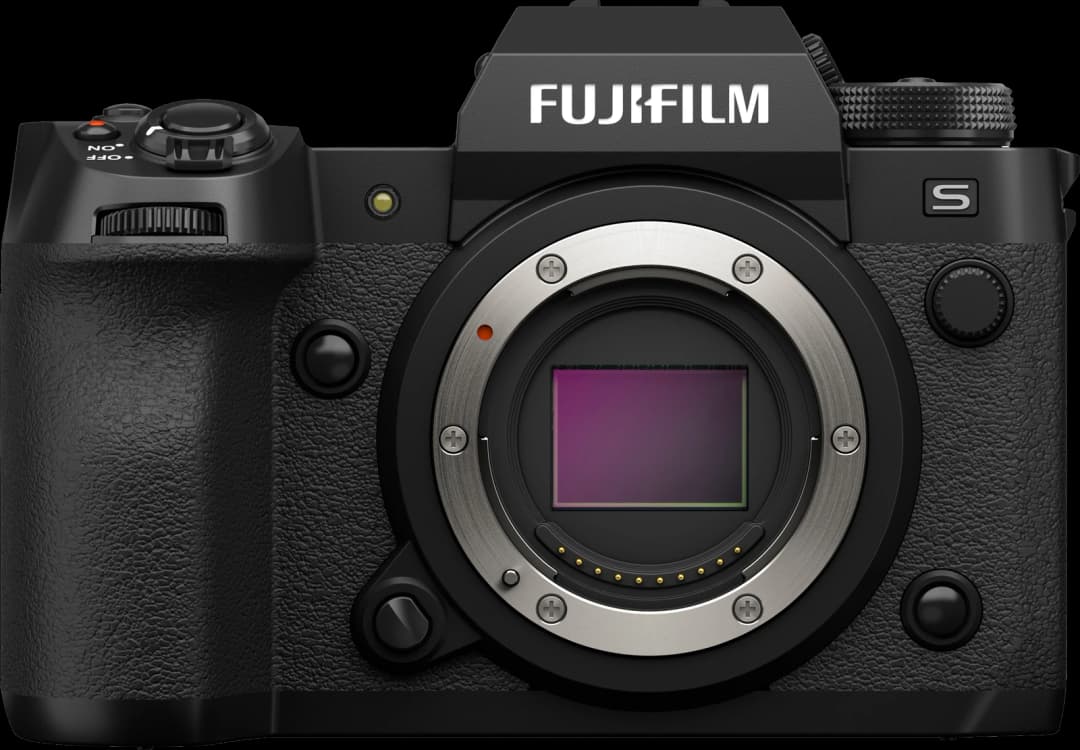
Fujifilm
X-H2S
2022
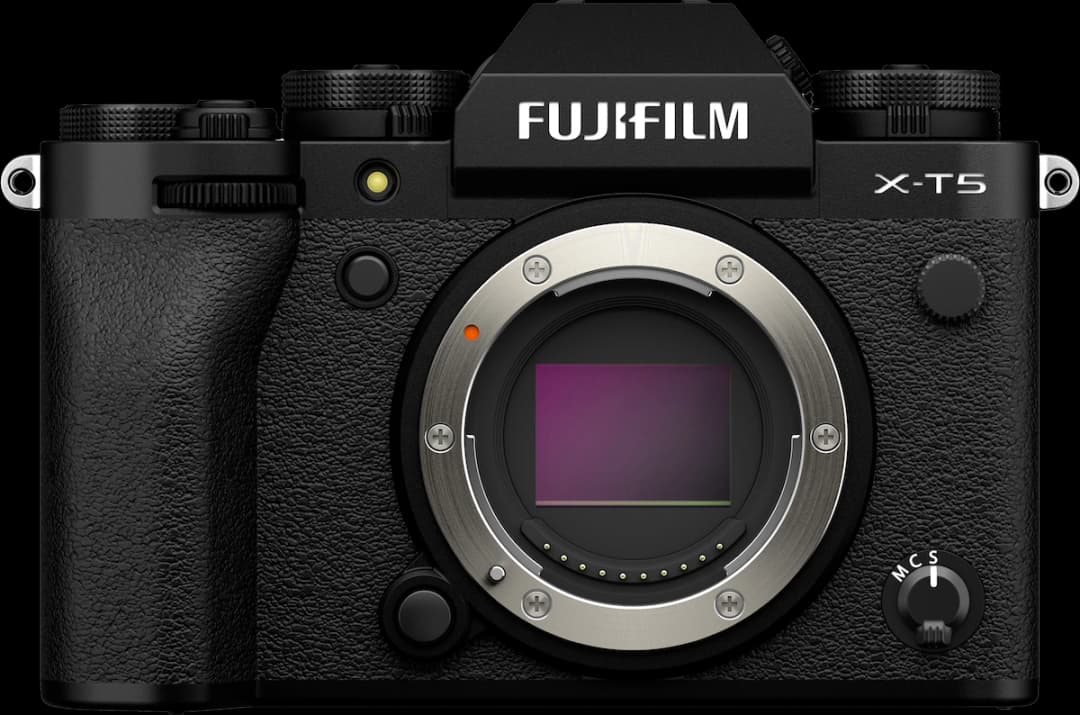
Fujifilm
X-T5
2022
Fujifilm X-H2S vs X-T5: Speed and Video versus Resolution and Compactness
Visual summary
— Reads in 5 seconds
Fujifilm
X-H2S
Fujifilm
X-T5
Where to buy
— Live merchant price comparator
Fujifilm X-H2S
FUJIFILM X-H2S Mirrorless Camera - Body Only, Black
2 299 GBP · Amazon UK

Fujifilm X-T5

FUJIFILM X-T5 Mirrorless Camera - Silver, Body Only, Silver/Grey
1 549 GBP · Amazon UK

You'll find the best prices on the market here, updated daily — and by going through these partner links, you support Camera Duel without paying a cent more.
The arbitration in brief
Choose the X-H2S for professional video and burst shooting, the X-T5 for resolution and lightness, but the single slot on the X-T5 is a deal-breaker in professional contexts.
Fujifilm released these two bodies the same year, in 2022, on the same X-mount and with the same X-Processor 5. The similarities end there. The X-H2S is the flagship hybrid of the range: built to handle high frame rates, demanding video and tough conditions. The X-T5 is a photography body first and foremost, compact, light, designed for maximum APS-C resolution.
The launch price sums up the positioning gap. The X-H2S launched at 2 499 USD, the X-T5 at 1 699 USD, an 800 USD difference. In 2026, the used market has rebalanced the two models, but the gap remains significant.
Both bodies share several fundamentals: weather-sealing, 7-stop IBIS, 425-point AF with 100 % coverage, native sensitivity up to 12 800 ISO, identical CIPA battery life of 580 shots and 6.2K video with F-Log2. On paper they look close. In practice, their sensors, codecs and ergonomics target very different photographers.
This comparison settles four concrete questions: burst and buffer for action, resolution and dynamic range for landscape and studio, video codecs for professional production, and weight with handling for travel and reportage. You will find verified figures, clear-cut verdicts and the deal-breakers that the manufacturer spec sheets do not highlight.
Standout strengths
— Where each camera shines
Fujifilm
X-H2S
Top advantages
- 40 fpsElectronic burst2× vs Fujifilm X-T5
- 720 Mb/sMax bitrate2× vs Fujifilm X-T5
- 170RAW buffer+49 % vs Fujifilm X-T5
- OuiProxy recordingAbsent sur Fujifilm X-T5
Fujifilm
X-T5
Top advantages
- 40.2 MPMegapixels1,5× vs Fujifilm X-H2S
- 125Native ISO min+28 % vs Fujifilm X-H2S
- OuiOpen GateAbsent sur Fujifilm X-H2S
- 557 gWeight+18 % vs Fujifilm X-H2S
Video reviews
— Long-form reviews
Fujifilm X-H2S
—
Fujifilm X-T5
Fujifilm X-T5 Final Review
DPReview TV · 10 min
Detailed spec-by-spec
— Round by round, the eight categories
Sensor
Autofocus
Speed & burst
Video
Stabilisation
Build
Ergonomics & screen
Connectivity & battery
Detailed analysis analysis
— Strengths, trade-offs and ideal user
Fujifilm X-H2S: what it does well, what it concedes
The X-H2S carries an X-Trans CMOS 5 HS sensor of 26.2 MP. Resolution is lower than the X-T5, but this sensor is optimised for readout speed, not pixel density. In electronic burst it reaches 40 fps with a RAW buffer of 170 frames. The X-T5 tops out at 20 fps and 114 frames. In practice, on a sports or wildlife sequence, the X-H2S lasts twice as long before filling up.
Video is where the gap is clearest. The X-H2S records ProRes 422 HQ internally, with a maximum bitrate of 720 Mb/s and 4:2:2 subsampling. It supports All-Intra recording, proxy recording and offers a measured rolling shutter of 7 ms, which is contained for a fast-readout APS-C sensor. The X-T5 is limited to H.265 and H.264 in 4:2:0, without ProRes, without All-Intra, without proxy. For professional production the difference in workflow is structural.
The X-H2S concedes on three precise points:
- 26.2 MP versus 40.2 MP: cropping in post is more limited.
- 660 g versus 557 g: the body is heavier and bulkier (136.3 x 92.9 x 84.6 mm).
- EVF at 5.76 M dots: an advantage over the X-T5, but the LCD screen at 1.62 M dots is less sharp than the X-T5.
The dual CFexpress Type B and SD UHS-II slot is a direct professional advantage. It allows redundancy for weddings or reportage, and CFexpress speed fully exploits the 170-frame RAW buffer.
For whom
The X-H2S is aimed at the photographer or videographer who works in repeated professional conditions. Wedding, event reportage, corporate or documentary video: these uses demand card redundancy, sustained burst rates and codecs that can be used directly in post-production without transcoding. The videographer who delivers in ProRes has no other choice in the Fujifilm APS-C range. The sports or wildlife photographer who needs 40 fps and a 170-frame RAW buffer will find a tool sized for the job, without compromise on frame rate.
Fujifilm X-T5: what it does well, what it concedes
The X-T5 carries an X-Trans CMOS 5 HR sensor of 40.2 MP, the highest-resolution APS-C sensor in the Fujifilm range. Measured dynamic range reaches 10.4 EV at base ISO versus 10 EV on the X-H2S, a modest but consistent gap with the higher pixel density. Minimum native ISO is 125 versus 160 on the X-H2S, giving a slight extra margin in bright light for long exposures or studio flash work.
The 40.2 MP resolution has a direct impact on two uses: large-format prints and cropping in post. In landscape or studio portraiture this definition allows prints up to 120 cm wide without visible interpolation, and a 50 % crop that still retains 20 MP usable. I regularly shoot in changing light on the Brittany coast, and the latitude offered by 40 MP in landscape is tangible: you can crop without regret.
The X-T5 concedes on points that matter depending on use:
- 20 fps electronic versus 40 fps: the rate is halved.
- 114 RAW frames in buffer versus 170: the sequence stops earlier.
- Single SD UHS-II slot: no redundancy possible, a deal-breaker in professional contexts.
- No ProRes, no All-Intra, no proxy: the video pipeline is limited.
The screen at 1.84 M dots is sharper than the X-H2S (1.62 M dots), and the three-axis articulation suits ground-level or high-angle landscape work well. The 557 g weight and 63.8 mm thickness make it the more compact of the two, a real advantage on travel or hiking.
For whom
The X-T5 is made for the photographer who places resolution and compactness at the centre of priorities. Landscape, studio portrait, travel or street photographer: these uses value the 40.2 MP, contained weight and identical 580-shot battery life. It also suits the occasional hybrid shooter who records in 10-bit H.265 for web or social media, without needing a ProRes workflow. However, as soon as data redundancy becomes a professional constraint, the single slot is prohibitive.
Our verdict
Which one to buy, and why
The overall photo score is virtually identical: 7.6 for the X-T5 versus 7.5 for the X-H2S. The difference is statistically insignificant. In video the X-H2S takes a clear lead: 7.2 versus 6.5. These scores faithfully reflect the reality of the specs.
The X-H2S wins unambiguously as soon as professional video enters the equation. ProRes 422 HQ at 720 Mb/s, 4:2:2 subsampling, proxy recording and 7 ms rolling shutter form a pipeline the X-T5 cannot reproduce. In action photography the 40 fps and 170-frame RAW buffer are also unmatched in the range. The dual CFexpress Type B and SD UHS-II slot is a deal-breaker for any professional who cannot afford to lose a card on assignment.
The X-T5 wins for pure photography, travel and landscape. The 40.2 MP, 10.4 EV dynamic range and 557 g weight form a combination the X-H2S does not offer. The single SD UHS-II slot is its only deal-breaker, but it is major:
- For solo wedding work without redundancy the risk is real.
- For landscape, travel or studio portrait the single slot is acceptable.
- For corporate or documentary video the lack of ProRes closes the door.
On value for money the X-T5 is more efficient for a photo-centric photographer. In 2026 both bodies are available on the used market at prices significantly below launch. A used X-T5 around 900 to 1 100 USD is a bargain for a landscape or portrait shooter. A used X-H2S around 1 400 to 1 600 USD remains justified for a videographer or sports photographer who actually uses the 40 fps and ProRes.
Clear verdict: choose the X-H2S if you do professional video or high-speed sport. Choose the X-T5 if you mainly photograph static or slow subjects and resolution matters most. Do not choose the X-T5 if card redundancy is a non-negotiable constraint in your work.
Frequently asked questions
Before you buy, the questions we get
Which one to choose for weddings?
The X-H2S is the professional choice for weddings. The dual CFexpress Type B and SD UHS-II slot allows real-time redundancy: every image is written simultaneously to two cards. The X-T5 offers only a single SD UHS-II slot. If a card fails during a ceremony there is no safety net. In addition the 40 fps of the X-H2S captures fleeting moments (first kiss, bouquet toss) with a margin the 20 fps of the X-T5 cannot guarantee. If you are a professional wedding photographer the single slot on the X-T5 is a deal-breaker.
Is the X-T5 usable for professional video?
No, not for a production that requires a ProRes pipeline. The X-T5 records in H.265 and H.264 in 4:2:0 10-bit, without All-Intra, without proxy recording. The X-H2S records ProRes 422 HQ at 720 Mb/s in 4:2:2 10-bit, with All-Intra and proxy. For editing in Premiere Pro or DaVinci Resolve with heavy grading, the ProRes file is directly usable without transcoding. The H.265 of the X-T5 requires transcoding or a powerful machine. For web or social media use without pipeline demands the X-T5 is sufficient.
Are the 40.2 MP of the X-T5 useful if I do not print large format?
The 40.2 MP resolution brings two advantages independent of large-format printing. First, cropping in post: at 50 % you still have 20 MP usable, which equates to a digital zoom without visible loss. Second, fine detail latitude in landscape or architecture: fine textures (foliage, façades, fabric) are rendered with a precision the 26.2 MP of the X-H2S cannot match. If you deliver only for web or A4 the difference is invisible. If you crop often or deliver A2 and larger, the 40.2 MP has tangible value.
Does the 800 USD launch gap still make sense in 2026?
In 2026 the used market has narrowed the gap. The X-H2S is found around 1 400 to 1 600 USD used, the X-T5 around 900 to 1 100 USD. The real difference is therefore 400 to 600 USD. This gap is justified only if you actually use ProRes, the 40 fps or the dual slot. If your use is mainly landscape or portrait photography, paying 400 to 600 USD more for features you do not use is not rational. The used X-T5 is the most efficient purchase for a photo-centric photographer in 2026.
Which body will age better against expected successors?
Both bodies share the X-mount, whose optical ecosystem is mature and stable. Fujifilm has not announced any mount change to date. The X-H2S will age better for video: ProRes and the 4:2:2 pipeline will remain production standards for several more years. The X-T5 will age better for pure photography: 40.2 MP on APS-C remains a resolution difficult to surpass without moving to medium format. Both bodies benefit from regular firmware updates from Fujifilm, extending their relevance. Neither is threatened with rapid obsolescence in its preferred domain.