Review · Fujifilm · 2020
Fujifilm X-T4 Review: the APS-C hybrid that punches above its weight
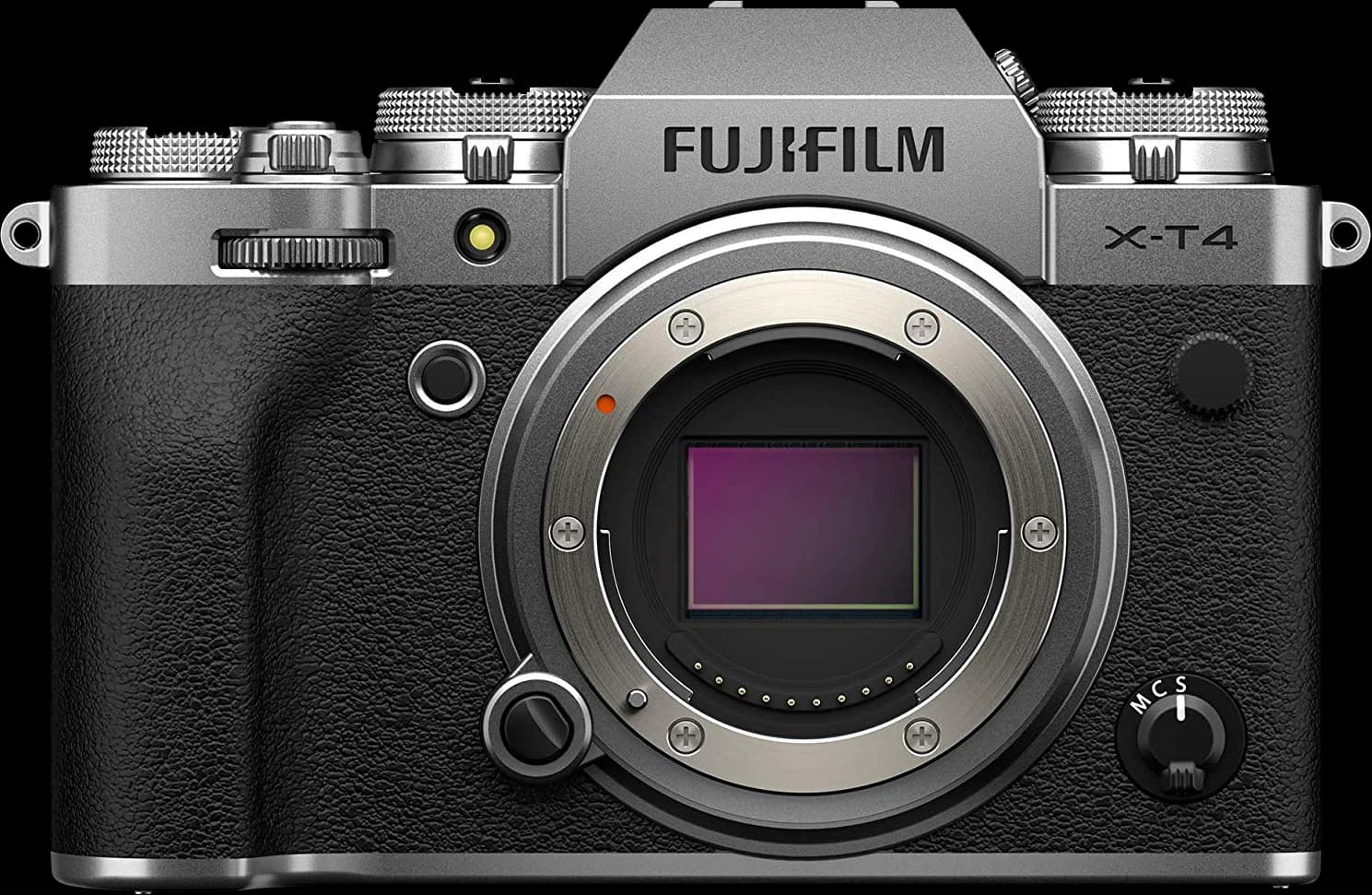
The X-T4 remains the APS-C benchmark for the hybrid video-photographer seeking a weather-sealed, stabilised body capable of unlimited 4K 10-bit recording.
Verdict
Six years after launch, the Fujifilm X-T4 still holds up for hybrid photo-video use. Its BSI 26-megapixel sensor delivers a measured 10,5 EV dynamic range and its 6,5-stop IBIS remains among the most effective in the APS-C class. The 20 fps electronic burst with a 83 RAW image buffer makes it viable for reportage and weddings. The main trade-off is its autofocus: 425 AF points with human and animal eye detection, but tracking performance shows its age against the Sony α6700 or Fujifilm X-T5. At under 700 EUR, it offers one of the best value propositions in the APS-C market for a travel photographer or independent videographer not chasing high-speed sports.
Pros
- IBIS 6,5 stops: stabilisation among the most effective in APS-C
- 4K 10-bit H.265 video with unlimited recording and native log
- Electronic burst 20 fps, 83 RAW image buffer
- Weather-sealing + dual UHS-II SD slots: real field reliability
- Measured 10,5 EV dynamic range at native ISO 160
- Fully articulated touchscreen
Cons
- Tracking AF outpaced by 2023-2026 competitors
- 607 g weight: heavy for APS-C, especially for light travel
- Micro HDMI (type D) port: fragile for intensive video use
- Native max ISO 12 800: low ceiling vs full-frame rivals
- 2020 body: no major firmware updates expected
Who is it for?
- The independent videographer seeking unlimited 4K 10-bit in a weather-sealed body under 1,000 EUR used
- The travel photographer alternating photo and video needing effective IBIS for low-light scenes
- The wedding photographer bursting at 20 fps wanting dual UHS-II SD slot security
- The landscape photographer exploiting 10,5 EV dynamic range and Fujifilm film simulations in JPEG
On video
Kai W · 11 min 06
Fujifilm X-T4: Ultimate APS-C Camera (but 5 Reasons Why You Wouldn't Get One)
Overview and Context: a 2020 body still relevant in 2026
The X-T4 launched in April 2020 at 1 699 USD. It succeeded the X-T3 by adding two missing features: IBIS and a fully articulated screen. Six years on, it coexists with the X-T5 (2022) in the Fujifilm lineup.
The X-T4 holds a unique position in the 2026 Fujifilm X lineup. The X-T5 replaced it at the top of APS-C with a 40-megapixel sensor, but without a fully articulated screen and more photo-oriented. The X-T4 thus remains the reference choice for hybrid photo-video use in the Fujifilm ecosystem, thanks to its unlimited 4K recording and fully articulated screen—two features sacrificed by the X-T5.
The sensor is a BSI-CMOS 26 megapixels in APS-C format (23,5 x 15,6 mm). Native sensitivity ranges from ISO 160 to ISO 12 800, expandable to ISO 51 200. Measured dynamic range reaches 10,5 EV per cross-referenced DXOMark and Photons to Photos data. These figures place the X-T4 in the upper mid-range of its APS-C category, without matching full-frame sensors from the same era.
Scores by use case: the X-T4 excels in video and travel, more limited in sports and wildlife.
On the used market, the X-T4 trades between 600 and 800 EUR in good condition in 2026. That's a decisive argument. At this price, no APS-C rival offers weather-sealing, dual slots, 6,5-stop IBIS and unlimited 4K 10-bit video simultaneously.
Ergonomics and Design: Fujifilm Philosophy Pushed to the Max
The X-T4 adopts the retro aesthetic of the X-T series with dedicated mechanical dials for each parameter. It's a bold choice that delights photographers from film backgrounds and baffles menu-driven users.
Mechanical Dials and Handling
The body measures 135 x 93 x 84 mm and weighs 607 g with battery and card. That's significantly heavier than the X-T30 II (383 g) or Sony α6600 (503 g). On travel, this weight tells over a full day of walking. The grip is deeper than on the X-T3, improving handling with heavy lenses like the XF 100-400mm.
Mechanical dials cover shutter speed, ISO sensitivity and exposure compensation. They operate independently of menus. This system lets you read settings at a glance without powering on. In practice, it's a real time-saver in the field, especially for reportage or travel where conditions change fast.
Fully Articulated Screen and OLED Viewfinder
The 3-inch 1 620 000-dot screen is fully articulated: it flips in all directions, including forward-facing for selfies or vlogging. That's a direct edge over the X-T5's simple tilt screen. For solo video or low-angle framing, this screen is a tangible asset.
The OLED viewfinder displays 3 690 000 dots at 0,75x magnification. That's standard resolution for high-end APS-C EVFs of this generation. Sunlight readability is good. Display lag remains noticeable in very low light, common to all EVFs of the era.
Weather-Sealing and Dual Slots
The body is weather-sealed. Fujifilm claims resistance to dust, moisture and temperatures down to -10 °C. I've used the X-T4 in Breton rain multiple times on coastal landscape shoots: no issues over two years with weather-sealed XF lenses. The sealing is genuine, not cosmetic.
The dual UHS-II SD slots are a major plus for reportage and weddings. Real-time redundancy or RAW/JPEG separation per slot is configurable. On an APS-C body at this price, it's a pro feature neither the Canon EOS R10 nor Sony α6400 offers.
| Release year | 2020 |
|---|---|
| Weight (with battery) | 607 g |
| Dimensions | 135 × 93 × 84 mm |
| Weather sealing | Yes |
| Viewfinder | OLED EVF |
| Viewfinder resolution | 3690000 dots |
| Screen | 3 inches |
| Screen articulation | fully articulated |
| Touchscreen | Yes |
| Battery (CIPA) | 500 frames |
| Dual SD slot | Yes |
| Wi-Fi / Bluetooth | Yes / Yes |
| Lens mount | Fujifilm X |
Image Quality: What the BSI 26 MP Sensor Really Delivers
The X-T4's BSI-CMOS 26-megapixel sensor is shared with the X-T3 and X-Pro3. It's well-documented, with independent measurements placing it precisely in the APS-C landscape.
Measured Dynamic Range and High-ISO Noise
Measured dynamic range reaches 10,5 EV at native ISO 160 per cross-referenced DXOMark and Photons to Photos data. That's solid for APS-C. For comparison, the Sony α6600 with its 24-megapixel sensor shows similar values. The full-frame Canon EOS R6 from the same era hits around 13 EV, a 2,5 EV gap significant for highlight recovery in high-contrast landscapes.
Minimum native ISO is 160, slightly higher than the 100 ISO native of many rivals. In practice, this means the X-T4 is less at ease than full-frame peers for long daytime exposures without ND filters. Not a deal-breaker, but worth noting for landscape shooters working filter-free.
ISO performance is good up to ISO 3 200, usable to ISO 6 400 in RAW with careful processing. Beyond, chrominance noise becomes hard to manage. Maximum native ISO is 12 800: the lowest ceiling in its high-end APS-C class. The Sony α6700 reaches ISO 32 000 native, a measurable edge in very low light.
Film Simulations: Fujifilm's Expert Angle
The X-T4 includes Fujifilm film simulations: Provia, Velvia, Astia, Classic Chrome, Eterna, and others. This isn't superficial marketing. These JPEG profiles are calibrated to Fujifilm's film emulsions and yield ready-to-use renders without post-processing. For travel or news photographers delivering JPEGs, it's a real time-saver. No Canon, Sony or Nikon rival from the era matches this in native JPEG.
26-megapixel resolution allows prints up to 50 x 75 cm at 300 dpi without interpolation. That's ample for most photo uses, including standard gallery exhibitions. Pixel-hungry shooters needing heavy crops or very large formats will look to the X-T5 (40 megapixels) or GFX 100S.
| Sensor | APS-C |
|---|---|
| Sensor size | 23.5 × 15.6 mm |
| Resolution | 26 MP |
| Sensor type | BSI-CMOS |
| Native ISO range | 160 – 12800 |
| Extended ISO | up to 51200 |
| Measured dynamic range | 10.5 EV |
| In-body stabilization | 6.5 stops |
| AF points | 425 |
| AF coverage | 100 % |
| Eye detection (human / animal) | Yes / Yes |
| Mechanical burst | 8 fps |
| Electronic burst | 20 fps |
| RAW buffer | 83 frames |
| Max shutter speed | 1/8000 |
Autofocus: Solid on Humans, Limited on Sports
The X-T4 AF system covers 425 points across 100 % of the sensor. It includes human and animal eye detection. Impressive on paper. Field reality is more nuanced.
Human Eye Detection: What Works, What Drops
Human eye detection works reliably in static portraits or slow movement. At weddings, it handles group scenes and normal-paced bride/groom movement well. The limit shows on fast, unpredictable motion: a running child, a pivoting dancer. Tracking drops more often than on 2023 systems like the Sony α6700 or Fujifilm X-T5.
Animal eye detection is present but limited to common pets. It doesn't match systems trained on broader datasets, like the Sony α6700 or Nikon Z8. For challenging wildlife, the X-T4 isn't the tool.
Low Light: the -6 EV Threshold
Fujifilm claims AF sensitivity to -6 EV. Top of its class at 2020 launch. In practice, near-dark focus is possible but slow. The body hunts more than successors in very dim light (candles, unlit night scenes). For dark wedding venues, supplemental lighting is advised.
Burst and Stabilisation: The X-T4's Killer Features
The X-T4 is the first X-T series body with IBIS. It also pushed electronic burst to 20 fps in the lineup. These two define its positioning.
6,5-Stop IBIS: Real-World Impact
IBIS compensates 6,5 stops per Fujifilm measurement. That's lab-ideal (static subject, stabilised axis, compatible lens). In real field conditions, I routinely get sharp handheld shots at 1/15 s with the XF 23mm f/2 in late-day light. At 1/8 s, hit rate drops but remains usable in bursts. Enough to ditch the tripod for most travel and urban landscape situations.
IBIS shines in video. Paired with electronic stabilisation, it enables gimbal-free handheld clips for short sequences. For long takes or motion, a gimbal is still needed. But for lightweight travel videographers, the X-T4 IBIS cuts kit significantly.
20 fps Electronic Burst and 83 RAW Buffer
Electronic burst hits 20 fps. The buffer takes 83 RAW images before slowing. Serious capacity for APS-C. At 20 fps, 83 RAW images equals about 4 seconds continuous. Plenty for wedding ceremonies or decisive reportage moments. Mechanical burst tops at 8 fps, more modest but rolling-shutter free.
20 fps electronic burst risks rolling shutter on fast-moving subjects with vertical lines. Fujifilm doesn't publish precise rolling shutter specs for the X-T4. Independent tests (DPReview, Imaging Resource) note present but moderate rolling shutter, comparable to other BSI APS-C sensors of the generation. For high-speed sports with electronic shutter, stick to mechanical 8 fps.
- Mechanical burst: 8 fps, no rolling shutter
- Electronic burst: 20 fps, moderate rolling shutter
- RAW buffer: 83 images before slowdown
- Max mechanical shutter speed: 1/8 000 s
- IBIS: 6,5 stops manufacturer-claimed compensation
Video: The Strong Suit Still Justifying the X-T4 in 2026
Video is the X-T4's strongest argument against successors. The X-T5 sacrificed unlimited recording and fully articulated screen for photo resolution. The X-T4 remains Fujifilm's hybrid videographer reference.
4K 10-Bit, Codecs and Log Profiles
The X-T4 records 4K up to 30 fps internally, 10-bit with H.264 and H.265 codecs. Native F-Log enables full colour grading in post. 10-bit depth is a concrete edge over 2020 rivals often limited to 8-bit internal (first-gen Canon EOS R6, Sony α6600).
Recording is unlimited, no thermal cutoff in normal use. Major differentiator for long interviews or events. Fujifilm fixed overheating plaguing some era peers. In practice, during hot outdoor shoots (over 25 °C), the body warms but doesn't stop.
Slow-Motion and Video Connectivity
Up to 240 fps Full HD for 10x slo-mo at 24 fps playback. Useful for travel videographers or content creators. Full HD slo-mo quality is decent but not outstanding: slight softness vs main 4K image.
Video connectivity includes Micro HDMI (type D) output. That's the X-T4 video connectivity weak point. The Micro HDMI port is mechanically fragile, especially with external monitors in heavy use. A cable protector or rigid arm is strongly advised to avoid port damage. Deal-breaker for videographers frequently connecting/disconnecting external monitors.
| Max resolution | 4K |
|---|---|
| Max frame rate | 240 fps |
| Codecs | H.264, H.265 |
| Bit depth | 10 bit |
| Log profile | Yes |
| Unlimited recording | Yes |
| In-body stabilization | 6.5 stops |
| HDMI output | HDMI Micro HDMI |
| USB connector | USB 3.2 Gen 1(5 GBit/sec) |
Connectivity and Battery: Essentials Without the Frills
The X-T4 covers modern connectivity basics without advanced wireless transfer or remote control.
CIPA-rated autonomy is 500 shots per charge. Decent for an APS-C mirrorless with EVF. In mixed photo-video use with articulated screen and video, expect 300 to 350 real shots. The NP-W235 battery is shared with the X-T5 and X-H2, easing spares management on travel with multiple Fujifilm bodies.
USB charging via USB 3.2 Gen 1 (5 Gbit/s) port. It also enables decent-speed file transfer. Wi-Fi and Bluetooth for wireless transfer and remote control via Fujifilm Camera Remote app. The app works but lags Sony or Canon solutions in interface and stability.
- CIPA autonomy: 500 shots (around 300-350 in real mixed use)
- USB: 3.2 Gen 1, 5 Gbit/s, charging and transfer
- HDMI: Micro HDMI type D (fragile in heavy use)
- Wi-Fi + Bluetooth: present, Fujifilm Camera Remote app
- Dual UHS-II SD slots: redundancy or RAW/JPEG separation
Vs Competitors: Where the X-T4 Stands in 2026
Compare the X-T4 to direct APS-C rivals: Sony α6700 (2023), Canon EOS R10 (2022) and its Fujifilm successor, the X-T5 (2022).
Vs Sony α6700: AF Changes Everything
The Sony α6700 (2023) is the X-T4's most direct high-end APS-C rival. Similar 26-megapixel sensor, but next-gen AF: AI detection for insects, birds, vehicles; native ISO to 32 000 vs X-T4's 12 800. However, single memory slot and 5-stop IBIS vs X-T4's 6,5 stops. X-T4 edges field reliability (dual slots, superior IBIS); α6700 wins AF and high ISO.
Vs X-T5: What You Really Lose
The X-T5 (2022) directly succeeds the X-T4 in Fujifilm's lineup. 40 megapixels and improved AI AF detection. But sacrifices two keys: fully articulated screen (simple tilt instead) and unlimited video. X-T5 superior for pure photo; X-T4 more versatile for hybrid video. X-T5 ~1 400 EUR new in 2026 vs 600-800 EUR used X-T4: price gap justifies X-T4 for tight budgets.
| Spec | Fujifilm X-T4Tested here | Sony α6700 | Canon EOS R10 | OM System OM-5 |
|---|---|---|---|---|
| Released | 2020 | 2023 | 2022 | 2022 |
| Sensor | APS-C | APS-C | APS-C | MFT |
| Resolution | 26 MP | 26 MP | 24.2 MP | 20.4 MP |
| Native ISO max | 12800 | 32000 | 32000 | 25600 |
| Dynamic range | 10.5 EV | 11 EV | 10.5 EV | 9.8 EV |
| AF points | 425 | 759 | 651 | 121 |
| Burst (elec.) | 20 fps | 11 fps | 23 fps | 30 fps |
| IBIS | 6.5 stops | 5 stops | No | 7.5 stops |
| Max video | 4K/240p | 4K/120p | 4K/60p | C4K/120p |
| Weather sealing | Yes | Yes | No | Yes |
| Dual SD slot | Yes | No | No | No |
| Weight | 607 g | 493 g | 429 g | 414 g |
| Launch price | 1699 USD | 1398 USD | 979 USD | 1199 USD |
X-T4 leads on IBIS and dual slots. Sony α6700 edges AF and high ISO. Canon EOS R10 lighter but no sealing or dual slots.
Price and Value: The Used Market Shifts the Equation
Launched at 1 699 USD in 2020, the X-T4 is no longer sold new by Fujifilm. Used market is its natural habitat.
In 2026, used X-T4s trade 600-800 EUR depending on condition and accessories. At this price, no APS-C rival matches: weather-sealing, dual UHS-II SD slots, 6,5-stop IBIS, unlimited 4K 10-bit log video. New Canon EOS R10 at 750 EUR lacks sealing, dual slots, IBIS. Used Sony α6600 at 700 EUR has single slot, no fully articulated screen.
Fujifilm X lens ecosystem is mature and dense. Over 30 native XF lenses cover all uses, with weather-sealed options for reportage and travel. Entry XC lenses complete budget kits. Edge over newer mounts like Canon RF-S or Sony E, with fewer high-end APS-C natives.
Verdict: Buy the Fujifilm X-T4 in 2026?
The 2020 X-T4 has aged well on some fronts, poorly on others. Verdict hinges on primary use.
For hybrid videographers and travel photographers, used X-T4 remains one of 2026's best APS-C buys. 6,5-stop IBIS, unlimited 4K 10-bit, weather-sealing and dual UHS-II SD slots unmatched at this price. 10,5 EV dynamic range and Fujifilm simulations round a very complete profile.
For sports, wildlife or tough nature shooters, X-T4 no longer fits. Tracking AF shows age vs 2023-2026 systems. Native max ISO 12 800 is low. Sony α6700 or Fujifilm X-H2S better suited, at higher cost.
7,2 / 10 overall score reflects this: excellent for hybrid photo-video and travel, limited for sports/wildlife. At 600-800 EUR used, it's a 7,2 / 10 equating to 8,5 / 10 value in segment.
Frequently asked questions
Is the Fujifilm X-T4 still a good buy in 2026?▾
Yes, for hybrid photo-video and travel. Used X-T4 trades 600-800 EUR with unique combo at price: 6,5-stop IBIS, unlimited 4K 10-bit, weather-sealing, dual UHS-II SD slots. Tracking AF lags 2023-2026 bodies, but fully competitive for portraits, weddings, travel.
What's the difference between Fujifilm X-T4 and X-T5?▾
X-T5 ups to 40 megapixels (vs X-T4 26 MP) and improves AF with AI detection. But sacrifices fully articulated screen (simple tilt) and unlimited video. X-T4 superior for hybrid video/vlog. X-T5 best for high-res pure photo. In 2026, X-T5 ~1 400 EUR new vs 600-800 EUR used X-T4.
Is the Fujifilm X-T4 suited to pro video?▾
Partially. 4K 10-bit H.265 with F-Log and no time limit. Pro level for indie production, light docs, online content. Main limit: Micro HDMI (type D) port, fragile for heavy external monitor use. For constant external monitoring, rig rigid HDMI cable mount.
Which lens to start with on Fujifilm X-T4?▾
Fujifilm X ecosystem has over 30 native XF lenses. For starters, XF 18-55mm f/2.8-4 OIS is excellent versatile weather-sealed. For light travel, compact weather-sealed XF 23mm f/2 WR. For video, XF 16-80mm f/4 OIS WR covers focal lengths with optical stabilisation complementing IBIS. Avoid non-sealed XC lenses for tough conditions.
Is the Fujifilm X-T4 weather-sealed?▾
Yes. Fujifilm claims dust, moisture and temperature resistance to -10 °C. Sealing effective with weather-sealed XF lenses (WR-marked). With non-sealed lens, protection incomplete at body-lens junction.
What's the real-world battery life of the Fujifilm X-T4?▾
Fujifilm rates 500 shots CIPA. In mixed photo-video with articulated screen and active Wi-Fi, expect 300-350 real shots per charge. NP-W235 compatible with X-T5/X-H2, easing travel spares with multiple Fujifilm bodies. Pack a spare for full-day shoots.
Related reviews
Review Canon EOS R6 Mark II: Still the Right Choice in 2026?
The Canon EOS R6 Mark II remains the most balanced general-purpose hybrid in its class for weddings, portraits and travel, provided you accept a RAW buffer limited to 75 images and video capped at 4K/60p.
Read the review
Review: Sony α7 IV – Still the Right Choice in 2026?
Full-frame all-rounder still relevant used for weddings, portraits and occasional video. New, 2023-2024 rivals offer more for the same budget.
Read the review
Nikon Z9 Review: Is the Nikon Flagship Still at the Top?
The Nikon Z9 remains a benchmark for professional sport and reportage thanks to its -8.5 EV AF and 1000 RAW buffer, yet the Z8 delivers the essentials for 1999 USD less.
Read the review