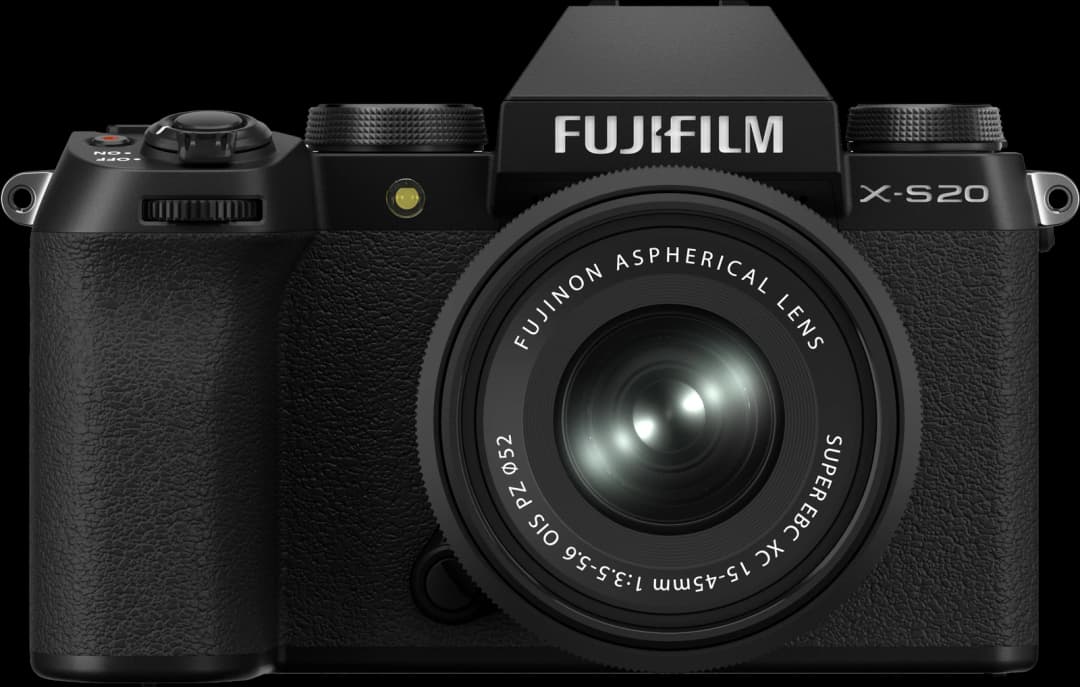
Fujifilm
X-S20
2023
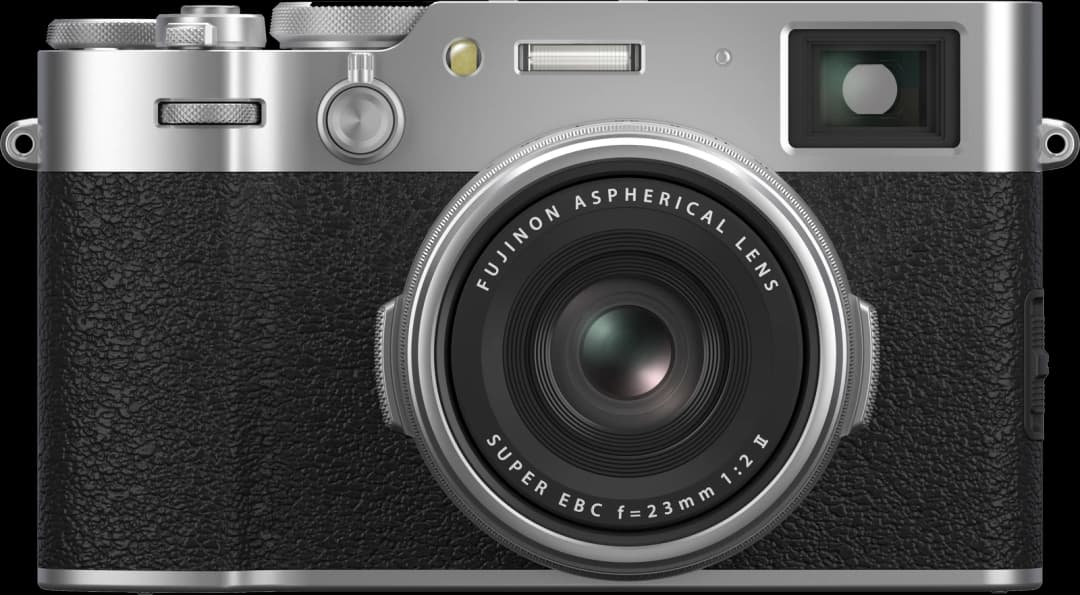
Fujifilm
X100VI
2024
Fujifilm X-S20 vs X100VI: Which to Choose in 2026?
Visual summary
— Reads in 5 seconds
Fujifilm
X-S20
Fujifilm
X100VI
Where to buy
— Live merchant price comparator
Fujifilm X-S20

FUJIFILM X-S20 Mirrorless Camera - Body Only, Black
1 249 GBP · Very

Fujifilm X100VI

FUJIFILM X100VI High Performance Compact Camera - Black, Black
1 749 GBP · Amazon UK

You'll find the best prices on the market here, updated daily — and by going through these partner links, you support Camera Duel without paying a cent more.
The arbitration in brief
The X-S20 is the rational choice for video and field endurance; the X100VI only makes sense if 40 MP resolution and the hybrid viewfinder are absolute priorities.
Two Fujifilm APS-C bodies, two opposing philosophies. The X-S20, released in 2023 at 1 299 USD, is an interchangeable-lens hybrid designed to cover a broad spectrum: travel, portrait, video. The X100VI, released in 2024 at 1 599 USD, is a fixed-lens compact with a 23 mm f/2 lens built for street photography, lightweight reportage and large-format prints. The starting price gap is 300 USD. In practice, the X100VI sold well above its list price for several months after launch, making the comparison even more relevant on the used market in 2026.
Both cameras share the same APS-C format and the same 425-point AF system with 100 % coverage. The similarities end there. The X-S20 carries a 26,1 MP X-Trans CMOS 4 sensor, 7-stop IBIS and a CIPA battery life of 750 shots. The X100VI steps up resolution with a 40,2 MP X-Trans CMOS 5 HR sensor, a hybrid OVF/EVF and an electronic shutter speed pushed to 1/180 000 s.
This comparison settles a genuine purchase dilemma: should you pay 300 USD more for the extra resolution and optional viewfinder, or keep the money for a lens and enjoy a far more complete video platform? The answer hinges on two variables: your relationship with video and your need for resolution in stills.
Standout strengths
— Where each camera shines
Fujifilm
X-S20
Top advantages
- 30 fpsElectronic burst1,5× vs Fujifilm X100VI
- 360 Mb/sMax bitrate1,8× vs Fujifilm X100VI
- 7 stopsIBIS rating+17 % vs Fujifilm X100VI
- -7 EVAF low light (EV)+2 vs Fujifilm X100VI
Fujifilm
X100VI
Top advantages
- 40.2 MPMegapixels1,5× vs Fujifilm X-S20
- 11 fpsMechanical burst+38 % vs Fujifilm X-S20
- 125Native ISO min+28 % vs Fujifilm X-S20
- 3.69 M dotsViewfinder resolution1,6× vs Fujifilm X-S20
Detailed spec-by-spec
— Round by round, the eight categories
Sensor
Autofocus
Speed & burst
Video
Stabilisation
Build
Ergonomics & screen
Connectivity & battery
Detailed analysis analysis
— Strengths, trade-offs and ideal user
Fujifilm X-S20: what it does well, what it concedes
The X-S20 is built around the 26,1 MP X-Trans CMOS 4 sensor. It is not Fujifilm’s latest generation, but the resolution remains sufficient for prints up to A2 without aggressive cropping. Native ISO reaches 12 800 with an extension to 51 200. Dynamic range is not published by Fujifilm for this model in the cross-checked sources available: this data is absent from verified references.
Electronic burst reaches 30 fps, versus 20 fps on the X100VI. The RAW buffer holds 79 frames before slowing. Low-light AF reaches -7 EV, two stops better than the X100VI. These three figures combined make the X-S20 more responsive in difficult conditions, especially for indoor reportage or natural-light portraiture.
Video is where the X-S20 opens the clearest gap:
- Unlimited recording (no 30-minute limit like the X100VI).
- Maximum bitrate of 360 Mb/s versus 200 Mb/s.
- Internal 4:2:2 chroma subsampling available, absent on the X100VI.
- External output compatibility with ProRes RAW and Blackmagic RAW.
- Full scopes: waveform, vectorscope, false colour, histogram, zebras.
IBIS is rated at 7 stops, one stop more than the X100VI. CIPA battery life reaches 750 shots, more than double the 310 shots of the X100VI. The UHS-II SD card is a tangible field advantage: higher write speeds reduce waiting time after a burst.
The concessions are real. No weather-sealing. Single card slot. The EVF shows 2,36 M dots at 0,62× magnification, behind on both counts compared with the X100VI. The vari-angle screen is an advantage for solo video, but the body is thicker (65,4 mm depth versus 55,3 mm), which changes the in-pocket feel.
For whom
The X-S20 suits the photographer-videographer who works on location and does not want to carry two bodies. It also appeals to the content creator who needs recording beyond 30 min, a 360 Mb/s bitrate and ProRes RAW output for a demanding post-production pipeline. In stills, it suits the traveller who shoots in varied lighting and values field endurance (750 shots) over raw resolution. The X-mount gives access to an extensive lens range, making it an evolving platform.
Fujifilm X100VI: what it does well, what it concedes
The X100VI carries the 40,2 MP X-Trans CMOS 5 HR sensor, the same generation as the X-T5 and GFX100S II. Measured dynamic range reaches 10,4 EV. Minimum native ISO drops to 125, versus 160 on the X-S20. These two points together deliver a measurable advantage in landscape and studio work: more latitude in post-processing, less noise in highlights.
Electronic shutter speed reaches 1/180 000 s. This is useful for shooting wide open (f/2) in bright sun without an ND filter. Mechanical burst hits 11 fps, versus 8 fps on the X-S20. The RAW buffer holds 84 frames, slightly ahead of the X-S20.
The hybrid OVF/EVF is the hardest-to-quantify yet easiest-to-feel differentiator:
- EVF resolution of 3,69 M dots, 56 % more than the X-S20.
- Magnification of 0,66× versus 0,62×.
- Direct optical viewing option for street work, with no electronic lag.
The concessions are serious. CIPA battery life falls to 310 shots, less than half that of the X-S20. The SD card is limited to the slower UHS-I standard. Video recording is capped at 30 minutes per clip. Low-light AF stops at -5 EV, two stops behind the X-S20. The lens is fixed: no possibility to change focal length, a deal-breaker for any work requiring variable coverage. The screen is a simple tilt design, less versatile than the X-S20’s vari-angle for solo video.
For whom
The X100VI targets the street or travel photographer who wants a single compact body, generous resolution for post-cropping, and a hybrid viewfinder that changes the shooting experience. It also suits the landscape photographer who values the measured 10,4 EV dynamic range and 40,2 MP for large-format prints. Conversely, it does not suit anyone needing long-duration video, focal flexibility or more than half a day of field endurance without recharging.
Our verdict
Which one to buy, and why
The X-S20 wins this comparison on four of the eight categories judged (AF, video, stabilisation, connectivity). The X100VI wins on the sensor. The remaining three categories are ties or non-significant gaps.
The deal-breakers are clear on both sides:
- Fixed lens on the X100VI: if you need to change focal length, the debate ends in favour of the X-S20.
- 30-minute video limit on the X100VI: if you record interviews, events or long vlogs, the X100VI is disqualified.
- 310 CIPA shots on the X100VI: a full day in the field without mains access becomes an exercise in battery management.
- UHS-I SD on the X100VI: write speed is a real bottleneck in RAW burst.
The X100VI justifies its 300 USD premium only if you need the 40,2 MP for large-format prints or the hybrid OVF for street work. These two strengths are real and measurable. Yet they do not offset the concessions on endurance, video and focal flexibility for versatile use.
On the 2026 used market, the X-S20 is regularly found under 900 USD in very good condition. The X100VI remains more expensive used because of its enduring popularity. The real price gap can exceed 500 USD depending on availability, further reinforcing the X-S20’s value advantage.
The X-S20 is the recommended choice for the majority of buyers. It covers more uses, costs less, and outperforms the X100VI on video, endurance and flexibility. The X100VI is an excellent camera, but it addresses a precise profile: the photographer who wants exclusively a fixed 23 mm compact with the best APS-C resolution in the Fujifilm range. If that profile is not yours, the X-S20 is the rational choice.
Frequently asked questions
Before you buy, the questions we get
Which to choose for photographing weddings?
The X-S20 is better suited for three quantified reasons. Its low-light AF reaches -7 EV versus -5 EV on the X100VI, which matters in dimly lit reception halls. Its 30 fps electronic burst offers more margin for decisive moments. Above all, the fixed lens of the X100VI is a real handicap for covering a full day: ceremony, drinks, dinner. The X-S20 with two or three X-mount lenses remains the most versatile solution. The lack of dual card slots on both bodies is a shared point of caution for professional use.
Does the 300 USD gap between the two bodies justify itself?
No, in the majority of cases. The X100VI costs 300 USD more at launch, and often more on the 2026 used market. In return you gain 14,1 MP extra, a hybrid viewfinder and an electronic shutter speed of 1/180 000 s. You lose unlimited video recording, 440 CIPA shots of endurance, UHS-II SD compatibility and focal flexibility. If the 40,2 MP and OVF are not priorities, the premium is not justified.
Is the X100VI really limited for video?
Yes, on two concrete points. Recording is limited to 30 minutes per clip, versus unlimited on the X-S20. Maximum bitrate is 200 Mb/s versus 360 Mb/s. The X100VI offers no internal 4:2:2 subsampling, nor ProRes RAW or Blackmagic RAW output. For occasional video use these limitations are acceptable. For a content creator or semi-professional videographer they are deal-breakers.
Does the X100VI’s hybrid viewfinder really change anything in practice?
Yes, for street photography. The X100VI’s optical viewfinder (OVF) offers zero-latency viewing and a slightly wider field than the capture frame, helping anticipate subjects entering the scene. EVF resolution is also markedly higher: 3,69 M dots versus 2,36 M dots on the X-S20, with 0,66× magnification versus 0,62×. For video, studio portrait or landscape, the X-S20’s EVF is sufficient. For reactive street work, the hybrid viewfinder of the X100VI is a genuine advantage.
Which will age better over the next two years?
The X-S20 has the structural advantage: its X-mount lets it benefit from new Fujifilm lenses over the years. The X100VI is tied to its fixed 23 mm f/2 lens, with no evolution possible on that front. On firmware, Fujifilm has historically supported its interchangeable-lens bodies well. The X100VI’s X-Trans CMOS 5 HR sensor is newer, giving it a raw-resolution edge over time. But for versatile use, the open platform of the X-S20 ages better.