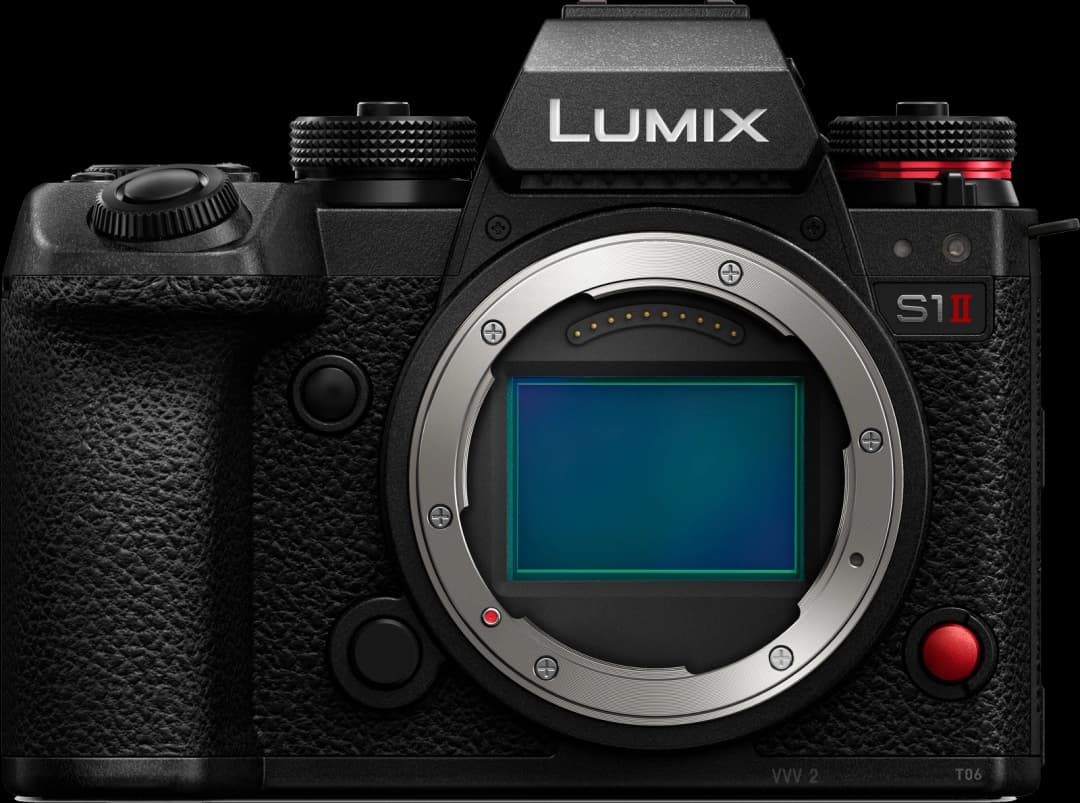
Panasonic
Lumix S1 II
2025
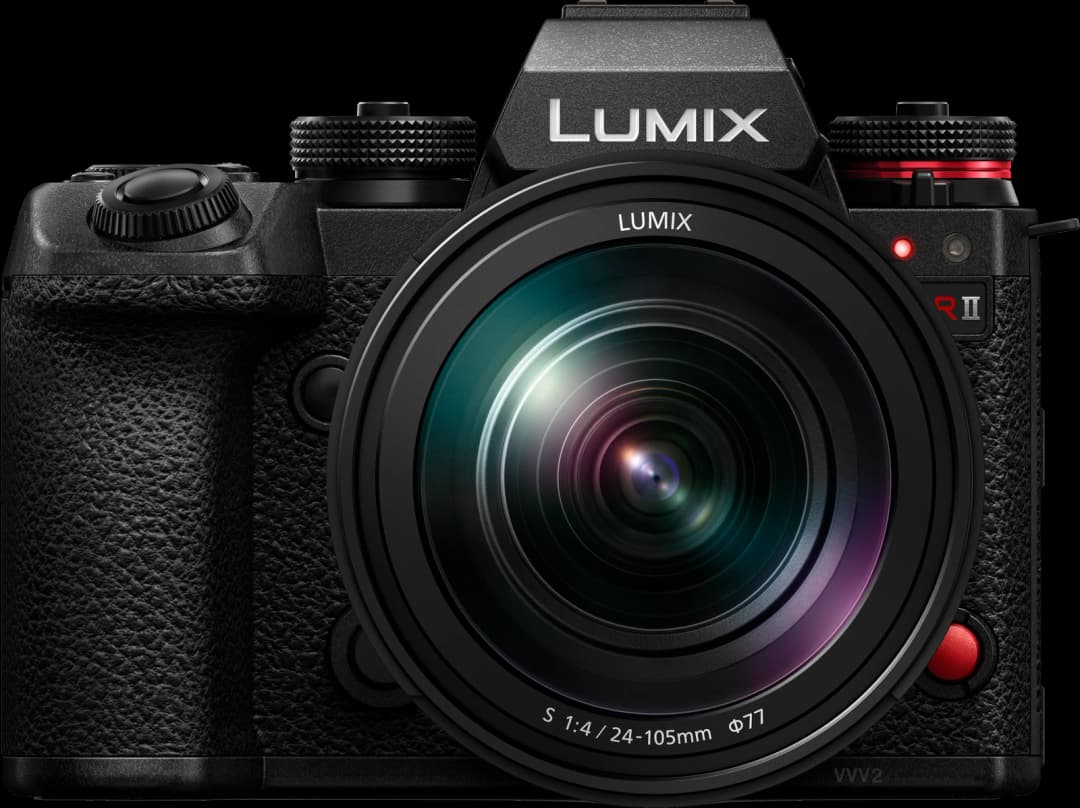
Panasonic
Lumix S1R II
2024
Panasonic Lumix S1 II vs S1R II: Which to Choose Between Video and High Resolution?
Visual summary
— Reads in 5 seconds
Panasonic
Lumix S1 II
Panasonic
Lumix S1R II
The arbitration in brief
The S1 II stands out for video and reportage; the S1R II is the logical choice as soon as resolution and electronic burst rate take priority.
Panasonic released the Lumix S1R II in 2024, then the Lumix S1 II in 2025. Both bodies share the same launch price of 3 200 USD, the same weather-sealed chassis, the same 5.76 million-dot EVF and the same Leica L mount. On paper, the confusion is total. In practice, the two cameras target photographers with opposing priorities.
The S1 II is a hybrid oriented towards video and versatility. Its 24.2-megapixel sensor with a measured dynamic range of 11.8 EV makes it a solid tool for weddings, portraits and reportage. Its ProRes RAW HQ codec, integrated Genlock/TC and 4K crop factor of 1× clearly position it as a professional filming tool.
The S1R II follows a different logic. Its 44-megapixel sensor is aimed at photographers who print large format or crop aggressively in post-production. Its electronic burst rate of 40 fps and 8K video make it a very high-definition body, both in photo and video.
This comparison arbitrates a duel between two philosophies at the same price. You do not have to choose between budget and quality. You have to choose between two visions of photographic work. The challenge is to determine which one matches your real practice, not your wish list.
Standout strengths
— Where each camera shines
Panasonic
Lumix S1 II
Top advantages
- 1×4K crop1,5× vs Panasonic Lumix S1R II
- OuiGenlock + Time CodeAbsent sur Panasonic Lumix S1R II
- 10 fpsMechanical burst+11 % vs Panasonic Lumix S1R II
- 11.8 EVDynamic range (EV)+6 % vs Panasonic Lumix S1R II
Panasonic
Lumix S1R II
Top advantages
- 44 MPMegapixels1,8× vs Panasonic Lumix S1 II
- 40 fpsElectronic burst+33 % vs Panasonic Lumix S1 II
- 12-bitBit depth+20 % vs Panasonic Lumix S1 II
- 8KMax video resolutionvs 6K
Detailed spec-by-spec
— Round by round, the eight categories
Sensor
Autofocus
Speed & burst
Video
Stabilisation
Build
Ergonomics & screen
Connectivity & battery
Detailed analysis analysis
— Strengths, trade-offs and ideal user
Panasonic Lumix S1 II: what it does well, what it concedes
The Lumix S1 II features a BSI-CMOS 24.2-megapixel sensor with a measured dynamic range of 11.8 EV at 100 ISO. That is 0.7 EV more than the S1R II. In practice, this gap translates into slightly better recovery in highlights and deep shadows, a concrete advantage in high-contrast landscapes or mixed-light weddings. It is not a spectacular difference, but it is measurable and consistent with Photons to Photos data on recent-generation BSI sensors.
In video, the S1 II pulls decisively ahead. It records in ProRes 422 HQ, ProRes RAW HQ and ProRes RAW, with a claimed bitrate of 800 Mb/s. The S1R II does not offer ProRes RAW. The S1 II also includes Genlock and Timecode, absent on the S1R II. For multi-camera productions or shoots synchronised with external equipment, this is a deal-breaker in favour of the S1 II. Its 4K crop factor is 1×, versus 1.5× on the S1R II. In concrete terms, you retain the native angle of view of your lenses in 4K, which matters as soon as you work with wide focal lengths.
The concessions are real. The RAW buffer is stated at 70 images, but Panasonic does not specify whether this figure corresponds to uncompressed RAW or lossy compressed RAW. Mechanical burst tops out at 10 fps, versus 9 fps on the S1R II, a negligible gap. Electronic burst reaches 30 fps, i.e. 10 fps less than the S1R II. For sport or wildlife in demanding conditions, this shortfall is noticeable.
Strengths of the S1 II:
- 11.8 EV dynamic range, i.e. 0.7 EV extra latitude versus the S1R II.
- Internal ProRes RAW HQ, integrated Genlock/TC, bitrate of 800 Mb/s.
- 4K crop factor of 1×, versus 1.5× on the S1R II.
- CIPA battery life of 380 shots, versus 350 on the S1R II.
The S1 II is a video production tool housed in a stills body.
For whom
The S1 II suits the hybrid videographer who works in professional production and uses the body for both stills and video. The integrated Genlock and Timecode are aimed at multi-camera crews. Internal ProRes RAW HQ suits colourists working in Final Cut Pro or DaVinci Resolve. For stills, the typical user is a wedding or portrait photographer who values RAW development latitude and 8-stop stabilisation for handheld shooting in natural light. The S1 II also suits the travel photographer who alternates stills and video without swapping bodies.
Panasonic Lumix S1R II: what it does well, what it concedes
The Lumix S1R II features a BSI-CMOS 44-megapixel sensor. That is 19.8 megapixels more than the S1 II, almost double the resolution. In practice, this allows prints up to roughly 100 cm × 67 cm at 300 dpi without interpolation, versus roughly 67 cm × 45 cm for the S1 II. For studio photography, large-format landscapes or reportage with aggressive post-production cropping, this difference is structural.
Electronic burst reaches 40 fps, versus 30 fps on the S1 II. On a one-second sequence you gain 10 extra frames. For wildlife or sport, this higher rate increases the probability of capturing the peak of action. Video goes up to 8K resolution, with 12-bit depth versus 10-bit on the S1 II. The 12-bit depth offers greater colour-correction latitude in post, especially on sky gradients and skin tones.
The concessions are significant. Measured dynamic range is 11.1 EV, i.e. 0.7 EV less than the S1 II. In low light or high-contrast scenes, this difference can translate into slightly less generous recovery at the extremes. The 4K crop factor is 1.5×, which penalises wide-angle lenses during filming. Genlock and Timecode are absent, ruling the S1R II out of synchronised multi-camera productions. RAW buffer data is not available from the sources consulted.
Strengths of the S1R II:
- 44 MP for large-format printing and post-production cropping.
- Electronic burst at 40 fps, i.e. 10 fps more than the S1 II.
- 8K video and 12-bit depth for maximum grading latitude.
- AF coverage of 100 % of the frame, versus 95 % on the S1 II.
The S1R II is a high-resolution body that incorporates advanced video capabilities without making them its core focus.
For whom
The S1R II is aimed at the photographer who places resolution at the centre of their practice. Studio fashion photographers, large-format landscape photographers or wedding photographers delivering files for very large prints will find in the 44 megapixels a working margin the S1 II cannot offer. The 40 fps electronic burst also suits wildlife or sport in good light. For video, the S1R II suits productions that value 8K resolution and 12-bit depth without requiring Genlock synchronisation with external equipment.
Our verdict
Which one to buy, and why
Both bodies share the same launch price (3 200 USD) and the same core architecture. The choice comes down to two concrete questions: do you work primarily in professional video, or is photo resolution your absolute priority?
For video, the S1 II is the only reasonable choice. Integrated Genlock/TC is a deal-breaker for any multi-camera production. Internal ProRes RAW HQ, absent on the S1R II, is a structural advantage for colourists. The 4K crop factor of 1× preserves the native angle of view of your lenses, whereas the S1R II imposes a 1.5× crop that penalises short focal lengths. If you regularly shoot in professional conditions, the S1 II is the right tool.
For high-resolution stills, the S1R II stands out without ambiguity. Its 44 megapixels allow 300 dpi prints up to roughly 100 cm × 67 cm without interpolation. The electronic burst rate of 40 fps exceeds that of the S1 II by 10 frames per second. 12-bit video depth offers superior grading latitude. AF coverage of 100 % of the frame versus 95 % on the S1 II is a marginal but real advantage on subjects at the edge of frame.
Deal-breakers to remember:
- S1 II: absence of ProRes RAW and Genlock/TC on the S1R II make the latter unsuitable for synchronised video production.
- S1R II: 4K crop factor of 1.5× and dynamic range of 11.1 EV (versus 11.8 EV) are real concessions for the videographer and the photographer working in difficult light.
On the used market, the S1R II released in 2024 is beginning to appear at prices below its launch tariff. If video is not your priority, it is worth watching.
My clear verdict: choose the S1 II if you produce professional video. Choose the S1R II if you print large format or crop systematically in post. At equal budget, specialisation beats versatility.
Frequently asked questions
Before you buy, the questions we get
Which to choose for wedding photography?
The S1 II is better suited if you alternate stills and video during the same event. Its ProRes RAW HQ, Genlock/TC and 4K crop factor of 1× make it a more complete filming tool. In pure stills, the S1R II offers 44 megapixels versus 24.2 MP, allowing more aggressive cropping on group portraits or details. If your main deliverable is video, take the S1 II. If you mainly deliver large-format photo files, take the S1R II.
Is the dynamic range difference between the two bodies visible in practice?
The gap is 0.7 EV in favour of the S1 II (11.8 EV versus 11.1 EV). In practice, this represents roughly two-thirds of a stop of extra latitude in highlights or shadows. On a high-contrast scene, bright sky against dark interior, the S1 II recovers slightly better detail at the extremes. The difference is real but not spectacular. It does not by itself justify choosing the S1 II if your needs in resolution or burst rate point towards the S1R II.
Should I go for 8K video if I mainly shoot in 4K?
No, unless you deliver files intended for cropping or display on very large screens. In standard 4K production, the 8K resolution of the S1R II brings no direct benefit. On the other hand, the 1.5× 4K crop factor on the S1R II is a concrete concession: your wide-angle lenses lose their native angle of view. The S1 II records 4K without cropping (1×) and offers ProRes RAW HQ, which is more useful day-to-day for professional 4K filming.
Is the RAW buffer on the S1 II sufficient for sport or wildlife?
Panasonic states 70 images in the RAW buffer for the S1 II. Data is not available for the S1R II from the sources consulted. On the S1 II, 70 images at 10 fps mechanical represents 7 seconds of continuous burst, which is adequate for most action sequences. In electronic burst at 30 fps, the buffer empties in under 2.5 seconds. For intensive wildlife work, this limit can be constraining. Panasonic does not specify whether this figure corresponds to uncompressed RAW or lossy compressed RAW, which is an important caveat on the announced value.
Which body will age better in the Leica L ecosystem?
Both bodies share the Leica L mount, supported by Panasonic, Leica and Sigma. The lens ecosystem is stable and continues to grow. The S1 II, released in 2025, will probably benefit from a longer firmware support cycle than the S1R II released in 2024. On the hardware side, both bodies are weather-sealed and built on the same mechanical base. The S1 II carries video functions (Genlock, ProRes RAW HQ) that match durable production standards. The S1R II bets on 44 MP resolution, a criterion that does not go out of fashion in stills. Both bodies have a comparable usage horizon.