Fundamentals
Understanding Focal Length in Photography: Definition, Effects and Practical Choice
Focal length determines the angle of view, perspective compression and depth of field. This guide explains each effect with precise figures, from wide angle to telephoto, full-frame or APS-C sensor.
What is focal length?
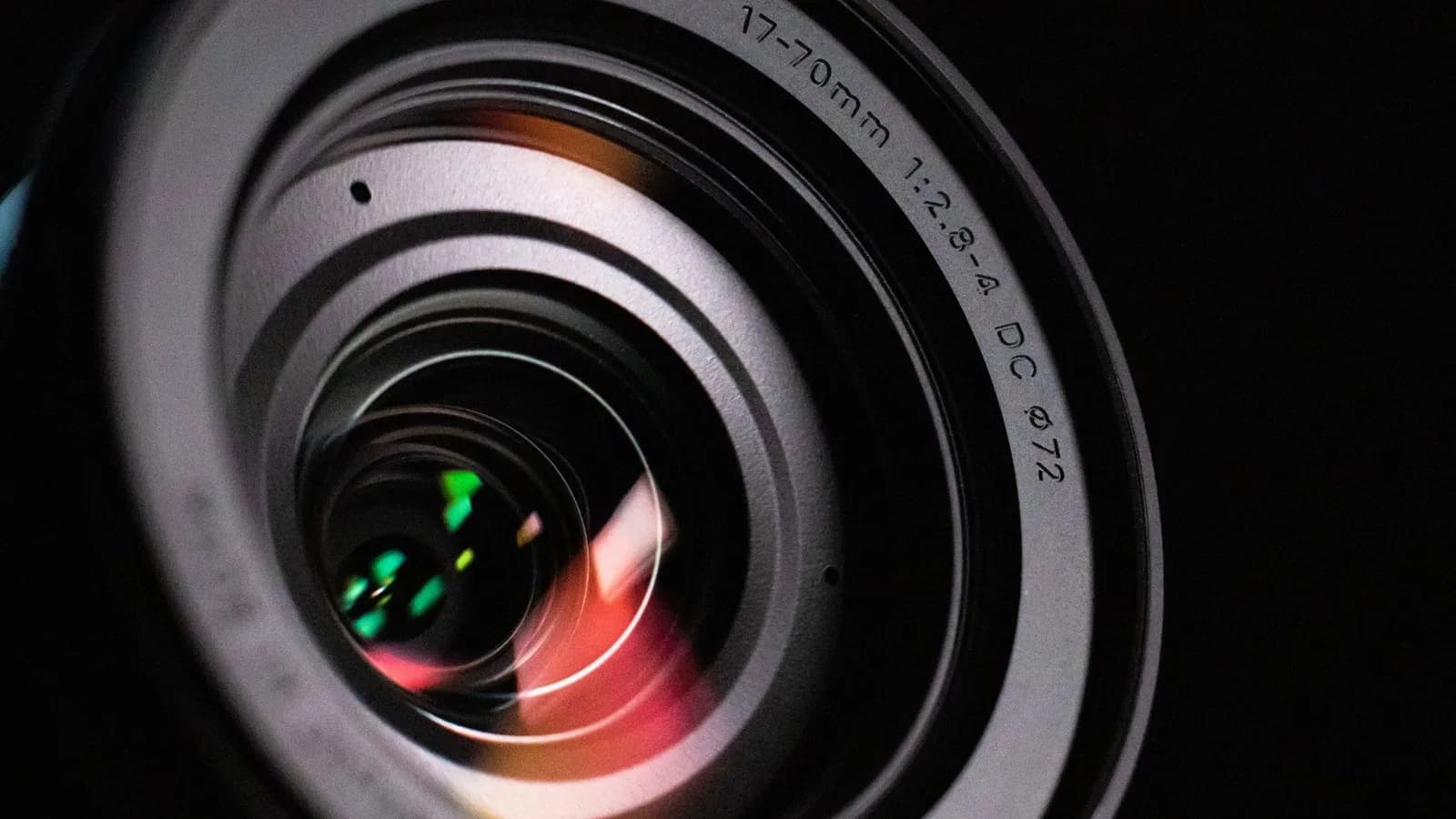
Focal length is the fundamental measurement of a lens. It determines what your sensor sees, and at what scale.
In practice, a 24 mm lens sees wide: it captures a broad panorama in front of you. A 200 mm lens sees narrow: it isolates a distant subject by bringing it closer visually. The millimetre value engraved on the lens is this focal length. It does not change according to the camera body used, but its visual effect does depend on sensor size. This point is covered later in this guide.
Focal length and angle of view: the direct link
Angle of view is the direct consequence of focal length. Understanding this link means understanding why one focal length is chosen over another.
Angle of view is measured in degrees. It expresses the portion of the scene captured by the lens on a given sensor. The relationship between focal length and angle of view is inversely proportional: doubling the focal length approximately halves the angle of view.
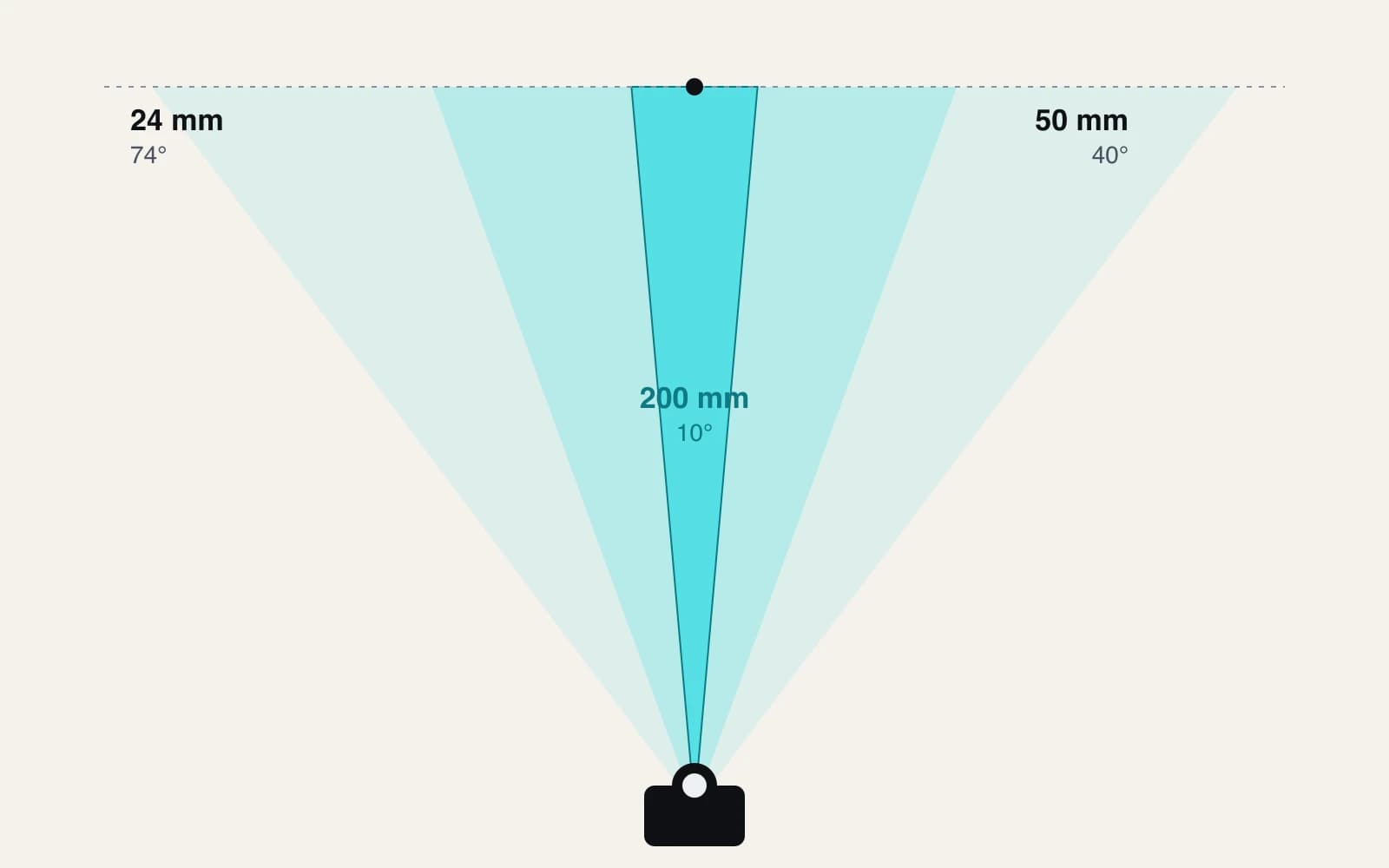
The longer the focal length, the narrower the angle of view: you isolate a distant subject instead of capturing a wide scene.
| Focal length (mm) | Angle of view (full frame) | Category |
|---|---|---|
| 8 mm | ~180° | Fisheye |
| 14 mm | ~114° | Ultra wide-angle |
| 24 mm | ~84° | Wide-angle |
| 35 mm | ~63° | Slightly wide-angle |
| 50 mm | ~47° | Standard |
| 85 mm | ~29° | Short portrait |
| 135 mm | ~18° | Long portrait / reportage |
| 200 mm | ~12° | Telephoto |
| 400 mm | ~6° | Super-telephoto |
| 600 mm | ~4° | Extreme super-telephoto |
Focal length categories: wide-angle, standard, telephoto
Each focal length category produces distinct visual effects. Knowing them allows you to choose the right lens for each situation.
Wide-angle: 8 mm to 35 mm
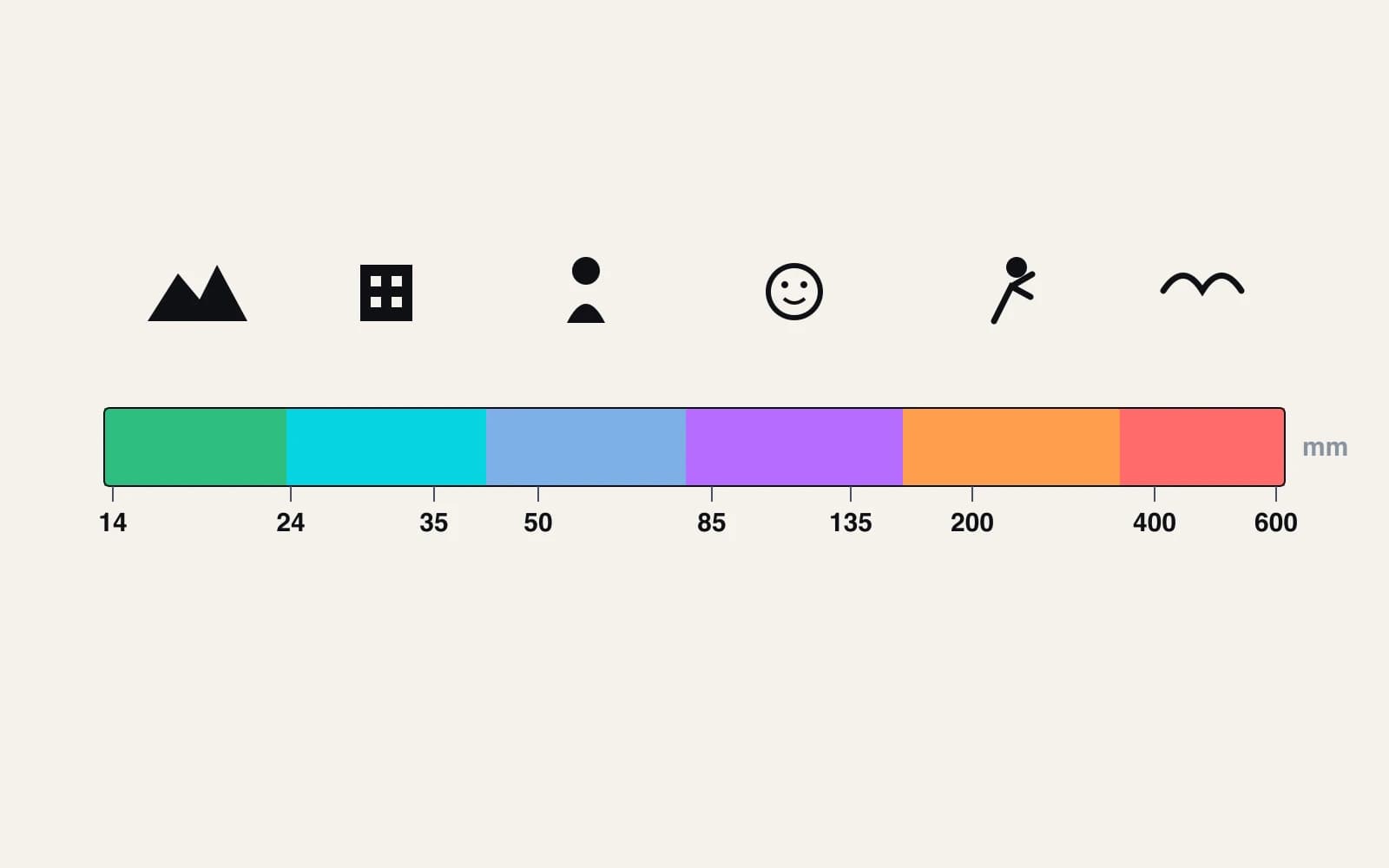
Focal lengths below 35 mm (on full frame) fall into the wide-angle category. They capture a wide field, accentuate perspective and give a sense of space. Lines converge strongly towards the centre of the image, which can distort faces if you get too close to the subject. These focal lengths are preferred for landscape, architecture, reportage in confined spaces and astrophotography.
- 14 to 21 mm: ultra wide-angle, for wide landscapes and interiors.
- 24 mm: versatile, the standard for reportage and travel.
- 28 to 35 mm: transition towards standard, widely used in street photography.
Standard focal length: 40 mm to 60 mm
The 40 to 60 mm range produces a perspective close to human vision. Distances between planes appear natural. There is neither exaggeration of depth (as with wide-angle) nor compression of distances (as with telephoto). The 50 mm f/1.8 is the most widespread entry-level lens: accessible, lightweight, bright, it forms an excellent tool for learning composition.
Telephoto: 70 mm to 600 mm and beyond
Beyond 70 mm, we enter the telephoto domain. The angle of view narrows, the subject appears enlarged and distances between planes appear compressed. A 200 mm lens visually brings a subject 10 metres away as if it were at 2.5 metres. This perspective compression is a compositional tool in its own right: it allows planes to be stacked, density to be created in the image, or a subject to be isolated against a distant blurred background.
Wide-angle
8 mm to 35 mm
- Wide angle of view (63° to 180°)
- Exaggerated perspective, converging lines
- Extended depth of field
- Ideal: landscape, architecture, travel
- Risk of distortion on close portraits
Standard
40 mm to 60 mm
- Natural angle of view (40° to 55°)
- Neutral perspective, close to the eye
- Versatile, discreet
- Ideal: street, everyday, reportage
- Pedagogical reference for learning composition
Telephoto
70 mm to 600 mm+
- Narrow angle of view (4° to 29°)
- Marked perspective compression
- Reduced depth of field
- Ideal: portrait, sport, wildlife, nature
- Increasing weight and bulk beyond 300 mm
The concrete effects of focal length on your photographs
Focal length does not merely frame differently. It modifies perspective, depth of field and subject legibility.
Perspective compression
Perspective compression is the most misunderstood effect in photography. Many attribute it to focal length. In reality, it depends on the distance between the photographer and the subject. If you photograph a subject at 2 metres with a 24 mm, then at 8 metres with an 85 mm while cropping to obtain the same subject framing, the perspective changes radically. Background planes appear closer with the 85 mm. It is not the focal length that compresses, it is the shooting distance. The focal length is simply the tool that forces you to move away or closer.
Depth of field
Depth of field is the zone of sharpness in the image. It depends on three factors: aperture, distance to the subject, and focal length. At identical aperture and shooting distance, a long focal length produces a shallower depth of field than a short focal length. An 85 mm f/1.8 at 2 metres from the subject produces a depth of field of approximately 4 to 5 cm. A 24 mm f/1.8 at the same distance produces a depth of field of several tens of centimetres. This effect is directly exploitable for portraiture: a long focal length naturally isolates the subject from its background.
Image stability and camera shake blur
The longer the focal length, the more the photographer’s micro-movements are amplified in the image. The classic empirical rule states that the minimum shutter speed for a sharp handheld photograph is the reciprocal of the focal length used. With a 200 mm on full frame, you should therefore aim for a minimum of 1/200 s. This rule remains a starting point: optical stabilisers (OIS) and in-body stabilisation (IBIS) allow several stops lower, depending on the camera body.
Focal length and sensor size: the 35 mm equivalent
The same focal length does not produce the same framing on all camera bodies. Sensor size is the conversion factor to master.
A sensor smaller than full-frame 24x36 mm captures only a central portion of the image projected by the lens. The visual result is identical to that obtained with a longer focal length on full frame. This is known as the crop factor.
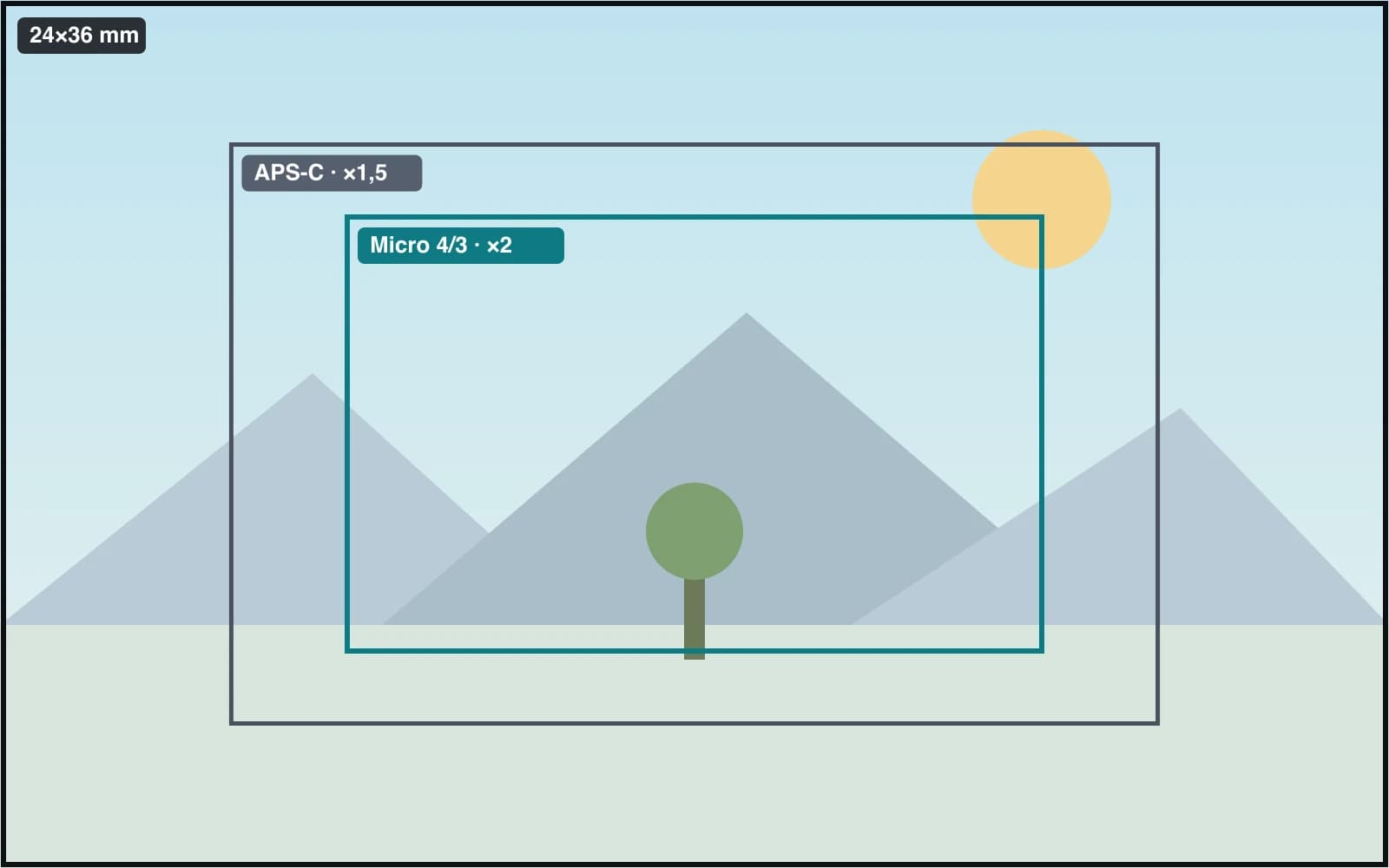
| Sensor format | Crop factor | Equivalent of a 50 mm | Equivalent of a 200 mm |
|---|---|---|---|
| Full frame (24x36 mm) | x1.0 | 50 mm | 200 mm |
| Canon APS-C (22.3x14.9 mm) | x1.6 | 80 mm | 320 mm |
| Sony / Fujifilm APS-C (23.5x15.6 mm) | x1.5 | 75 mm | 300 mm |
| Micro Four Thirds (17.3x13 mm) | x2.0 | 100 mm | 400 mm |
| 1-inch (13.2x8.8 mm) | x2.7 | 135 mm | 540 mm |
The 35 mm equivalent is the universal convention for comparing angles of view between different formats. When a manufacturer states that an 18-55 mm lens on APS-C (factor x1.5) covers a 27-82 mm equivalent, it means the angle of view is identical to that obtained with a 27-82 mm on a full-frame sensor. The physical focal length remains 18-55 mm: this determines the actual depth of field.
Full frame, APS-C or Micro Four Thirds: which to choose in 2026?The complete guide to choosing your sensor format according to your use and budget.Prime or zoom: what focal length changes in this choice
The choice between a prime lens and a zoom is not limited to convenience. Focal length plays a direct role in optical compromises.
A prime lens has a single focal length. It does not zoom. In return, its optical formula is optimised for that single focal length: manufacturers can offer larger maximum apertures (f/1.4, f/1.8) at accessible prices, and optical quality is often superior to a zoom in the same price range. A zoom covers a range of focal lengths, for example 24-70 mm or 70-200 mm, at the cost of compromises on maximum aperture and sometimes on optical quality at the extremes.
Prime
E.g.: 35 mm f/1.8, 85 mm f/1.4
- Larger maximum aperture (f/1.4 to f/2.0 common)
- Often superior optical quality at equal budget
- Light and compact, ideal for travel and discretion
- Forces movement to frame: compositional discipline
Zoom
E.g.: 24-70 mm f/2.8, 100-400 mm f/4.5-5.6
- Versatility: one focal length for every situation
- Maximum aperture often limited (f/2.8 to f/5.6)
- Heavier, especially on bright professional zooms
- Indispensable when you cannot move (sport, wildlife)
Which focal length for which use?
Focal length is not an abstract aesthetic choice. Each photographic use has its constraints, and certain focal lengths respond better than others.
- 1
Landscape and architecture
16 to 35 mm focal lengths (full-frame equivalent) dominate. They allow wide scenes to be captured, a strong foreground to be included and a sense of immensity to be conveyed. In architecture, the 24 mm and 28 mm are standards. Beware of edge distortion on ultra wide-angles below 16 mm.
- 2
Portrait
The 85 to 135 mm range is the reference on full frame. It requires a sufficient shooting distance to avoid facial distortion and produces a pleasantly blurred background. The 50 mm works for environmental portraits (subject in context). The 35 mm should be avoided for close-up facial portraits.
- 3
Sport and wildlife
200 to 600 mm focal lengths are essential. They allow you to remain at a distance from the subject (wild animals, sports field) while obtaining a tight framing. Autofocus speed and burst rate count as much as focal length in these disciplines.
- 4
Street photography and reportage
The 28 mm, 35 mm and 50 mm are the historical focal lengths of reportage. They allow work close to the subject, maintain context in the frame and remain discreet. The 28 mm forces closer approach, which can create narrative tension in the image.
- 5
Travel and versatility
A 24-105 mm or 24-70 mm zoom covers the majority of situations. If weight is a constraint, a 35 mm f/2 or 40 mm f/2.8 pancake offers an excellent compromise between natural angle of view, lightness and discretion.
Focal length multipliers (teleconverters)
A teleconverter is placed between the camera body and the lens to increase the effective focal length. It is a useful tool, with precise trade-offs.
Teleconverters exist mainly in two factors: x1.4 and x2.0. A x1.4 teleconverter transforms a 300 mm f/2.8 into a 420 mm f/4.0. A x2.0 teleconverter transforms it into a 600 mm f/5.6. The rule is simple: each multiplication factor of one stop (x1.4) costs 1 EV of light. The x2.0 factor costs 2 EV.
- x1.4: focal length x1.4, loss of 1 EV, moderate impact on autofocus.
- x2.0: focal length x2.0, loss of 2 EV, greater impact on autofocus.
- Limited compatibility: not all lenses accept all teleconverters.
- Optical quality: brand teleconverters (Canon, Nikon, Sony, Fujifilm) preserve quality better than third-party models.
Relationship between focal length and aperture
Focal length and aperture are two distinct parameters, yet their combination determines the actual brightness of the lens.
Lens aperture is expressed as an f-number (f-stop). An f/1.8 lets through much more light than an f/5.6. The relationship between focal length and aperture is indirect: focal length does not dictate a maximum aperture. A 600 mm f/4 is technically possible (and exists), but its front element diameter exceeds 150 mm, which explains its weight and price. It is optical physics that makes bright telephoto lenses expensive and bulky.
For variable-aperture zooms (for example f/3.5-5.6), the maximum aperture decreases when zooming towards longer focal lengths. At 18 mm, the lens opens at f/3.5. At 55 mm, it opens only at f/5.6. This is a design concession to maintain a reasonable price and weight.
Understanding the exposure triangle: aperture, shutter speed, ISOComplete guide to the three exposure parameters and their interactions.Common mistakes related to focal length
Several misconceptions circulate about focal length. Correcting them avoids unsuitable purchases and field disappointments.
Mistake 1: confusing focal length with optical zoom
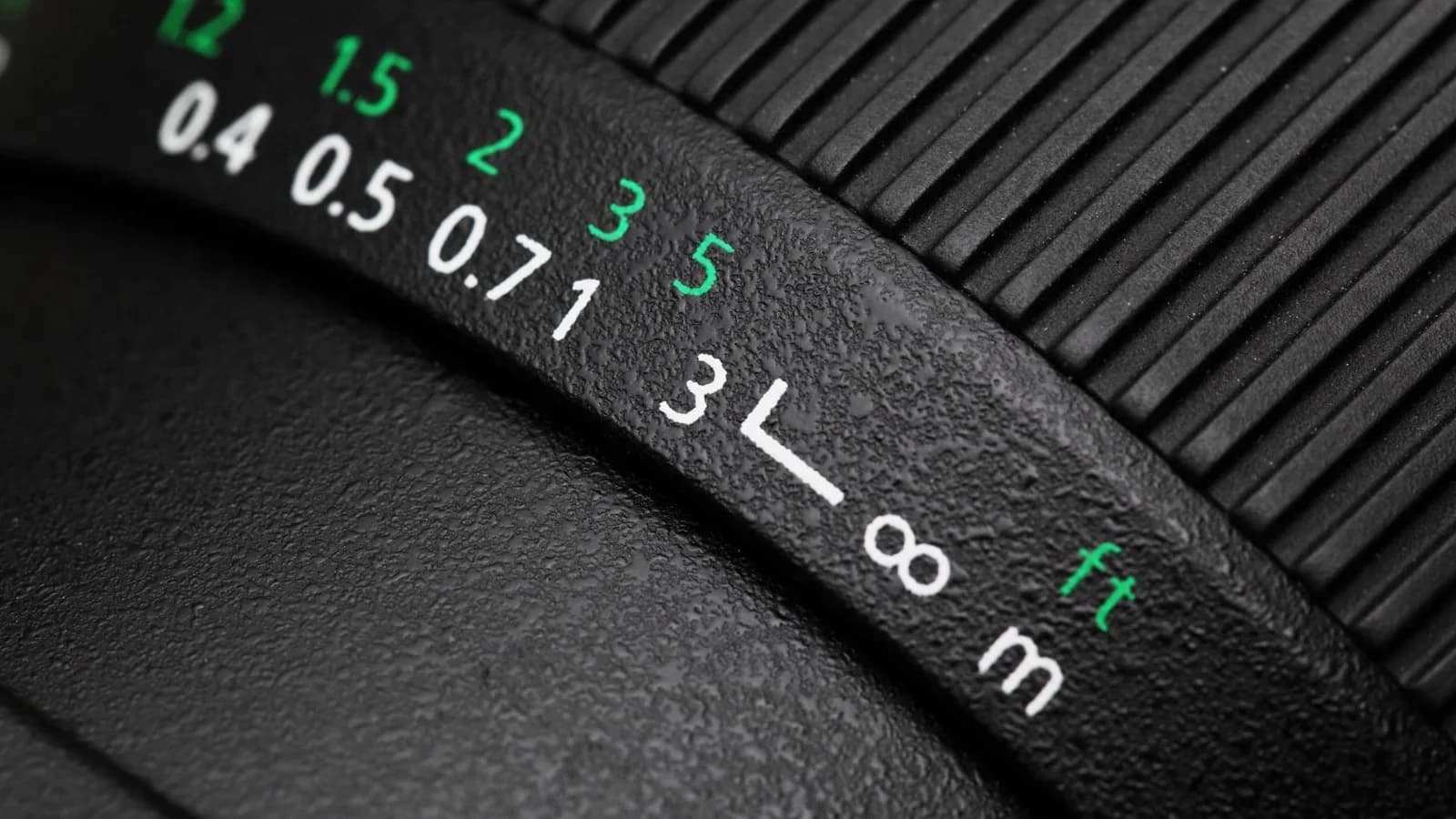
Optical zoom measures the ratio between the minimum and maximum focal length of a lens. A 24-240 mm zoom has a zoom ratio of x10. This figure does not indicate optical quality, nor the range of focal lengths covered in absolute terms. A 100-400 mm has a ratio of only x4, but covers much longer focal lengths than a 24-105 mm (ratio x4.4). Always compare values in millimetres, not zoom ratios.
Mistake 2: believing wide-angle always distorts
A 24 mm does not distort straight lines if you photograph holding the camera perfectly horizontal and centred. Distortion appears when you tilt the camera (verticals converge) or when you photograph a face from very close. It is not the focal length that distorts: it is the geometry of the shot.
Mistake 3: applying the 35 mm equivalent to depth of field
The 35 mm equivalent applies only to angle of view. A 50 mm f/1.8 on APS-C (equivalent to 75 mm full frame) does not have the depth of field of a 75 mm f/1.8 full frame. It has that of a 50 mm f/1.8 full frame, i.e. a slightly greater depth of field. This point is often poorly explained, even by reference sources.
Focal length is a compositional tool. It constrains your position, and it is this position that builds the perspective of your image.
Teddy, camera-duel.com
How to choose your first focal length or first zoom
The choice of a focal length depends on your main use, your sensor format and your budget. Here is a four-step method.
- 1
Identify your main use
Portrait, landscape, travel, sport, street: each use has a preferred focal length range. If you do not yet know, start with an 18-55 mm kit zoom (APS-C) or 24-70 mm (full frame). Then analyse your EXIF data to identify the focal length you use most often.
- 2
Take your sensor format into account
A 50 mm on APS-C gives the angle of view of a 75 to 80 mm full frame. It is not a standard focal length on APS-C: it is a portrait focal length. On APS-C, the 35 mm is the standard focal length. On Micro Four Thirds, it is the 25 mm.
- 3
Evaluate the weight / aperture / price compromise
An 85 mm f/1.4 is heavier and more expensive than an 85 mm f/1.8. The difference in aperture is 1 EV. For the majority of portrait uses, f/1.8 is sufficient. Reserve f/1.4 if you regularly work in very low light or need an extremely shallow depth of field.
- 4
Test before buying
Lens rental (one day or a weekend) allows you to validate a choice before purchase. This is particularly useful for heavy and expensive telephoto lenses. The second-hand market is also a serious option: lenses age well mechanically and optically.
Frequently asked questions
What is the difference between focal length and focal length?▾
Both terms designate exactly the same thing: the distance in millimetres between the optical centre of the lens and the sensor plane, focused at infinity. In French, "longueur focale" is the most precise optical term. "Distance focale" is common usage, particularly in the translation of manufacturer documentation. Both are accepted and understood in the same way in photographic practice.
What is the 35 mm equivalent focal length?▾
The 35 mm equivalent focal length is a reference value that allows comparison of the angle of view of a lens between different sensor formats. It expresses which focal length, on a 24x36 mm full-frame sensor, would produce the same angle of view. For example, a 23 mm on APS-C (factor x1.5) has a 35 mm equivalent focal length of 34.5 mm, i.e. approximately 35 mm full frame. This convention facilitates communication between photographers using different systems.
Does focal length affect image quality?▾
Focal length itself does not affect image quality. It is the quality of the optical elements, the lens coatings and manufacturing precision that determine sharpness, contrast and aberration control. A poorly designed 50 mm will be inferior to a high-quality 200 mm. However, very short focal lengths (ultra wide-angle) and very long focal lengths (super-telephoto) are more difficult to design optically, which explains why high-quality lenses at these extreme focal lengths are more expensive.
Which focal length to start photography with?▾
The kit zoom supplied with most camera bodies (18-55 mm on APS-C, 24-70 mm on full frame) is a solid starting point. It covers common situations and allows you to identify your preferences. If you wish to invest in a prime from the start, the 35 mm f/1.8 on APS-C or the 50 mm f/1.8 on full frame offer the best value for learning composition and working in difficult light.
Can a full-frame lens be used on an APS-C body?▾
Yes, in the vast majority of cases, a lens designed for full frame works on an APS-C body of the same mount. The APS-C sensor uses only the central portion of the image projected by the lens, which corresponds precisely to the sharpest area least prone to edge aberrations. The effective focal length is multiplied by the crop factor (x1.5 or x1.6 depending on the brand). The reverse is not always true: an APS-C lens on a full-frame body will produce marked vignetting at the edges.
What is the focal length of the human eye?▾
The human eye does not function like a fixed focal length lens. Its focal length varies according to accommodation (focusing). In terms of sharp vision angle (foveal zone), the photographic equivalent lies between 43 and 50 mm on a full-frame sensor. This is the reason the 50 mm is described as a standard focal length: it renders a perspective and angle of view close to natural perception, without apparent distortion or compression.