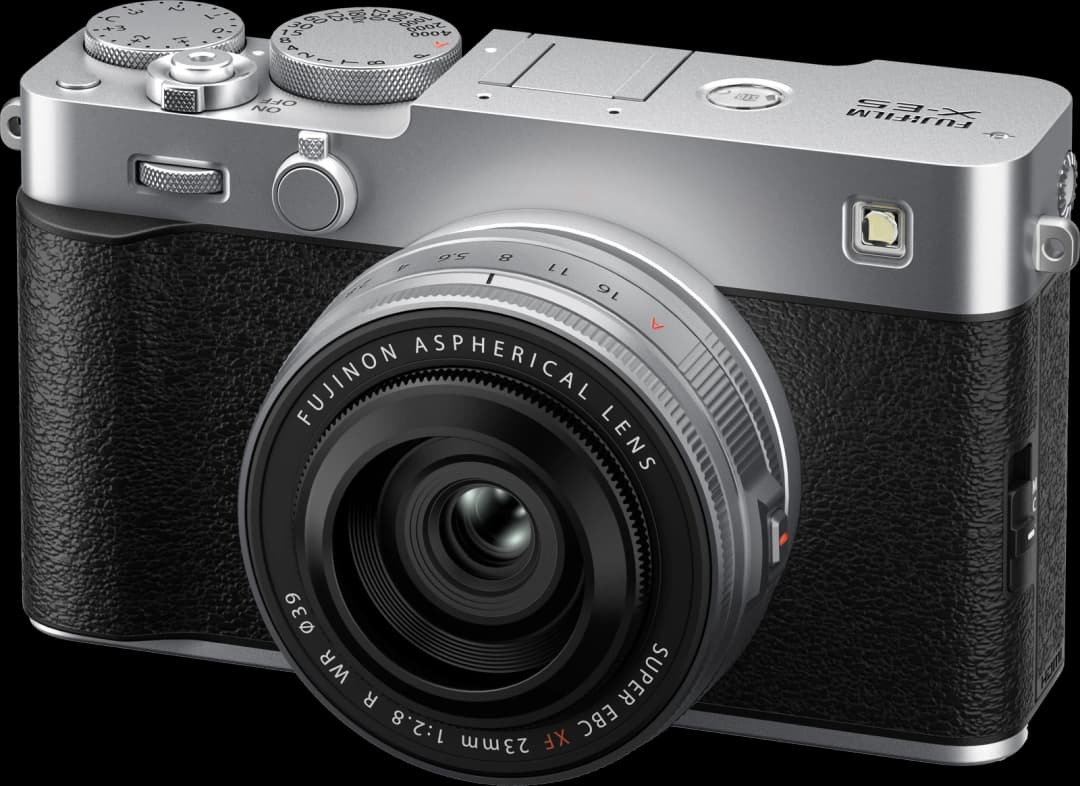
Fujifilm
X-E5
2025
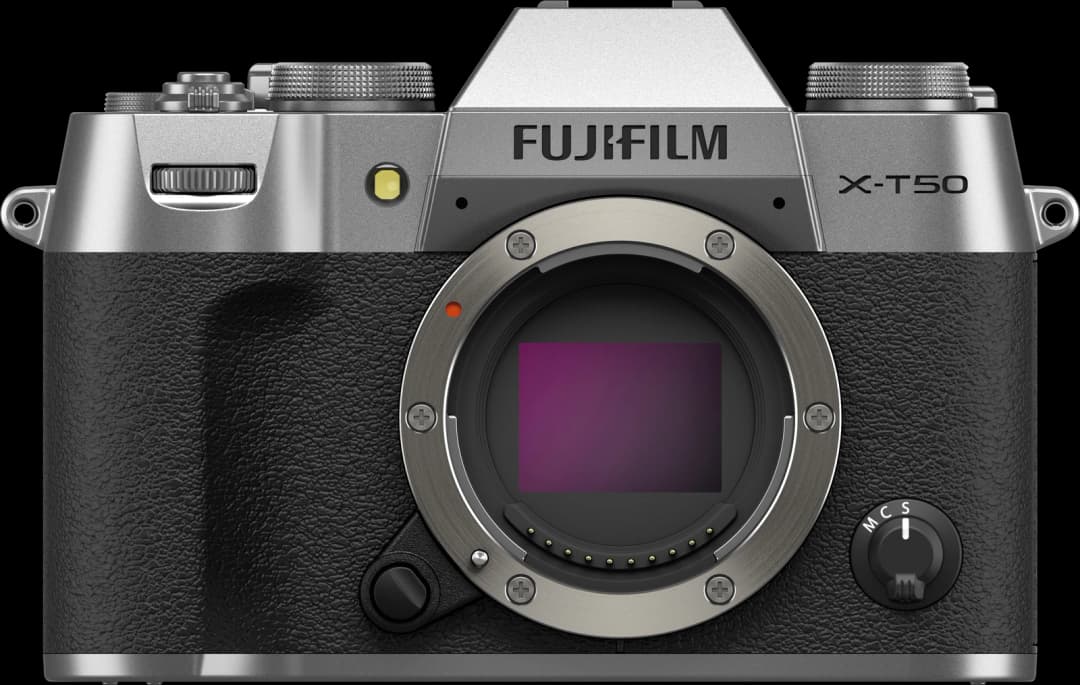
Fujifilm
X-T50
2024
Fujifilm X-E5 vs X-T50: Which to Choose for Hybrid Photo and Video in 2026?
Visual summary
— Reads in 5 seconds
Fujifilm
X-E5
Fujifilm
X-T50
The arbitration in brief
The X-T50 stands out in photo thanks to its RAW buffer of 79 images; the X-E5 responds in video with open gate and the built-in XLR input.
Fujifilm has offered two lines of compact APS-C bodies for several years: the X-E series, focused on discretion and minimalism, and the X-T series, more oriented toward manual controls and versatility. The X-E5, released in 2025, and the X-T50, released in 2024, share the same X-Trans CMOS 5 HR sensor of 40.2 megapixels, the same processor, and a very similar specification sheet on paper. Yet the engineering differences between the two bodies create concrete gaps in use.
The X-E5 is listed at 1,549 euros at launch. The X-T50 launched at 1,399 dollars (official euro pricing not available in the data). The price gap is real, but it does not tell the whole story: you have to look at what each body sacrifices and what it adds.
This comparison targets hybrid photographers hesitating between the two: the traveller wanting a light body capable in video, the portraitist seeking maximum definition without bulk, or the amateur videographer wanting to progress without investing in a dedicated system. Both bodies target the same declared uses: portrait, travel, street. But their technical compromises steer them toward different profiles. Here is how to separate them.
Standout strengths
— Where each camera shines
Fujifilm
X-E5
Top advantages
- OuiOpen GateAbsent sur Fujifilm X-T50
- OuiXLR inputAbsent sur Fujifilm X-T50
- 10.6 EVDynamic range (EV)Absent sur Fujifilm X-T50
- 310 clichésBattery life (CIPA)+2 % vs Fujifilm X-T50
Fujifilm
X-T50
Top advantages
- 79RAW buffer4,6× vs Fujifilm X-E5
- 360 Mb/sMax bitrate1,8× vs Fujifilm X-E5
- 1.84 M dotsScreen resolution1,8× vs Fujifilm X-E5
- 100 %AF coverageAbsent sur Fujifilm X-E5
Detailed spec-by-spec
— Round by round, the eight categories
Sensor
Autofocus
Speed & burst
Video
Stabilisation
Build
Ergonomics & screen
Connectivity & battery
Detailed analysis analysis
— Strengths, trade-offs and ideal user
Fujifilm X-E5: what it does well, what it concedes
The X-E5 is the most compact body in this duel. It measures 124.9 x 72.9 x 39.1 mm and weighs 445 grams. This discreet format is a real asset for travel and street, where bulk matters as much as performance.
Its X-Trans CMOS 5 HR sensor delivers 40.2 megapixels and a dynamic range measured at 10.6 EV. This is the only dynamic-range figure available in this comparison: the X-T50 does not have an equivalent published measurement in the cross-checked sources. This 10.6 EV value is respectable for a modern APS-C sensor, without being exceptional. It allows reasonable recovery of highlights in RAW, useful in landscape or portrait work in high-contrast natural light.
Where the X-E5 stands out clearly is in video. It offers open-gate mode, absent from the X-T50. This mode uses the full surface of the sensor without crop, giving more flexibility for cropping in post-production or for vertical-format shooting. It also includes an XLR audio input, rare equipment at this level. These two points make the X-E5 a serious tool for the hybrid videographer working with a quality external microphone.
Its concessions are clear:
- RAW buffer of 17 images versus 79 on the X-T50, a prohibitive gap for sustained burst shooting.
- Screen at 1.04 M dots versus 1.84 M dots, lower resolution that complicates manual focus on screen.
- No weather-sealing, no dual card slot: two absences shared with the X-T50, but still deal-breakers for demanding use.
CIPA battery life is 310 shots, slightly above the 305 of the X-T50. The difference is negligible in practice.
For whom
The X-E5 suits the hybrid photographer who places video at the centre of their use. Open-gate mode and the built-in XLR input give it a concrete advantage on shoots with an external microphone. In photo it remains capable for portrait and travel, provided you do not exceed 17 images in RAW burst. It also appeals to the traveller wanting the most discreet body possible without giving up 40.2 megapixels and 7 stops of IBIS.
Fujifilm X-T50: what it does well, what it concedes
The X-T50 shares the same sensor, the same AF and the same stabilisation as the X-E5. But it stands out on two technical points that change daily use.
First point: the RAW buffer. The X-T50 handles 79 RAW images before saturating, versus 17 on the X-E5. In electronic burst at 20 fps, that represents roughly 3.9 seconds of continuous burst for the X-T50, against less than one second for the X-E5. For sport, wildlife or any fast-moving subject, this gap is a deal-breaker. I have not tested the X-T50 in sports conditions, but the figures published by DigicamDB and DPReview confirm this 79-image value.
Second point: the screen. The X-T50 shows 1.84 M dots versus 1.04 M dots on the X-E5. In practice the difference is visible to the naked eye when checking focus in live view or reviewing images in the field.
In video the X-T50 offers a maximum bitrate of 360 Mb/s versus 200 Mb/s on the X-E5. It also includes proxy recording, internal LUT preview and more complete video scopes (waveform, histogram, zebras). These tools are useful for a structured video workflow.
Its concessions versus the X-E5 are:
- No open-gate mode: the sensor is always used with a crop in video.
- No XLR input: external audio remains limited to standard mini-jack connectors.
- Larger dimensions (123.8 x 84 x 48.8 mm): the X-T50 is thicker and taller, making it less discreet in street photography.
CIPA battery life is 305 shots, i.e. 5 shots fewer than the X-E5. The difference has no real consequence.
For whom
The X-T50 suits the photographer leaning toward photo-sport or photo-event versatility and needing a buffer that can absorb long bursts. Its high-resolution screen and advanced video tools also make it a good choice for the solo videographer working without an XLR microphone. It appeals to the traveller who accepts a slightly thicker body in exchange for more complete ergonomics and an uncompromised buffer.
Our verdict
Which one to buy, and why
These two bodies share the same sensor, the same AF, the same stabilisation and the same maximum video resolution. The duel is decided on four concrete points: the RAW buffer, video tools, screen and price.
The X-T50 wins in photo. Its buffer of 79 RAW images versus 17 on the X-E5 is a gap that cannot be recovered in post-production. If you photograph moving subjects, events or amateur sport, the X-E5 is disqualified on this single criterion. The photo score from the camera-duel.com algorithm confirms this advantage: 7.5 for the X-T50 versus 6.9 for the X-E5.
The X-E5 wins in video. Open-gate mode and the XLR input are two functions absent from the X-T50 and difficult to compensate for otherwise. The video score from the algorithm confirms it: 7.1 for the X-E5 versus 6.6 for the X-T50. For a hybrid videographer working with a reporting microphone or wanting to maximise sensor area in shooting, the X-E5 is the right choice.
The deal-breakers common to both bodies are worth repeating:
- No weather-sealing on either: avoid without extra protection in the rain.
- Single SD UHS-II slot on each: redundancy is impossible, ruling out critical professional use.
- X-E5 buffer at 17 RAW images: prohibitive for any sustained-burst use.
On value for money, the X-T50 launched at 1,399 dollars and is now available on the used market below its launch price. The X-E5, launched at 1,549 euros in 2025, is more recent and therefore more expensive used. If your use is mainly photographic, a used X-T50 represents better value-performance.
The final verdict is clear. For photography in the broad sense, choose the X-T50: its buffer, screen and complementary video tools make it the more versatile of the two. For hybrid video with an external microphone and maximum sensor exploitation, choose the X-E5. But if you are still hesitating between the two without a specific video need, the X-T50 is the default choice.
Frequently asked questions
Before you buy, the questions we get
Which to choose for photographing a wedding?
The X-T50, without hesitation. Its RAW buffer of 79 images versus 17 on the X-E5 is decisive during key sequences: bride and groom entrance, bouquet toss, first look. In a wedding the decisive moments rarely last more than two seconds, but they arrive fast and without warning. A 17-image buffer at 20 fps represents less than one second of continuous burst: it is insufficient. The X-T50 holds 3.9 seconds in the same conditions. The lack of dual slots on both bodies remains a point to watch for professional use.
Is the X-E5 buffer really limiting for everyday use?
For street, portrait or landscape photography, no. These uses rarely trigger more than 5 to 10 images in a row. The 17 RAW images buffer of the X-E5 is sufficient in these contexts. On the other hand, for any fast-moving subject, amateur sport, wildlife or event reportage, 17 images at 20 fps represents less than one second of burst. The body saturates and slows down. This is a documented deal-breaker, not a theoretical limit.
Does the X-E5 XLR input really change anything for an amateur videographer?
Yes, if you already use an XLR microphone or plan to acquire one. XLR microphones offer a better signal-to-noise ratio than mini-jack mics, and the XLR connection eliminates external phantom-power issues. On the X-T50 you will need an adapter or external recorder, adding weight and complexity. The XLR input built into the X-E5 simplifies the video rig and directly improves audio quality without extra gear. For a serious hybrid videographer it is a concrete advantage.
Is the screen difference between the two bodies noticeable in use?
Yes. The X-T50 shows 1.84 M dots versus 1.04 M dots on the X-E5. The difference is perceptible when checking focus in live view, especially in direct light. For reviewing images in the field or assisted manual focus, the X-T50 screen is noticeably more readable. It is not a deal-breaker for automatic photography, but it is a real advantage for anyone working in manual mode or checking images outdoors.
Is a used X-T50 better value than a new X-E5?
In most cases, yes. The X-T50 was released in 2024 and shares the same sensor, AF and stabilisation as the X-E5 launched at 1,549 euros in 2025. A used X-T50 in good condition can be found in 2026 at a price noticeably below the new X-E5. If your use is mainly photographic and you do not need open-gate mode or the XLR input, a used X-T50 offers better value-performance, with a buffer 4.6 times larger for a lower price.