Gear
Canon RF Wide-Angle Lens: Which Model to Choose in 2026?
From the RF 16mm F2.8 STM at **165 g** to the RF 15-35mm F2.8L IS USM at **840 g**, the Canon RF range covers all wide-angle uses. This guide classifies, compares and decides for every photographer profile.
What the RF Mount Changes for Wide Angles
The RF mount has a 54 mm internal diameter bayonet and a flange focal distance of only 20 mm. These two figures are significant: they allow engineers to design wide-angle optics with formulas impossible in EF.
In EF mount, a 16 mm f/2.8 required a complex retrofocus formula to maintain flange focal distance. In RF, the short flange-to-sensor distance permits straighter designs, fewer corrective elements, and chromatic aberrations that are easier to control. The result shows in the weights: the RF 16mm F2.8 STM weighs 165 g, versus 590 g for the former EF 16-35mm F2.8L II USM.
The RF wide-angle range today covers two distinct segments. On one side, full-frame (RF) optics, usable on EOS R5, R6, R1 and their successors. On the other, APS-C (RF-S) optics, designed for the smaller sensors of the EOS R7, R10, R50 and R100. An RF-S lens on a full-frame body does not cover the full image circle: the body automatically switches to crop mode.
Understanding Angle of View Before Buying
Focal length alone is not enough to compare two lenses. Sensor format changes the actual angle of view. A 16 mm on Canon APS-C (×1.6 crop factor) equates to 25.6 mm on full-frame.
Focal length, format and full-frame equivalent
| Lens | Actual focal length | Format | Full-frame equivalent |
|---|---|---|---|
| RF 10-20mm F4L IS STM | 10-20 mm | Full-frame | 10-20 mm |
| RF 14-35mm F4L IS USM | 14-35 mm | Full-frame | 14-35 mm |
| RF 15-35mm F2.8L IS USM | 15-35 mm | Full-frame | 15-35 mm |
| RF 16-28mm f/2.8 IS STM | 16-28 mm | Full-frame | 16-28 mm |
| RF-S 10-18mm F4.5-6.3 IS STM | 10-18 mm | APS-C ×1.6 | 16-28.8 mm |
| RF-S 14-30mm f/4-6.3 IS STM PZ | 14-30 mm | APS-C ×1.6 | 22.4-48 mm |
| RF 16mm F2.8 STM | 16 mm | Full-frame | 16 mm |
| RF 14mm F1.4 L VCM | 14 mm | Full-frame | 14 mm |
| RF 20mm F1.4 L VCM | 20 mm | Full-frame | 20 mm |
| RF 24mm F1.4 L VCM | 24 mm | Full-frame | 24 mm |
| RF 24mm F1.8 MACRO IS STM | 24 mm | APS-C ×1.6 | 38.4 mm |
Which focal length for which use?
Below 14 mm on full-frame, one enters ultra-wide-angle territory: landscapes with dominant sky, interior architecture, astrophotography with wide star fields. Between 15 and 24 mm, one remains in classic wide-angle, versatile for landscape, reportage and travel. Beyond 28 mm, one approaches the standard: the angle of view tightens, distortion recedes, and perspective becomes more natural.
Full-Frame RF Wide-Angle Zooms
Five zooms cover the wide-angle segment in full-frame. Their positionings are clear: budget, versatility, brightness, lightness or ultra-wide-angle.
Full-frame RF wide-angle zooms
RF 10-20mm f/4L IS STM

RF 14-35mm F4 L IS USM

RF 15-35mm F2.8L IS USM
RF 16-28mm f/2.8 IS STM

RF 15-30mm F4.5-6.3 IS STM
RF 15-35mm F2.8L IS USM: the pro reference, at a premium price
The RF 15-35mm F2.8L IS USM is the reference lens for professional photographers in RF mount. Its constant f/2.8 aperture throughout the focal range, combined with optical stabilisation, makes it the tool of choice for indoor reportage, weddings and low-light video. Its weight of 840 g and 82 mm filter diameter make it the most imposing lens in this selection. It dates from 2019 but remains without equal in terms of bright versatility on a full-frame RF wide-angle zoom.
RF 14-35mm F4L IS USM: the lightweight version for travel
The RF 14-35mm F4L IS USM sacrifices one stop of brightness to save 300 g on the scales. At 540 g with a 77 mm filter, it remains a weather-sealed L-series lens, built for tough conditions. Its f/4 aperture penalises it in low light but suffices for daytime landscape and architecture. It is the wide-angle zoom I systematically take on travel for its compactness without optical quality compromise.
RF 16-28mm f/2.8 IS STM: the 2025 compromise to watch
Released in 2025 at £1,199, the RF 16-28mm f/2.8 IS STM is the bright entry-level option in the range. With 445 g and a 67 mm filter, it is markedly more compact than the 15-35mm F2.8L. It does not belong to the L series and is not weather-sealed, which is a deal-breaker for regular outdoor use in rain. Its stabilisation is rated at 5.5 stops. Its weight-to-brightness ratio is the best in the RF wide-angle zoom range.
RF 10-20mm F4L IS STM and RF 15-30mm F4.5-6.3 IS STM: the two extremes
The RF 10-20mm F4L IS STM (2023, 570 g) is the ultra-wide-angle lens of the range. At 10 mm on full-frame, the diagonal angle of view exceeds 130 degrees. It is a specialised tool for interior architecture, wide-field astrophotography and landscapes with a very close foreground. At the opposite end, the RF 15-30mm F4.5-6.3 IS STM (2022, 390 g) is the budget option for tight budgets. Its variable aperture limited to f/4.5 at the wide end restricts it to good-light use.
RF 15-35mm F2.8L IS USM
For the versatile pro
- Constant f/2.8 aperture
- Weather-sealed L-series
- 840 g, 82 mm filter
- Best in low light
RF 14-35mm F4L IS USM
For the demanding traveller
- Constant f/4 aperture
- Weather-sealed L-series
- 540 g, 77 mm filter
- Ideal for landscape and travel
RF 16-28mm f/2.8 IS STM
For the bright budget option
- Constant f/2.8 aperture
- Not weather-sealed
- 445 g, 67 mm filter
- £1,199, best weight/brightness ratio
Full-Frame RF Wide-Angle Prime Lenses
RF wide-angle primes divide into two families: high-end L VCM optics and accessible STM lenses. The former target maximum quality, the latter compactness.
Full-frame RF wide-angle prime lenses
RF 14mm F1.4 L VCM

RF 16mm F2.8 STM
RF 20mm F1.4 L VCM

RF 24mm F1.8 MACRO IS STM

RF 24mm F1.4 L VCM
RF 28mm F2.8 STM
RF 28mm f/2 STM

RF 35mm F1.8 MACRO IS STM
RF 35mm F1.4 L VCM
The L VCM series: 14mm, 20mm, 24mm, 35mm
Canon has structured its bright prime range around the VCM (Voice Coil Motor) system, a focusing motor designed for video: linear movement, silent, without focus breathing. These lenses are all weather-sealed. The RF 14mm F1.4 L VCM (2026, £2,599, 578 g) is the most ambitious lens in the range: at f/1.4 on 14 mm, it opens unique possibilities in astrophotography and night-time wide-angle reportage. The RF 20mm F1.4 L VCM (2025, £1,699, 519 g) and the RF 24mm F1.4 L VCM (2024, 515 g) complete the series with more versatile focal lengths. The RF 35mm F1.4 L VCM (2023, 555 g) technically leaves strict wide-angle but remains relevant for reportage and travel.
The compact STM lenses: 16mm, 28mm and 35mm
The RF 16mm F2.8 STM (2022, 165 g, 43 mm filter) is the lightest wide-angle lens in the full-frame RF range. It is not weather-sealed and its f/2.8 aperture is adequate without being exceptional. It suits perfectly as a lightweight travel lens on an EOS R6 or R8. The RF 28mm F2.8 STM (2023, 120 g) is the lightest lens in the entire RF range. At 28 mm, it leaves strict wide-angle but remains useful in urban reportage. The RF 28mm f/2 STM (2024, £499, 145 g, 55 mm filter) adds one stop of brightness for a moderate premium. The RF 35mm F1.8 MACRO IS STM (2018, 305 g, 52 mm filter) is the oldest in the range, but its 5-stop stabilisation and macro capability make it a versatile lens difficult to displace at this price.
| Lens | Focal length | Aperture | Weight | Weather-sealed | Indicative price |
|---|---|---|---|---|---|
| RF 14mm F1.4 L VCM | 14 mm | f/1.4 | 578 g | Yes | £2,599 |
| RF 16mm F2.8 STM | 16 mm | f/2.8 | 165 g | No | n.a. |
| RF 20mm F1.4 L VCM | 20 mm | f/1.4 | 519 g | Yes | £1,699 |
| RF 24mm F1.4 L VCM | 24 mm | f/1.4 | 515 g | Yes | n.a. |
| RF 28mm F2.8 STM | 28 mm | f/2.8 | 120 g | No | n.a. |
| RF 28mm f/2 STM | 28 mm | f/2 | 145 g | No | £499 |
| RF 35mm F1.8 MACRO IS STM | 35 mm | f/1.8 | 305 g | No | n.a. |
| RF 35mm F1.4 L VCM | 35 mm | f/1.4 | 555 g | No | n.a. |
APS-C Wide-Angle Lenses: the RF-S Range
The RF-S range offers two wide-angle lenses for Canon APS-C bodies. Their actual angle of view must be calculated with the ×1.6 factor.
RF-S wide-angle lenses (APS-C)

The RF-S 10-18mm F4.5-6.3 IS STM (2022, 240 g, 67 mm filter) is the ultra-wide-angle of the APS-C range. At 10 mm on APS-C, the full-frame equivalent is 16 mm: a very wide angle of view, suited to interior architecture and landscape. Its 4-stop stabilisation partially compensates for its limited aperture. The RF-S 14-30mm f/4-6.3 IS STM PZ (2024, £799, 220 g, 55 mm filter) is a motorised zoom (PZ, Power Zoom) designed for video. Its electric zoom motor enables smooth, repeatable zoom movements. Its stabilisation reaches 5 stops. At 220 g, it is the lightest wide-angle lens in the complete selection.
The RF 24mm F1.8 MACRO IS STM (2022, 270 g, 52 mm filter, 5.5-stop stabilisation) deserves particular mention. Technically an RF full-frame lens, it is optimised for APS-C bodies: its angle of view on an APS-C sensor equates to 38.4 mm in full-frame, placing it in the standard rather than wide-angle register. Its macro capability and stabilisation make it a versatile travel lens on EOS R7 or R10.
Which Lens for Which Use: the Selection Guide
The same specification does not carry the same weight whether you photograph landscapes, architecture or stars. Here is how to decide according to your main practice.
Landscape and travel: priority on weight and weather-sealing
For landscape, maximum aperture matters less: one generally works between f/8 and f/11 to maximise depth of field. Stabilisation helps for long exposures at sunset, but a tripod remains preferable. Weather-sealing, however, is a serious criterion: sea spray, rain and fog are daily realities in landscape work. L-series lenses (RF 14-35mm F4L, RF 15-35mm F2.8L, RF 10-20mm F4L, RF 14mm F1.4 L VCM, RF 20mm F1.4 L VCM, RF 24mm F1.4 L VCM) are all weather-sealed. STM lenses are not.
Astrophotography: priority on aperture and short focal length
In astrophotography, each stop of aperture halves the exposure time. The difference between f/1.4 and f/2.8 represents four times less light collected at equal exposure time. The RF 14mm F1.4 L VCM is the most performant lens in the range for this use: 14 mm and f/1.4 allow short exposures with a very wide star field. The RF 20mm F1.4 L VCM is a slightly less wide-angle but equally bright alternative. On APS-C, the RF-S 10-18mm F4.5-6.3 IS STM offers an angle equivalent to 16 mm full-frame, but its f/4.5 aperture imposes longer exposures.
Architecture and interiors: distortion as the criterion
In architecture, barrel distortion of wide angles is the main enemy. Canon L-series lenses incorporate more advanced optical corrections than STM lenses. The RF 10-20mm F4L IS STM is designed for interior architecture: at 10 mm, it captures entire rooms in a single frame. Distortion correction in post-processing is effective with Canon profiles built into Lightroom and Capture One, but native optical correction remains preferable for critical straight lines.
Video: focusing motor takes precedence
For video, focusing noise and breathing are decisive criteria. VCM lenses (RF 14mm, RF 20mm, RF 24mm, RF 35mm F1.4 L VCM) are best suited. The RF-S 14-30mm f/4-6.3 IS STM PZ is the only RF wide-angle lens with motorised zoom: its electric zoom enables smooth, silent zoom movements impossible to reproduce manually. At 220 g and £799, it is the most accessible wide-angle video option in the range.
- 1
Full-frame landscape and travel
RF 14-35mm F4L IS USM. Weather-sealed, 540 g, constant f/4 aperture. The best weight-quality-protection ratio in the zoom range.
- 2
Full-frame astrophotography
RF 14mm F1.4 L VCM. f/1.4 at 14 mm, weather-sealed. No direct competitor in RF mount at this aperture and focal length.
- 3
Low-light reportage and weddings
RF 15-35mm F2.8L IS USM. Constant f/2.8 aperture, weather-sealed, stabilised. The reference pro wide-angle zoom.
- 4
Ultra-light full-frame travel
RF 16mm F2.8 STM. 165 g, 43 mm filter. No weather-sealing, but no other full-frame RF wide-angle lens weighs less.
- 5
Wide-angle video on APS-C
RF-S 14-30mm f/4-6.3 IS STM PZ. Motorised zoom, 220 g, 5-stop stabilisation. The only wide-angle RF with Power Zoom.
The Deal-Breakers to Identify Before Buying
Certain missing specifications outweigh ten secondary qualities. Here are the stopping points to check before any purchase decision.
Weather-sealing: absent from STM, present on all L-series
No STM lens in the RF range is weather-sealed. The RF 16mm F2.8 STM, the RF 28mm F2.8 STM, the RF 28mm f/2 STM, the RF 35mm F1.8 MACRO IS STM and the RF 16-28mm f/2.8 IS STM are all non-weather-sealed. In practice, this does not mean they fail at the first raindrop, but Canon offers no humidity resistance guarantee. For regular outdoor use in variable conditions, L-series lenses are the only risk-free choice.
RF-S compatibility: check your body
RF-S lenses are compatible only with Canon APS-C bodies (EOS R7, R10, R50, R100). On a full-frame body (EOS R5, R6, R1, R8), the body switches to APS-C crop mode. Effective resolution is reduced by approximately 60 % on a 45 MP sensor (EOS R5), yielding approximately 18 MP usable. This is not unusable, but it is not the intended use.
Filter: check compatibility with your existing set
Filter diameters range from 43 mm (RF 16mm F2.8 STM) to 82 mm (RF 15-35mm F2.8L IS USM). If you use polarising or ND filters, check compatibility with your existing set. Buying an 82 mm ND filter for a single lens represents a significant additional cost. The RF 16-28mm f/2.8 IS STM and several other lenses share the 67 mm diameter, facilitating filter sharing.
Stabilisation: present or absent depending on the model
All L-series lenses in the range include optical stabilisation. Among STM lenses, the situation is more nuanced. The RF 35mm F1.8 MACRO IS STM is stabilised over 5 stops. The RF 24mm F1.8 MACRO IS STM is stabilised over 5.5 stops. The RF 16-28mm f/2.8 IS STM is stabilised over 5.5 stops. Conversely, the RF 16mm F2.8 STM, the RF 28mm F2.8 STM and the RF 28mm f/2 STM have no optical stabilisation. On bodies with IBIS (EOS R5, R6, R7), sensor-shift stabilisation partially compensates for the absence.
Budget and Value for Money: Where to Set the Bar
The RF wide-angle range spans a very wide price amplitude. Identifying the right investment level according to your practice avoids regrettable purchases.
The RF 28mm F2.8 STM at 120 g is the absolute entry-level. The RF 28mm f/2 STM at £499 represents the first serious investment for a bright compact prime. The RF 16-28mm f/2.8 IS STM at £1,199 is the entry threshold for a bright stabilised zoom. The RF 20mm F1.4 L VCM at £1,699 marks entry into the L VCM series. The RF 14mm F1.4 L VCM at £2,599 is the highest investment in the RF wide-angle range.
A weather-sealed L-series lens bought second-hand in good condition is often worth more than a new STM lens for intensive outdoor use. Weather-sealing cannot be retrofitted.
Teddy, camera-duel.com
The second-hand market is particularly active on Canon L-series lenses. The RF 15-35mm F2.8L IS USM (2019) and the RF 14-35mm F4L IS USM (2022) are regularly found in excellent condition on specialist platforms. A second-hand purchase on these two models allows access to L-series quality with a 20 to 30 % discount on new price. Canon L-series lenses have high mechanical longevity and optical defects are rare on well-maintained examples.
Compare two Canon RF bodiesCompare EOS R bodies side by side to choose the body suited to your lenses.Common Errors When Choosing an RF Wide-Angle Lens
Several errors recur systematically in forums and purchase feedback. Identifying them upstream avoids costly returns.
- 1
Confusing actual focal length and full-frame equivalent
An RF-S 10 mm on APS-C gives an angle equivalent to 16 mm full-frame, not 10 mm. Always check the full-frame equivalent before buying, especially when comparing lenses of different formats.
- 2
Underestimating weight over a long day
840 g for the RF 15-35mm F2.8L IS USM is the lens weight alone. Add 700 to 900 g for an EOS R5 or R6 body, and you carry 1.5 to 1.7 kg permanently. On a day of hiking or travel, the difference with the RF 14-35mm F4L IS USM (540 g) is noticeable.
- 3
Buying an RF-S while planning to move to full-frame
If you plan to migrate to a full-frame body within two years, buying an RF-S is a mistake. The lens will not be unusable, but you will lose most of its angle of view. Prefer an RF lens from the start.
- 4
Neglecting filter compatibility
Buying a lens with a non-standard filter diameter (such as 43 mm) without checking your existing filter set can generate an unforeseen extra cost. Check diameters before purchase, especially if you use ND or polarising filters.
- 5
Confusing optical stabilisation and IBIS
A lens without optical stabilisation (IS) on a body with IBIS still benefits from stabilisation, but it is less effective than an IS + IBIS combination. On bodies without IBIS (EOS R8, R50, R100), a lens without IS requires higher shutter speeds handheld.
Overview: All RF Wide-Angle Lenses at a Glance
This summary table covers the entire RF and RF-S wide-angle range for quick comparison before decision.
| Lens | Focal range | Maximum aperture | Weight | Stab. | Weather-sealed |
|---|---|---|---|---|---|
| RF 10-20mm F4L IS STM | 10-20 mm | f/4 | 570 g | Yes | Yes (L) |
| RF 14-35mm F4L IS USM | 14-35 mm | f/4 | 540 g | Yes | Yes (L) |
| RF 15-35mm F2.8L IS USM | 15-35 mm | f/2.8 | 840 g | Yes | Yes (L) |
| RF 16-28mm f/2.8 IS STM | 16-28 mm | f/2.8 | 445 g | 5.5 stops | No |
| RF 15-30mm F4.5-6.3 IS STM | 15-30 mm | f/4.5 | 390 g | Yes | No |
| RF 14mm F1.4 L VCM | 14 mm | f/1.4 | 578 g | No | Yes (L) |
| RF 16mm F2.8 STM | 16 mm | f/2.8 | 165 g | No | No |
| RF 20mm F1.4 L VCM | 20 mm | f/1.4 | 519 g | No | Yes (L) |
| RF 24mm F1.4 L VCM | 24 mm | f/1.4 | 515 g | No | Yes (L) |
| RF 24mm F1.8 MACRO IS STM | 24 mm (APS-C) | f/1.8 | 270 g | 5.5 stops | No |
| RF 28mm F2.8 STM | 28 mm | f/2.8 | 120 g | No | No |
| RF 28mm f/2 STM | 28 mm | f/2 | 145 g | No | No |
| RF 35mm F1.8 MACRO IS STM | 35 mm | f/1.8 | 305 g | 5 stops | No |
| RF 35mm F1.4 L VCM | 35 mm | f/1.4 | 555 g | No | No |
| RF-S 10-18mm F4.5-6.3 IS STM | 10-18 mm (APS-C) | f/4.5 | 240 g | 4 stops | No |
| RF-S 14-30mm f/4-6.3 IS STM PZ | 14-30 mm (APS-C) | f/4-6.3 | 220 g | 5 stops | No |
Frequently asked questions
What is the difference between an RF lens and an RF-S lens?▾
An RF lens is designed for Canon full-frame bodies (EOS R5, R6, R1, R8). It covers a 43.1 mm diagonal image circle. An RF-S lens is designed for Canon APS-C bodies (EOS R7, R10, R50, R100) and covers a smaller image circle. An RF-S mounted on a full-frame body automatically triggers an APS-C crop, reducing effective resolution by approximately 60 %. An RF lens mounted on an APS-C body functions normally, but the angle of view is reduced by the ×1.6 factor.
Which is the best Canon RF wide-angle lens for landscape?▾
For landscape, the RF 14-35mm F4L IS USM is the most balanced choice: weather-sealed, 540 g, constant f/4 aperture, optical stabilisation. If you mainly photograph in daylight with a tripod, f/4 aperture is sufficient. If you want an ultra-wide-angle, the RF 10-20mm F4L IS STM reaches 10 mm on full-frame. For tight budgets without weather-sealing requirements, the RF 15-30mm F4.5-6.3 IS STM at 390 g is an economical alternative.
Which Canon RF wide-angle lens to choose for astrophotography?▾
The RF 14mm F1.4 L VCM (2026, £2,599) is the most direct answer: f/1.4 at 14 mm on full-frame, weather-sealed. No other lens in the RF range combines this focal length and aperture. If budget is limited, the RF 20mm F1.4 L VCM (£1,699) offers the same brightness at a slightly longer focal length. On APS-C, the RF-S 10-18mm F4.5-6.3 IS STM gives a 16 mm full-frame equivalent, but its f/4.5 aperture imposes longer exposures and therefore more risk of star trails.
Is the Canon RF 16mm F2.8 STM a good lens?▾
The RF 16mm F2.8 STM is a remarkably compact lens (165 g, 43 mm filter) for its price. Its main asset is its weight: it is the lightest full-frame RF wide-angle lens in the range. Its limits are clear: no weather-sealing, no optical stabilisation, and an uncommon 43 mm filter diameter. For lightweight travel on a body with IBIS, it is a coherent choice. For intensive outdoor use in rain, one must turn to L-series lenses.
Can an EF wide-angle lens be used on a Canon RF body?▾
Yes, with the Canon EF-EOS R adapter. All EF and EF-S lenses are compatible with RF bodies via this adapter. Autofocus, stabilisation and EXIF function normally. The adapter adds approximately 100 to 200 g depending on the model. This solution is relevant if you already own quality EF wide-angle lenses (EF 16-35mm F2.8L II, EF 17-40mm F4L) and are migrating to RF. In the long term, native RF optics offer better optical performance thanks to the wider mount.
What is the difference between L VCM lenses and L IS USM lenses?▾
L VCM (Voice Coil Motor) lenses use a linear focusing motor designed to eliminate focus breathing in video. They are silent and offer precise, repeatable focus movement. L IS USM lenses use a USM (UltraSonic Motor) and an optical IS (Image Stabilizer) system. VCM lenses generally do not include optical stabilisation, but compensate through their video-oriented design. For pure photography, the difference is marginal. For video, VCM lenses are superior regarding focus breathing.
Read next
Best Camera for Vlogging: The Guide to Choosing Without Mistakes in 2026
8 bodies compared on their video score, field strengths and deal-breakers. A factual guide to choosing the right vlogging camera for your real usage.
Best value camera: the guide to choosing without mistakes in 2026
Six bodies, three sensor formats, one goal: find the camera that matches your use without paying for unnecessary specs. Structured comparison, clear verdicts.
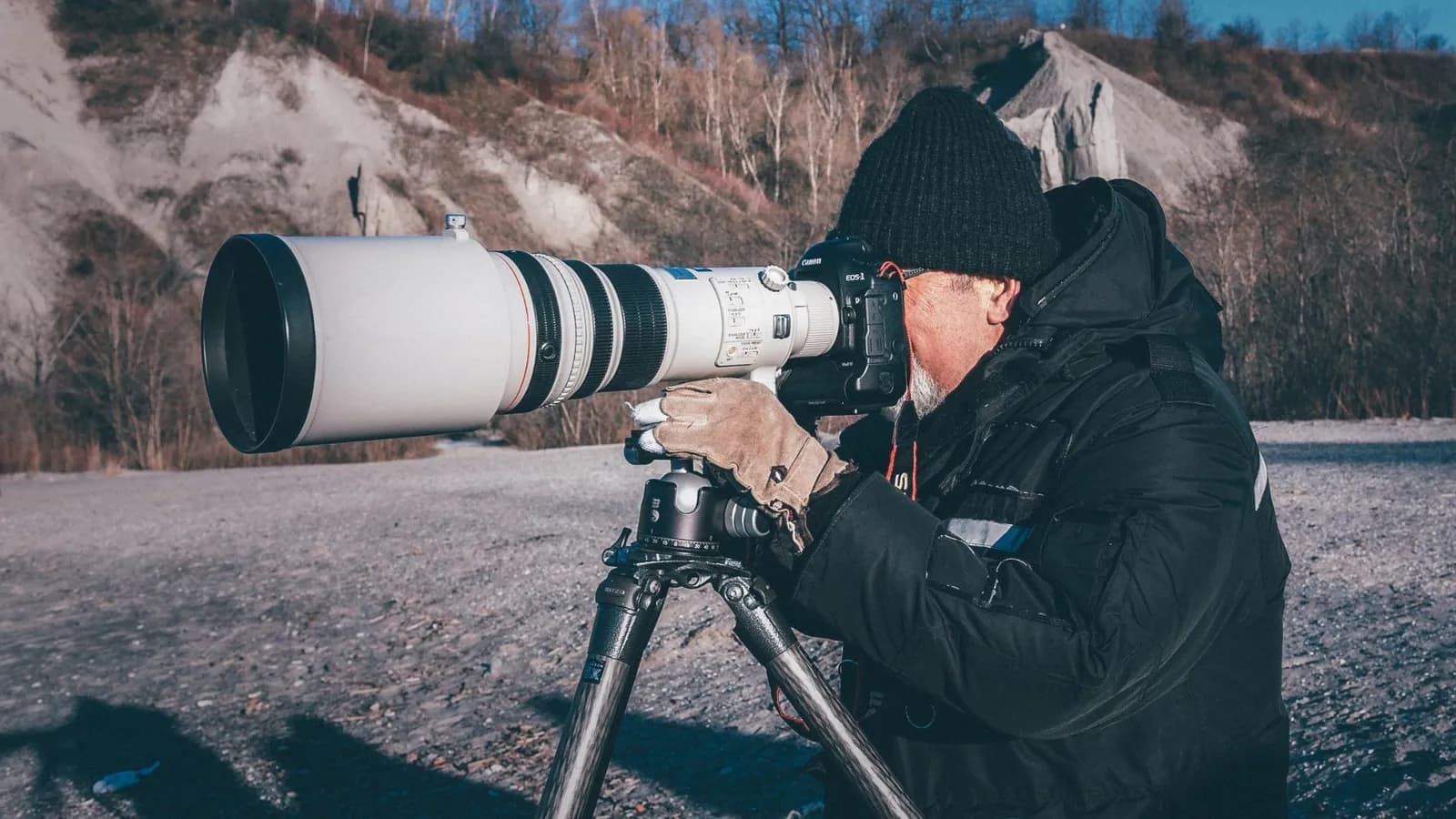
Which Telephoto Lens to Choose for Sports and Wildlife: The Complete Guide
Minimum focal length, aperture, stabilisation and field weight: this guide examines every criterion and compares 16 verified telephoto lenses to help you decide.