Review · Canon · 2020
Canon EOS R5 Review: the pro hybrid that changed the game
The Canon EOS R5 suits wedding, portrait and landscape photographers who want 45 MP, -6 EV AF and 8 stops of IBIS, not videographers shooting continuously beyond a few minutes in 8K.
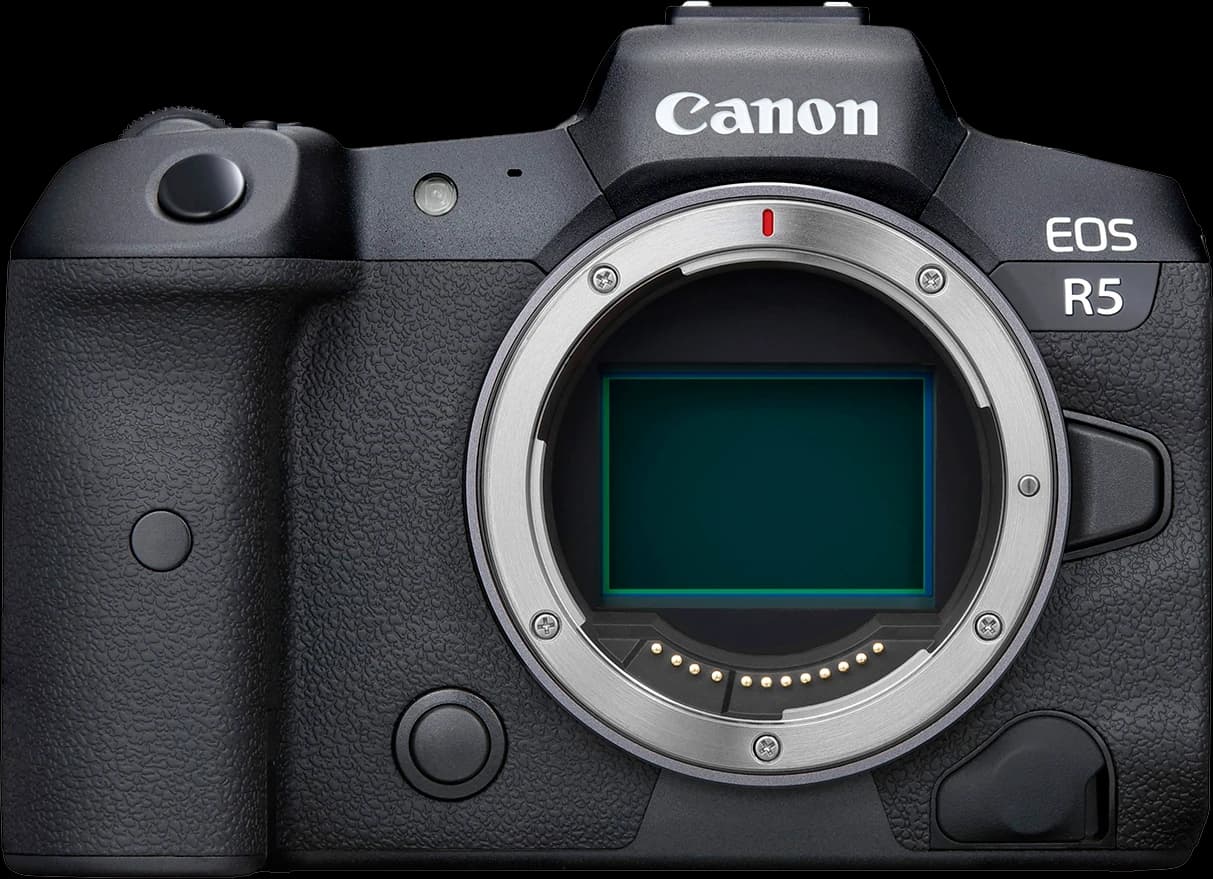
Verdict
The Canon EOS R5 remains a high-level stills camera in 2026: 45 MP, -6 EV AF on 1053 points covering 100% of the sensor, and 8-stop IBIS for handheld work. The accepted compromise lies in video, where the lack of unlimited 8K/30p recording reflects thermal limits well documented since 2020. Against the newer R5 Mark II and the cheaper R6, the R5 holds its place for those who crop in 45 MP and do not shoot continuously, especially on the used market where its performance-to-price ratio is hard to beat.
Pros
- 45 MP full-frame for cropping and large prints
- 1053-point AF, 100% coverage, human and animal eye detection
- AF functional down to -6 EV, ideal for dark ceremonies
- 8-stop IBIS for handheld long exposures
- Dual CFexpress Type B + SD UHS-II slots, weather-sealed body
- 5.76-million-dot viewfinder and 2.1-million-dot articulated screen
Cons
- No unlimited video recording, known thermal limits in 8K/30p
- Fragile Micro HDMI port for intensive video use with rigs
- RAW buffer of 180 frames that drops sharply without CFexpress
- Native ISO capped at 51 200 vs 102 400 on the Canon EOS R6
- R5 Mark II successor already available, new price increasingly hard to justify
Who is it for?
- Wedding photographers needing reliable -6 EV AF in dark churches and a silent 20 fps electronic burst.
- Landscape photographers who crop 45 MP files and exploit the measured 11.9 EV dynamic range in handheld long exposures.
- Studio portrait photographers combining high resolution with human eye detection across 100% of the sensor.
- Used buyers wanting a mature Canon RF full-frame without paying the new R5 Mark II price.
- Occasional videographers who accept the thermal limits of 8K/30p in exchange for internal 12-bit RAW.
On video
Peter McKinnon · 13 min 21
Hands ON with the NEW CANON EOS R5! THE GRAIL CAMERA!
Presentation: the RF range pivot six years on
Launched in 2020 at $4499, the Canon EOS R5 remains in 2026 a used reference and an unavoidable benchmark against the R5 Mark II. Here is why this full-frame hybrid still deserves a place in a current comparison.
The Canon EOS R5 arrived in 2020 at $4499, right in the middle of Canon’s shift to the RF mount. Six years later, in 2026, it coexists with its successor, the Canon EOS R5 Mark II, and the video-oriented EOS R5 C. This mid-to-high positioning directly affects used prices and how we judge it today: it is no longer a full-price new purchase that makes sense for everyone, but a mature body whose strengths and limits are now perfectly documented after years of field feedback.
Canon designed the R5 for three specific uses, confirmed by our usage data: portrait, wedding and landscape. The combination of a 45 MP sensor, 1053-point autofocus covering 100% of the sensor and 8-stop IBIS matches exactly the demands of these three practices: detail usable in post-production, reliable tracking in ceremony light, and handheld long exposures without a tripod. The body makes less generous choices for extended video, which is not an oversight but a coherent decision aligned with its stills positioning.
Canon EOS R5 usage profile: dominant in stills (portrait, wedding, landscape), more measured for extended video.
Ergonomics and handling: the deliberate reflex form factor
The R5 adopts Canon’s professional reflex proportions rather than extreme mirrorless miniaturisation. This choice has concrete consequences for prolonged handling.
At 738 g and 138.5 x 97.5 x 88 mm, the R5 sits at the upper end of full-frame mirrorless bodies, closer to a Nikon Z8 (910 g) than a Sony A7R IV (665 g). In practice, this weight gives better balance with heavy RF lenses (70-200 mm f/2.8, 100-500 mm) and less fatigue during extended bursts, at the cost of bag space comparable to a high-end APS-C DSLR. Canon’s weather-sealing has proven itself on my rainy, salt-spray outings in Brittany: no ingress after hours of continuous exposure.
Viewfinder and screen: the professional standard
The OLED electronic viewfinder shows 5 760 000 dots at 0.76x magnification. This delivers an image as detailed as a high-grade optical focusing screen, without the pixelation seen on entry-level 2.36-million-dot EVFs. For manual-focus portrait work at wide apertures, this resolution genuinely improves confidence in sharpness before zooming on the rear screen.
The 3.2-inch, 2 100 000-dot touchscreen is fully articulated. This is a deliberate choice for vlogging and low- or high-angle shooting, less optimal for strict studio tripod use where a tilting screen would suffice. For weddings and reportage, the fully articulated design remains the most versatile option on the market in 2026.
| Release year | 2020 |
|---|---|
| Weight (with battery) | 738 g |
| Dimensions | 138.5 x 97.5 x 88 |
| Weather sealing | Yes |
| Viewfinder | OLED EVF |
| Viewfinder resolution | 5760000 dots |
| Screen | 3.2 inches |
| Screen articulation | fully articulated |
| Touchscreen | Yes |
| Battery (CIPA) | 490 frames |
| Dual SD slot | Yes |
| Wi-Fi / Bluetooth | Yes / Yes |
| Lens mount | Canon RF |
Image quality: 45 MP sensor and measured dynamic range
The R5’s sensor was Canon’s first 45 MP full-frame CMOS in the RF mount. Six years later it remains a reference for the resolution-to-noise compromise.
45 MP on a 36 x 24 mm full-frame sensor allows large prints without upscaling and comfortable cropping in post-production, equivalent to a 1.5x crop without perceptible loss below 30 MP final files. For a landscape photographer who crops systematically or a portrait photographer delivering files for 4x3 m display, this resolution is a practical advantage, not marketing.
Dynamic range and ISO: what independent measurements show
Measured dynamic range reaches 11.9 EV at base sensitivity. This is solid but not exceptional in the 40+ MP class: the Nikon Z8 measures 11.3 EV, the Sony A7R IV 11.6 EV, while the Leica M11-P reaches 15.1 EV thanks to radically different sensor processing. In short, the R5 sits in the upper mid-range of 40+ MP hybrids, sufficient to recover blocked shadows in landscapes provided you stay at low native ISO.
Native sensitivity runs from 100 to 51 200 ISO, expandable to 102 400 ISO. This ceiling, compared with the 204 800 ISO extended range of the Canon EOS R6 or Nikon Zf, is explained by the higher pixel density: more photosites on the same sensor area means smaller photosites and therefore more noise at equal ISO. The compromise is logical and consistent with the body’s portrait/landscape vocation, less so for reportage in very low light where a lower-density sensor such as the R6’s 20 MP is objectively more forgiving.
| Sensor | Full Frame |
|---|---|
| Sensor size | 36 × 24 mm |
| Resolution | 45 MP |
| Sensor type | CMOS |
| Native ISO range | 100 – 51200 |
| Extended ISO | up to 102400 |
| Measured dynamic range | 11.9 EV |
| In-body stabilization | 8 stops |
| AF points | 1053 |
| AF coverage | 100 % |
| Eye detection (human / animal) | Yes / Yes |
| Mechanical burst | 12 fps |
| Electronic burst | 20 fps |
| RAW buffer | 180 frames |
| Max shutter speed | 1/8000 |
Autofocus: 1053 points and animal detection, the wedding ace
Canon gave the R5 the same autofocus module as the R6 and R3, a rare density at this level in 2020 and still relevant in 2026.
With 1 053 AF points covering 100% of the sensor, the R5 lets you place a focus point right into the extreme corners of the frame, a real advantage for off-centre portraits or tight wedding compositions. Detection combines human and animal eye modes, both active simultaneously without manual switching.
Tracking and reliability in difficult conditions
The stated sensitivity reaches -6 EV, corresponding to a scene lit only by candlelight. In practice this covers almost all church ceremonies, including ring exchanges backlit by stained glass. The Canon EOS R6 goes further at -6.5 EV in a lighter body, while the professional R3 reaches -7.5 EV thanks to its stacked sensor. The R5 therefore remains near the top of its class without being the absolute champion in its own range.
Against direct rivals, the Nikon Z8 claims -9 EV and the Nikon Zf -10 EV, figures that reflect a later generation of detection algorithms (2023 versus 2020). This three-generation software gap is the real argument for upgrading to the R5 Mark II for those who work exclusively in very dark interiors, a minority use case for classic weddings but real for night events.
Burst and buffer: 20 fps electronic, the real limit lies elsewhere
The R5’s burst was designed to cover occasional sport and light wildlife without entering the R3’s overkill territory.
The R5 offers 12 frames per second with the mechanical shutter and 20 frames per second electronically, with a maximum shutter speed of 1/8000 s. In practice, 20 fps in total silence covers a religious service or award ceremony without audible distraction, a genuine plus versus a DSLR. Compared with the Canon EOS R3 (30 fps electronic) or Nikon Z8 (120 fps electronic), the R5 stays in the upper tier without targeting professional sports.
The 180-frame RAW buffer: enough for sport?
The stated buffer holds 180 RAW frames before slowing. At 20 fps electronic this equals roughly 9 seconds of continuous shooting before the camera must empty the buffer to the card. This is sufficient for isolated action (a tennis serve, a medal presentation) but insufficient to cover a full athletics sprint where a deeper buffer or faster card changes the outcome.
Here the specification hides an important nuance: the 180-frame figure assumes the CFexpress Type B slot, which is markedly faster than the secondary SD UHS-II port. Using the SD card as the primary burst medium, whether for convenience or budget, mechanically reduces real buffer depth and lengthens write times. This is a point few tests detail in their burst analysis, yet it directly conditions the experience during long bursts.
8-stop IBIS: the foundation of handheld work
The R5’s IBIS was one of the most discussed launch arguments in 2020. Six years later its real-world relevance remains intact for handheld shooters.
The stabilised sensor compensates up to 8 stops according to manufacturer figures, a rating shared with the R6 and R3 in the Canon range. In landscape and travel I have held 1- to 2-second exposures handheld with short RF focal lengths, a technique that would have required a tripod a decade ago. This is a genuine mobility gain for anyone walking in mountains or cities without wanting to carry an extra tripod.
Compared with the Sony A7R IV (5.5 stops) or Panasonic Lumix S1R (6 stops), the difference is clear and tangible in low light handheld, especially inside churches for weddings or at dusk in landscapes. The Nikon Z8, released three years later, claims the same 8 stops, proof that Canon set a solid reference on this point as early as 2020.
Video: the 8K that sparked controversy, six years on
The R5’s 8K provoked controversy from its 2020 launch around overheating. Six years later the subject remains the best lens through which to judge the body in video.
The R5 records 8K at 30 fps, encoded in H.264, H.265 and internal 12-bit RAW, with Log profiles available. On paper these specs rival dedicated cinema bodies. In reality the specification confirms the absence of unlimited recording, which directly reflects the thermal limits documented by independent tests since 2020.
The real issue: heat, not resolution
This is typically the kind of data manufacturers minimise in datasheets: Canon communicates resolution and bitrate, rarely the actual duration before thermal cut-off in warm ambient conditions. The absence of an unlimited mode in our verified spec sheet is the reliable signal to retain: beyond a certain internal temperature threshold the R5 stops recording to protect itself, behaviour confirmed by numerous independent tests since launch. For occasional use (short interviews, B-roll, weddings) this limit is never reached. For documentary or event work with long continuous takes, it becomes a real planning factor before the shoot.
Canon addressed the issue with the R5 C, a video-oriented variant with active cooling and a measured cinema dynamic range of 14.6 EV versus 11.9 EV on the standard R5. The message is clear: if extended video is your primary use, the R5 C or a dedicated video body remains the better technical answer, not the standard R5 which deliberately chose passive cooling and compact size.
| Max resolution | 8K |
|---|---|
| Max frame rate | 30 fps |
| Codecs | H.264, H.265, RAW |
| Bit depth | 12 bit |
| Log profile | Yes |
| Unlimited recording | No |
| In-body stabilization | 8 stops |
| HDMI output | HDMI Micro HDMI |
| USB connector | USB-C 3.1 Gen 2 |
Connectivity, storage and battery life: the mixed dual slot
The R5’s storage and connectivity mix professional choices with period compromises, six years after launch.
The dual slot combines one CFexpress Type B port and one SD UHS-II port. This was a pragmatic choice for the 2020 transition (few photographers yet owned CFexpress cards), but it creates a speed asymmetry between the two slots. For wedding safety (simultaneous RAW on both cards) this is not a problem. For extended sport bursts it forces advance thought about which slot is the primary medium.
Fast USB-C, fragile HDMI: connectivity in practice
The USB-C 3.1 Gen 2 port enables fast transfers and on-the-go charging, a real comfort when travelling. The video port, however, is Micro HDMI, a connector notoriously more fragile mechanically than the full-size HDMI found on dedicated cinema bodies. For intensive video use with external monitors and daily cabling, this choice demands extra vigilance to protect the port, otherwise the connector can detach prematurely.
CIPA battery life is rated at 490 shots per charge. This is respectable for a full-frame hybrid at this sensor resolution, higher than the Nikon Z8 (340 shots) but lower than the Sony A7R IV (660 shots). On a full wedding day this means carrying at least one spare battery, standard practice anyway for event professionals.
Direct competition: Nikon Z8, Sony A7R IV and the R6 cousin
In 2026 the R5 faces three very different rival profiles: a modern stacked sensor, a higher-resolution studio body, and its own more affordable sibling.
| Spec | Canon EOS R5Tested here | Nikon Z8 | Sony α7R IV | Canon EOS R6 |
|---|---|---|---|---|
| Released | 2020 | 2023 | 2019 | 2020 |
| Sensor | Full Frame | Full Frame | Full Frame | Full Frame |
| Resolution | 45 MP | 45.7 MP | 61 MP | 20 MP |
| Native ISO max | 51200 | 25600 | 32000 | 102400 |
| Dynamic range | 11.9 EV | 11.3 EV | 11.6 EV | 11.2 EV |
| AF points | 1053 | 493 | 567 | 1053 |
| Burst (elec.) | 20 fps | 120 fps | 10 fps | 20 fps |
| IBIS | 8 stops | 8 stops | 5.5 stops | 8 stops |
| Max video | 8K/30p | 8K/30p | 4K/30p | 4K/120p |
| Weather sealing | Yes | Yes | Yes | Yes |
| Dual SD slot | Yes | Yes | Yes | Yes |
| Weight | 738 g | 910 g | 665 g | 680 g |
| Launch price | 4499 USD | 4000 USD | 3500 USD | 2499 USD |
The R5 remains competitive for stills but shows its generation gap against the Z8 on AF and extreme burst.
Nikon Z8 (2023): the real stacked-sensor rival
Released three years after the R5, the Nikon Z8 carries a stacked sensor that changes two key areas: electronic burst rises to 120 fps versus 20 fps on the R5, and low-light AF reaches -9 EV versus -6 EV. In pure stills (landscape, portrait) the measured dynamic-range gap remains small (11.3 EV versus 11.9 EV, favouring the R5). The Z8 wins clearly on fast action; the R5 stays ahead on base-ISO dynamic range.
Sony A7R IV (2019): more pixels, fewer frames
With 61 MP, the Sony A7R IV targets a studio and landscape audience even more demanding on resolution than the R5. The trade-off is clear on responsiveness: 10 fps maximum versus 20 fps on the R5, and AF coverage of 93% versus 100%. For wedding work where tracking and burst matter as much as resolution, the R5 remains the more balanced choice.
Canon EOS R6 (2020): the same AF block for $2000 less
The R6 shares the same AF module (1053 points, -6.5 EV) and the same stabilisation (8 stops) as the R5, for a launch price of $2499 versus $4499. The difference lies solely in resolution (20 MP versus 45 MP) and native ISO ceiling (102 400 versus 51 200, favouring the R6 in very low light). For a wedding photographer who does not crop and values sensitivity over resolution, the R6 remains a serious budget argument against the R5.
Price and used market in 2026
The R5 launched at $4499 in 2020. Its pricing position has mechanically shifted with the arrival of the R5 Mark II.
Six years after launch the R5 new coexists with residual stock and an active used market fed by professionals migrating to the R5 Mark II or R3. This is the classic scenario of a pro body at the end of its commercial cycle: the used price falls faster than technical relevance, making it a serious used-buy candidate for those who do not need the latest autofocus gains.
Canon EOS R5

Canon EOS R5 C Cinema EOS Full Frame Mirrorless Camera Body Only
2 943,59 GBP · PcNova.co.uk


You'll find the best prices on the market here, updated daily — and by going through these partner links, you support Camera Duel without paying a cent more.
The sensible calculation in 2026 is to compare the price of a good used R5 against a new R6 or R8. If the price gap remains modest, the R6 or R8 with intact manufacturer warranty may prove more rational than a used R5 without warranty, unless 45 MP resolution is a non-negotiable requirement for your work (large-format landscape, systematic cropping).
Verdict: should you still buy the Canon EOS R5 in 2026?
The Canon EOS R5 no longer needs proving in 2026. The question is no longer its capabilities but its relevance against a Canon range that has evolved around it.
The R5 remains an excellent stills camera (9.1/10 on our stills scale) driven by 45 MP resolution, dense AF across 100% of the sensor and 8-stop stabilisation. In video the score drops to 7.9/10, dragged down by the lack of unlimited recording and thermal limits in 8K well documented since 2020. The trade-off is clear: outstanding versatile stills body, occasional rather than demanding professional videographer.
- Buy the R5 (new or used) if your dominant use is portrait, wedding or landscape.
- Move to the R5 Mark II if -6 EV AF and the 180-frame RAW buffer are already a felt limit on your current work.
- Prefer the R6 or R8 if budget matters more than 45 MP resolution.
Frequently asked questions
Is the Canon EOS R5 still worth buying in 2026 against the R5 Mark II?▾
Yes for primarily stills use. The R5 Mark II mainly brings AF gains (newer algorithms) and burst improvements, but the R5’s core stills performance (45 MP, measured 11.9 EV dynamic range, 8 stops IBIS) remains relevant. On the used market the price gap strongly favours the R5 for those not shooting extended video or very high-speed sport.
Does the Canon EOS R5 really overheat in 8K video?▾
The specification confirms the absence of unlimited recording, reflecting real thermal limits in 8K/30p documented by numerous independent tests since 2020. For short use (interviews, B-roll, weddings) this limit almost never appears. For long continuous capture it requires cooling pauses.
Is the Canon EOS R5 suitable for wedding photography?▾
Yes, it is one of its three target uses alongside portrait and landscape. AF reaches -6 EV, sufficient for dark church ceremonies, and the silent 20 fps electronic burst is ideal during vows. The dual CFexpress + SD slots secure every shot with simultaneous RAW.
What is the difference between the Canon EOS R5 and the Canon EOS R6?▾
Both share the same AF block (1053 points) and stabilisation (8 stops), but the R5 rises to 45 MP versus 20 MP on the R6, at the cost of a lower native ISO ceiling (51 200 versus 102 400). Launched at $2499 versus $4499 for the R5, the R6 remains the more rational option if resolution is not your priority.
Is the Canon EOS R5 buffer sufficient for sport?▾
The stated RAW buffer is 180 frames, roughly 9 seconds at 20 fps electronic, but only with a CFexpress Type B card in the primary slot. With an SD UHS-II card the real depth drops noticeably. For intensive high-speed sport over long sequences, the Nikon Z8 (120 fps electronic) or Canon EOS R3 (30 fps, deeper buffer) remain better equipped.
Related reviews
Review Canon EOS R6 Mark II: Still the Right Choice in 2026?
The Canon EOS R6 Mark II remains the most balanced general-purpose hybrid in its class for weddings, portraits and travel, provided you accept a RAW buffer limited to 75 images and video capped at 4K/60p.
Read the review
Review: Sony α7 IV – Still the Right Choice in 2026?
Full-frame all-rounder still relevant used for weddings, portraits and occasional video. New, 2023-2024 rivals offer more for the same budget.
Read the review
Nikon Z9 Review: Is the Nikon Flagship Still at the Top?
The Nikon Z9 remains a benchmark for professional sport and reportage thanks to its -8.5 EV AF and 1000 RAW buffer, yet the Z8 delivers the essentials for 1999 USD less.
Read the review