Review · Nikon · 2021
Nikon Z9 Review: Is the Nikon Flagship Still at the Top?
The Nikon Z9 remains a benchmark for professional sport and reportage thanks to its -8.5 EV AF and 1000 RAW buffer, yet the Z8 delivers the essentials for 1999 USD less.
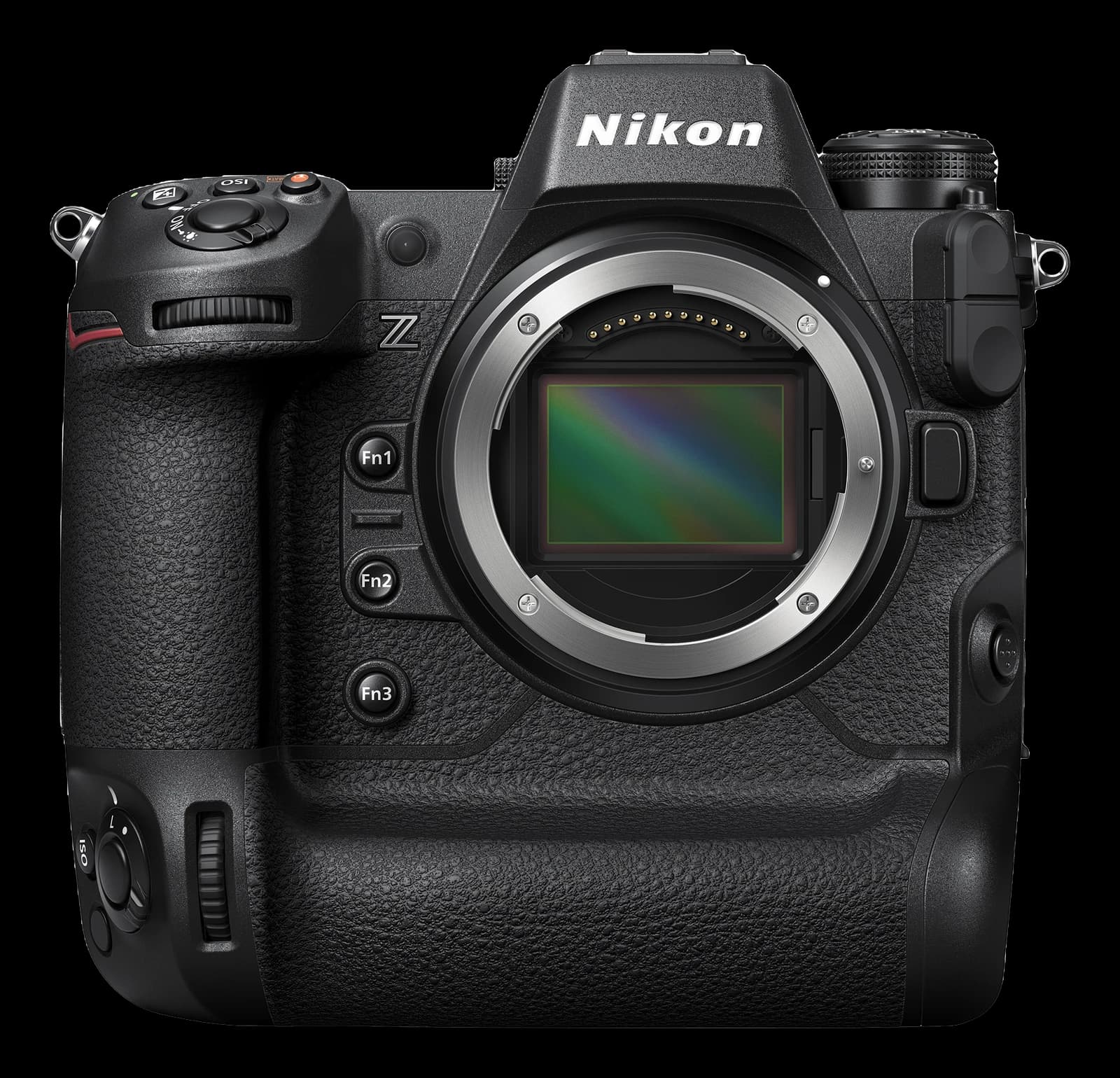
Verdict
The Nikon Z9 remains technically flawless for professional sport and reportage: 120 fps electronic, a 1000-image RAW buffer and -8.5 EV AF in low light have no direct equivalent at Canon at this frame rate. But five years after its 5999 USD launch, it must now contend with its own sibling, the Z8, which matches the core specs for 1999 USD less, and with the Canon EOS R5 Mark II, more recent, which surpasses it on IBIS (8 stops) and measured dynamic range (11.5 EV). The Z9 earns its place for the professional who needs the integrated grip and 740-shot CIPA battery life, nowhere else.
Pros
- 1000-image RAW buffer, well above market average.
- -8.5 EV AF in low light, ahead of the Canon EOS R3 (-7.5 EV) and R5 Mark II (-6.5 EV).
- 120 fps electronic burst with 100 % AF coverage.
- 8K/30p internal 12-bit RAW and ProRes RAW, no recording-time limit.
- 740-shot CIPA battery life thanks to the integrated grip.
Cons
- IBIS limited to 6 stops versus 8 stops on the Z8 and Canon EOS R5 Mark II.
- The Z8 matches the core specs for 1999 USD less at launch.
- Simple tilt touchscreen, not vari-angle, a drawback for solo vlogging.
- 8K capped at 30 fps, versus 60 fps on the Canon EOS R5 Mark II.
- 1340 g weight and CFexpress Type B slots only, a high card budget.
Who is it for?
- The professional sports photographer who needs a 1000-image RAW buffer and 120 fps burst without missing the action.
- The broadcast reporter who shoots 8K ProRes RAW internally with no time limit and requires 740-shot CIPA endurance in the field.
- The wedding or portrait photographer working in difficult light thanks to -8.5 EV AF and reliable eye detection.
- The professional already invested in Nikon Z lenses who needs the integrated grip to stabilise heavy telephotos.
On video
Damien Bernal · 7 min 46
Présentation Nikon z9 : meilleur hybride au monde ?
Presentation: the Nikon Z9, five years after launch
The Nikon Z9 was announced in 2021 at 5999 USD as the flagship of the Z mount, designed to replace the D6 and compete in professional sport, reportage and broadcast video. In 2026, with no official successor announced, the question is simple: does it still compare with newer, cheaper rivals?
The Z9’s positioning is unambiguous. Nikon built a body for the professional photographer covering a sports event, a wedding ceremony with continuous bursts, or a broadcast video shoot in a single day. The 45.7 MP Stacked CMOS sensor, the 493-point autofocus covering 100 % of the frame and the 120 fps electronic burst are not isolated marketing claims: they form a coherent package intended never to miss the decisive moment, even at the cost of compactness and discretion.
Z9 positioning by use: sport and pro video at the top, travel and discretion further back.
Five years later: still flagship, but no longer alone
In 2021 the Z9 had no direct Nikon rival. That is no longer true. The Nikon Z8, released in 2023 at 4000 USD, re-uses the same 45.7 MP sensor, the same 493-point AF system and the same 120 fps burst in a 910 g body versus 1340 g for the Z9. The Z8 mainly loses the integrated grip and some battery life. This technical proximity changes the 2026 buyer’s calculation: the Z9 is no longer judged in isolation, it is judged against its own younger sibling.
No official successor has been announced at the time of writing. The Z9 therefore remains Nikon’s professional standard-bearer in a market where Canon has refreshed its line-up with the EOS R5 Mark II (2024). This lack of update weighs directly on the price equation discussed below.
The priority use cases identified for this body are portrait, wedding and professional video, in addition to sport, its historic vocation. This high-end versatility justifies its weight and price for a multi-role professional, but becomes superfluous for an enthusiast who practises only one of these uses occasionally.
Ergonomics and handling: the unapologetic DSLR format
The Z9 abandons the compact philosophy of mirrorless cameras to adopt the proportions of a professional DSLR with integrated grip. This choice has direct consequences on weight, endurance and handling.
A professional DSLR-sized body, not a compact mirrorless
The body weighs 1340 g and measures 149 x 149.5 x 90.5 mm. That is significantly heavier than the Z8 (910 g) or a Sony α9 II (678 g). In practice the weight stabilises the combination with long lenses such as a 400 mm f/2.8, and the integrated grip eliminates any mechanical play an add-on grip might introduce during extended bursts. The downside is immediate: this is not a lightweight travel body, and it does not pretend to be.
The OLED viewfinder shows 3 690 000 dots at 0.8x magnification. This resolution allows the photographer to judge focus by eye in single-point AF, a real advantage for tight portraits. The 3.2-inch, 2 100 000-dot screen is touch-sensitive, but its articulation remains a simple tilt mechanism without lateral rotation.
Tilt screen only: the video compromise
The choice of tilt (rather than vari-angle) directly penalises solo videographers filming to camera. On a body positioned for broadcast and sport, Nikon prioritised optical-axis rigidity over the flexibility of a 180° screen. That is defensible for a team cameraman with an external monitor assistant, but it is a genuine weakness for a solo creator filming in 8K without an operator.
- Dual CFexpress Type B slots only: no SD fallback, a pro choice that assumes a substantial card budget.
- 740-shot CIPA endurance, the best in class thanks to the integrated grip.
- Full weather-sealing, confirmed by field use in humid conditions and Breton sea spray.
- Full-size USB-C and HDMI (not micro), a genuine plus for studio tethering and video monitoring.
| Release year | 2021 |
|---|---|
| Weight (with battery) | 1340 g |
| Dimensions | 149 x 149.5 x 90.5 |
| Weather sealing | Yes |
| Viewfinder | OLED EVF |
| Viewfinder resolution | 3690000 dots |
| Screen | 3.2 inches |
| Screen articulation | tilt |
| Touchscreen | Yes |
| Battery (CIPA) | 740 frames |
| Dual SD slot | Yes |
| Wi-Fi / Bluetooth | Yes / Yes |
| Lens mount | Nikon Z |
Image quality: 45.7 MP Stacked sensor
The Z9’s Stacked CMOS sensor combines generous resolution with fast readout, two qualities rarely found together on the same photosite.
Resolution and RAW file versatility
At 45.7 MP, the Z9 offers comfortable cropping margin for wildlife or sport when the subject does not fill the frame. This is the same resolution as the Z8, versus 24.1 MP on the Canon EOS R3, which was designed for pure readout speed rather than resolution. The resolution/speed compromise is the Z9’s true technical signature: Nikon has managed to fit a 45.7 MP sensor with Stacked readout fast enough to support 120 fps electronic without visible distortion on fast-moving subjects.
Measured dynamic range versus direct rivals
Measured dynamic range reaches 11.3 EV at base ISO 64. This matches the Z8, logically, since the sensor is identical. Against direct competition, the Canon EOS R3 reaches 11.9 EV and the Canon EOS R5 Mark II 11.5 EV, both at equal or lower resolution. The Sony α9 II claims 14.7 EV according to our data. The difference is not visible on a well-exposed portrait, but it becomes noticeable when recovering deep shadows on a high-contrast landscape, to the advantage of the rivals cited.
Native sensitivity runs from 64 ISO to 25 600 ISO, extendable to 102 400 ISO. Nikon did not push native ISO as high as a Sony α7S III (102 400 ISO native) or a Canon EOS R3 (102 400 ISO native), two bodies optimised for low light before resolution. For stadium sport or daytime reportage the range remains entirely adequate.
A final point to watch is chromatic noise in low-light indoor wedding photography. The Z9 offers extended ISO up to 102 400, but the recommended limit for usable results in large-format prints remains below 12 800 ISO, a common ceiling on sensors above 40 MP where photosite size reduces high-ISO headroom compared with a 24 MP sensor.
| Sensor | Full Frame |
|---|---|
| Sensor size | 35.9 × 23.9 mm |
| Resolution | 45.7 MP |
| Sensor type | Stacked CMOS |
| Native ISO range | 64 – 25600 |
| Extended ISO | up to 102400 |
| Measured dynamic range | 11.3 EV |
| In-body stabilization | 6 stops |
| AF points | 493 |
| AF coverage | 100 % |
| Eye detection (human / animal) | Yes / Yes |
| Electronic burst | 120 fps |
| RAW buffer | 1000 frames |
| Max shutter speed | 1/32000 |
Autofocus: 493 points and low-light detection
Autofocus is the Z9’s central argument for its target sport and wildlife use. The raw figures hide an interesting nuance with the Z8.
100 % coverage and subject detection: what it changes in practice
The system comprises 493 AF points covering 100 % of the frame, with native human-eye and animal-eye detection. Full-frame coverage means a subject at the edge of the image, typical in ball sports where framing anticipates trajectory, remains tracked without recomposition. This is a concrete advantage over systems with partial coverage such as the Sony α7R IV (93 %) or Sony α9 II (93 % according to our database).
Low-light detection: the surprising Z8 advantage
The Z9 is rated at -8.5 EV AF sensitivity in low light. The figure is impressive in absolute terms, yet the Z8, which shares the same sensor and AF engine, is listed at -9 EV in our database. The gap is small in practice (less than one-third of a stop), but it illustrates a classic manufacturer phenomenon: detection firmware and algorithms continue to improve after a flagship launch, and the younger sibling released two years later sometimes benefits more in its initial measurement.
Against the Canon EOS R3 (-7.5 EV) and Canon EOS R5 Mark II (-6.5 EV), the Z9 retains a clear advantage in very low light, a key point for the wedding photographer at the end of the evening or the reporter in poorly lit halls.
- Human-eye and animal-eye AF active by default, no dedicated mode required for most scenes.
- 100 % frame coverage, a real plus in ball sports and birds in flight at the frame edge.
- -8.5 EV in low light, ahead of the Canon EOS R3 (-7.5 EV) and Canon EOS R5 Mark II (-6.5 EV).
Burst and buffer: the figure that really matters
The 120 fps burst makes the headlines, but it is the real-world buffer that decides whether the body sustains the load during long action sequences.
Electronic burst and controlled rolling shutter
The Z9 reaches 120 fps in electronic burst, with a maximum shutter speed of 1/32 000 s. This extreme speed, combined with the absence of a separate mechanical shutter (the Z9 operates only electronically), is possible only thanks to the fast readout of the Stacked sensor. Rolling shutter, historically the weak point of fast electronic shutters, is sufficiently controlled here for rapid panning in sport, a conclusion most independent reviews confirm on fast lateral subjects such as cycling or skiing.
1000-image RAW buffer: the figure that really counts
The announced buffer reaches 1000 RAW images in continuous burst. This is a rare figure on the market and, together with the sensor, the most concrete argument for a professional sports photographer: they can shoot continuously through a goal sequence, a sprint or a smash without fear of the body slowing after a few seconds, a common flaw on bodies that advertise high burst rates but fill their buffer in 2–3 seconds. This figure alone justifies the choice of CFexpress Type B cards, more expensive than SD, but necessary to empty the buffer at sufficient write speed.
Stabilisation: 6 stops claimed, a curious gap versus the Z8
The Z9’s IBIS remains a point of discussion, especially against its own sibling.
Nikon claims 6 stops of IBIS compensation for the Z9. This is a solid figure for handheld long-exposure landscape or run-and-gun video, yet it surprises against the Z8, which claims 8 stops with an identical sensor. The discrepancy is not officially explained in available data and may stem from measurement methodology or an evolution in the stabilisation algorithm between firmware generations. We recommend verifying the point on a comparative field test before deciding, but on paper the Z8 shows a clear numerical advantage.
Against the competition, both the Canon EOS R3 and Canon EOS R5 Mark II claim 8 stops, placing the Z9 behind on this specific criterion among stacked flagships of its generation. In sport photography with fast shutter speeds, IBIS matters little. In handheld video or low-light landscape work, the difference becomes perceptible.
Video: internal 8K, ProRes RAW and unlimited recording
The Z9 is one of the few mirrorless cameras to offer internal RAW video with no recording-time limit, a strong argument for broadcast and lightweight cinema productions.
Internal 8K and 12-bit RAW
The body records 8K at up to 30 fps, encoded in 12 bits. Available codecs include H.264, H.265, ProRes, ProRes RAW and RAW. This combination is rare in the mirrorless market: most competitors offer RAW only via an external recorder, whereas the Z9 records it internally to CFexpress Type B cards. For an editor working with heavy grading, 12-bit internal RAW without destructive compression opens far greater tonal and colour latitude than a standard 8-bit file.
Unlimited recording: the flagship advantage
The Z9 records without time limit, including in 8K, thanks to thermal design intended for prolonged broadcast use. This is a genuine differentiator versus more compact mirrorless bodies that cut recording after 20–30 minutes at high resolution for heat reasons. Nikon Log is available for HDR post-production or Rec.2020 grading.
The remaining weakness is the maximum 8K frame rate, capped at 30 fps, versus 60 fps on the Canon EOS R5 Mark II. For high-resolution slow motion the Z9 must drop to 4K to regain higher frame rates, a limit to consider before purchase for cinema work requiring native 8K slow motion.
| Max resolution | 8K |
|---|---|
| Max frame rate | 30 fps |
| Codecs | H.264, H.265, ProRes, ProRes RAW, RAW |
| Bit depth | 12 bit |
| Log profile | Yes |
| Unlimited recording | Yes |
| In-body stabilization | 6 stops |
| HDMI output | HDMI Full HDMI |
| USB connector | USB-C |
Against the competition: Z8, Canon R3 and Canon R5 Mark II
The Z9 is no longer compared only with its 2021 rivals. Three bodies now shape the purchase decision.
Nikon Z8: the internal duel that weighs most
The Z8, released in 2023 at 4000 USD, shares the 45.7 MP sensor, 493-point AF and 120 fps burst of the Z9. It improves on low-light AF (-9 EV versus -8.5 EV) and IBIS (8 stops versus 6 stops), at 910 g versus 1340 g. The only genuine argument for the Z9 over its sibling is broadcast ergonomics: integrated grip, higher CIPA endurance and better handling with long lenses. For travel, portrait or amateur sport use, the Z8 is objectively the better 2026 purchase.
Canon EOS R3 and R5 Mark II: direct competition
The Canon EOS R3, launched at the same 5999 USD price in 2021, pits a 24.1 MP Stacked sensor and 1053-point AF against a 30 fps electronic burst (versus 120 fps on the Z9) but superior measured dynamic range of 11.9 EV. The choice between the two depends mainly on whether resolution or pure burst speed is the priority: the Z9 wins decisively on frame rate and cropping latitude, the R3 on dynamic range and a denser AF-point coverage system.
Newer and cheaper, the Canon EOS R5 Mark II (2024, 4299 USD) offers 45 MP, a 30 fps electronic burst, 8-stop IBIS, 11.5 EV dynamic range and 8K/60p video. On paper it surpasses the Z9 on IBIS, dynamic range and 8K video frame rate, for 1700 USD less than the Z9’s launch price. The only area where the Z9 remains clearly ahead is pure photo burst (120 fps versus 30 fps) and RAW buffer. For strict high-frame-rate sport the Z9 retains legitimacy. For everything else the price gap becomes difficult to justify.
Sony α9 II: the used-market outsider
The Sony α9 II (2019, 4500 USD at launch), although older, remains a used-market alternative for those who prioritise lightness (678 g) and measured dynamic range of 14.7 EV, the highest in this comparison, at the cost of a more modest 20 fps burst and 24 MP resolution. It is not a direct 2026 competitor to the Z9, but it illustrates that measured dynamic range is not the preserve of the newest bodies.
| Spec | Nikon Z9Tested here | Nikon Z8 | Canon EOS R3 | Canon EOS R5 Mark II |
|---|---|---|---|---|
| Released | 2021 | 2023 | 2021 | 2024 |
| Sensor | Full Frame | Full Frame | Full Frame | Full Frame |
| Resolution | 45.7 MP | 45.7 MP | 24.1 MP | 45 MP |
| Native ISO max | 25600 | 25600 | 102400 | 51200 |
| Dynamic range | 11.3 EV | 11.3 EV | 11.9 EV | 11.5 EV |
| AF points | 493 | 493 | 1053 | 1053 |
| Burst (elec.) | 120 fps | 120 fps | 30 fps | 30 fps |
| IBIS | 6 stops | 8 stops | 8 stops | 8.5 stops |
| Max video | 8K/30p | 8K/30p | 6K/60p | 8K/60p |
| Weather sealing | Yes | Yes | Yes | Yes |
| Dual SD slot | Yes | Yes | Yes | Yes |
| Weight | 1340 g | 910 g | 1015 g | 746 g |
| Launch price | 5999 USD | 4000 USD | 5999 USD | 4299 USD |
The Z8 matches the Z9 for 1999 USD less; the R5 Mark II surpasses it on IBIS and dynamic range.
Price and used market in 2026
The Z9’s pricing must now be read in the light of its own range, not only against Canon and Sony.
Launched at 5999 USD in 2021, the Z9 has never received a major refresh. Five years later, with no successor announced, its list price remains uncompetitive against the Z8 (4000 USD at launch, i.e. 1999 USD less for virtually identical sensor and AF) and against the Canon EOS R5 Mark II (4299 USD, newer and superior on several measured criteria). On the used market the Z9 logically trades below its launch price, restoring value for buyers who specifically need the 120 fps burst, 1000-image RAW buffer and broadcast ergonomics without paying full new price.
On a tight budget, a used Z9 becomes defensible once it approaches the new price of a Z8, because it adds 740-shot CIPA endurance and the integrated grip. Above that threshold the calculation systematically favours a new Z8, with warranty and less mechanical wear after thousands of burst frames.
Verdict: for whom does the Nikon Z9 remain relevant in 2026?
The verdict balances technical admiration against the budgetary case for the Z8.
The Z9 remains a coherent professional tool for sport, wildlife and broadcast reportage: 120 fps electronic, 1000-image RAW buffer, -8.5 EV AF and 100 % frame coverage make it a body that never misses the decisive moment. But five years after launch it is no longer alone in its price bracket: the Z8 matches the essentials for 1999 USD less, and the Canon EOS R5 Mark II surpasses it on IBIS (8 stops versus 6 stops) and dynamic range (11.5 EV versus 11.3 EV) at a lower price as well.
The real 2026 arbitration is no longer ‘Z9 or Sony/Canon’, it is ‘Z9 or Z8’. Unless a specific need for integrated grip and 740-shot CIPA endurance for intensive broadcast work exists, the Z8 remains the better value proposition in Nikon’s professional line-up.
Frequently asked questions
Nikon Z9 or Z8, which to choose in 2026?▾
The Z8 shares the 45.7 MP sensor, 493-point AF and 120 fps burst of the Z9, for 1999 USD less at launch, plus better IBIS (8 stops versus 6 stops). The Z9 retains the advantage only on the integrated grip and CIPA endurance (740 shots). For the majority of uses the Z8 is the better choice in 2026.
Does the Nikon Z9 have a mechanical shutter?▾
No. The Z9 operates exclusively with an electronic shutter, maximum speed 1/32 000 s. This enables the 120 fps burst without mechanical wear, at the cost of vigilance on rolling shutter during very rapid panning.
What is the real-world battery life of the Nikon Z9?▾
The Z9 is CIPA-rated for 740 shots, a high score for a full-frame mirrorless camera, thanks to its integrated grip that houses a larger battery than on a compact body such as the Z8 or Sony α9 II.
Is the Nikon Z9 suitable for professional video?▾
Yes, with caveats. The Z9 records 8K/30p internally in 12-bit RAW and ProRes RAW with no time limit, a genuine broadcast asset. The limit is the 8K frame rate capped at 30 fps, versus 60 fps on the Canon EOS R5 Mark II, a consideration for cinema work requiring high-resolution slow motion.
Is the Nikon Z9 still competitive against the Canon EOS R5 Mark II?▾
On paper the R5 Mark II (4299 USD) outperforms on IBIS (8 stops), dynamic range (11.5 EV) and 8K video (60 fps), for less money. The Z9 retains the advantage only on pure photo burst (120 fps versus 30 fps) and RAW buffer. For very high-frame-rate sport the Z9 remains relevant; for everything else the R5 Mark II is the more rational choice.
Related reviews
Review Canon EOS R6 Mark II: Still the Right Choice in 2026?
The Canon EOS R6 Mark II remains the most balanced general-purpose hybrid in its class for weddings, portraits and travel, provided you accept a RAW buffer limited to 75 images and video capped at 4K/60p.
Read the review
Review: Sony α7 IV – Still the Right Choice in 2026?
Full-frame all-rounder still relevant used for weddings, portraits and occasional video. New, 2023-2024 rivals offer more for the same budget.
Read the review
Canon EOS R5 Review: the pro hybrid that changed the game
The Canon EOS R5 suits wedding, portrait and landscape photographers who want 45 MP, -6 EV AF and 8 stops of IBIS, not videographers shooting continuously beyond a few minutes in 8K.
Read the review