Review · Canon · 2023
Canon EOS R50 Review: Still the Right Choice for Beginners in 2026?
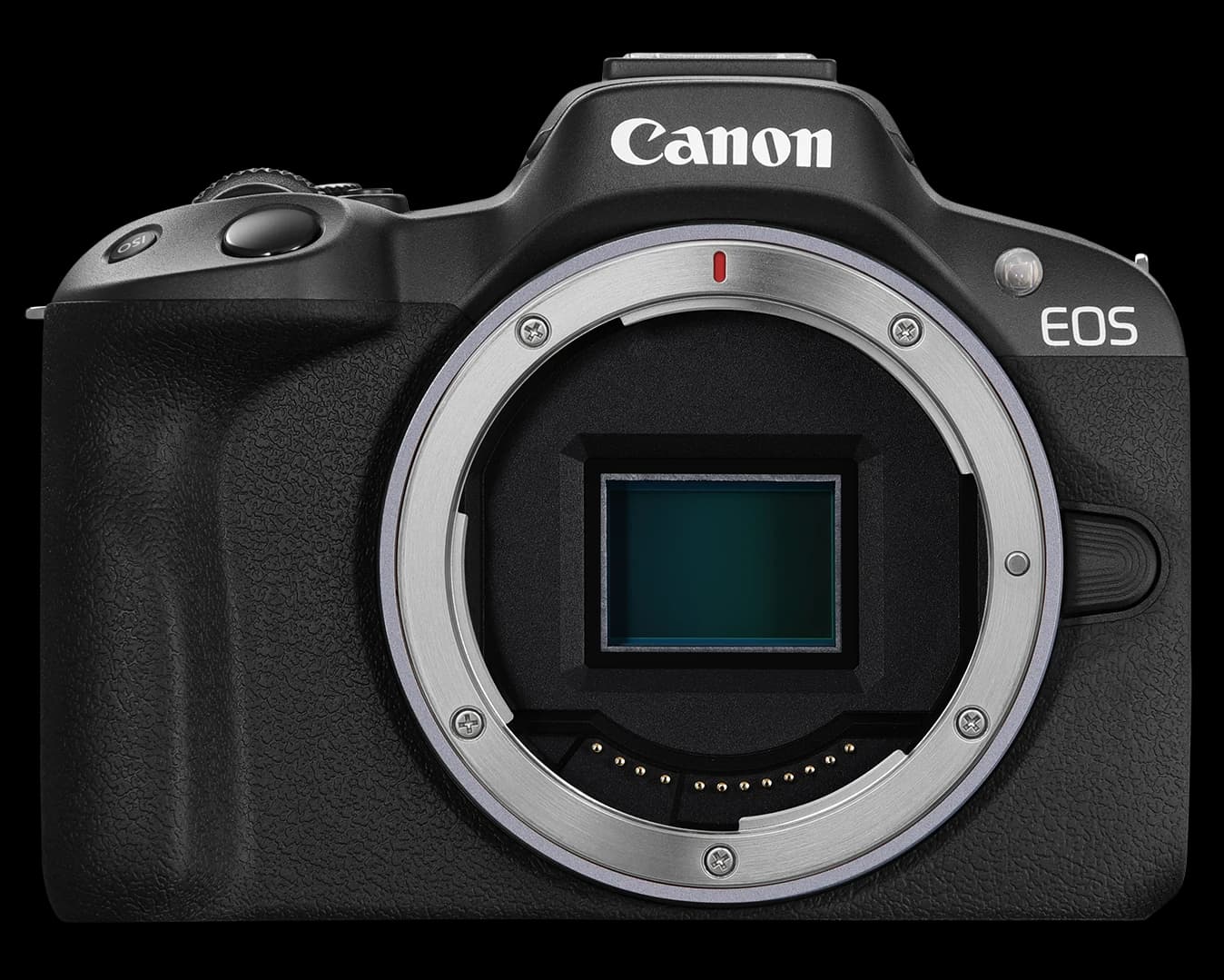
The Canon EOS R50 targets beginners and light travellers with 651 AF points and 375 g on the scales. A sensible choice under 700 USD, provided you accept the lack of IBIS and a RAW buffer of only 7 frames.
Verdict
With 651 AF points at 100 % coverage, eye and animal detection, and 375 g on the scales, the Canon EOS R50 fulfils its brief as a first RF hybrid for street, portrait and light travel. The accepted compromises are the RAW buffer (7 frames, or 0.47 s at 15 fps), the complete absence of IBIS and the lack of weather-sealing. Against its own video successor, the R50 V, and its bigger brother the R10, the R50 remains defensible only for buyers who prioritise pure stills on a tight budget.
Pros
- 651-point AF with 100 % coverage and human/animal eye detection, rare under 700 USD
- 15 fps electronic burst to capture the decisive moment in street and travel
- 375 g on the scales, the lightest RF body with a viewfinder in the Canon range
- 2.36 M-dot OLED viewfinder at 0.95x and fully articulated 3-inch touchscreen (1.62 M dots)
- Launch price of 679 USD, an affordable entry into the RF ecosystem
Cons
- RAW buffer limited to 7 frames, or 0.47 s of useful burst at 15 fps
- No IBIS; all stabilisation relies on the lens
- Single SD UHS-I card slot, no backup or high write speed
- Video capped at 4K 30p with no Log profile, clearly behind the R50 V
- No weather-sealing, a point to watch in damp travel conditions
Who is it for?
- The beginner photographer wanting to enter the Canon RF ecosystem without exceeding 700 USD
- The light traveller who prefers a 375 g body with built-in viewfinder over a smartphone
- The occasional portrait photographer who uses eye detection on 651 AF points without complex settings
- The street photographer who accepts the lack of IBIS in exchange for a compact, discreet body
On video
Tech Through The Lens · 16 min 38
Canon EOS R50 Tutorial - Complete Beginner Guide
Canon EOS R50: presentation and positioning in 2026
Launched in 2023 at 679 USD, the R50 sits at the entry level of the APS-C RF range. Three years on, its intended role must be understood precisely before judging its compromises.
The Canon EOS R50 effectively replaces the M50 Mark II on the RF-S mount. Canon’s stated mission for the camera covers three uses: street, portrait and travel. This framing matters, because it determines what should weigh in the final judgement. A body designed for these three uses does not need a competition-grade buffer or war-reporter weather-sealing. It needs reliable autofocus, contained weight and an accessible price.
Canon EOS R50 usage profile: autofocus and portability lead, sustained burst and video lag behind.
In the Canon APS-C range, the R50 sits between the R100 (480 USD, 143 AF points, stripped back) and the R10 (979 USD at launch, 429 g, faster burst). It inherits the 24.2 MP CMOS sensor in 22.3 × 14.9 mm format and a dense AF array of 651 points with 100 % coverage. This last figure justifies most of the price: at 679 USD, few rivals offer full AF coverage with human and animal eye detection.
- 24.2 MP on APS-C CMOS sensor, sufficient resolution for A3 prints without aggressive cropping.
- 375 g body only, the lightest R-series body with an electronic viewfinder.
- 651 AF points at 100 % coverage, with human and animal eye detection.
- 679 USD at 2023 launch, an entry price that remains competitive against the R10 and R7.
In 2026 the landscape has shifted: Canon has released the R50 V, a video-oriented derivative that now coexists with the original R50. This clarifies the role of the classic R50. It remains the choice for those who want stills first, with a viewfinder, and leave advanced video to the R50 V. We will examine that duel later with supporting figures.
Ergonomics and handling: a body designed for lightness
375 g and jacket-pocket size: the R50 makes portability its number-one argument against the rest of the RF range.
At 375 g and dimensions of 116.3 × 85.5 × 68.8 mm, the R50 is lighter than the R10 (429 g) and the M50 Mark II (387 g), both in the same APS-C category. The difference is noticeable on a full day of walking with the camera around the neck. The expected trade-off is a reduced grip and less secure hold for large hands or with heavy lenses such as the RF 70-200 mm.
| Release year | 2023 |
|---|---|
| Weight (with battery) | 375 g |
| Dimensions | 116.3 x 85.5 x 68.8 |
| Weather sealing | No |
| Viewfinder | OLED EVF |
| Viewfinder resolution | 2360000 dots |
| Screen | 3 inches |
| Screen articulation | fully articulated |
| Touchscreen | Yes |
| Battery (CIPA) | 440 frames |
| Dual SD slot | No |
| Wi-Fi / Bluetooth | Yes / Yes |
| Lens mount | Canon RF |
The OLED viewfinder shows 2 360 000 dots at 0.95x magnification. This is a good level for an entry-level body: framing stays sharp and eye comfort is acceptable for extended use. The 3-inch touchscreen (1 620 000 dots) is fully articulated, a genuine asset for travel selfies or low-angle street work. CIPA battery life of 440 shots covers half a day of active shooting without a spare battery, which is reasonable for this weight class.
Image quality: sensor, resolution and dynamic range
The R50 sensor invents nothing new, yet it holds its own in the generalist APS-C standard of 2023-2026.
| Sensor | APS-C |
|---|---|
| Sensor size | 22.3 × 14.9 mm |
| Resolution | 24.2 MP |
| Sensor type | CMOS |
| Native ISO range | 100 – 32000 |
| Extended ISO | up to 51200 |
| Measured dynamic range | 10.6 EV |
| In-body stabilization | No |
| AF points | 651 |
| AF coverage | 100 % |
| Eye detection (human / animal) | Yes / Yes |
| Mechanical burst | 12 fps |
| Electronic burst | 15 fps |
| RAW buffer | 7 frames |
| Max shutter speed | 1/8000 |
Measured dynamic range: 10.6 EV, the sensor’s true position
Measured dynamic range reaches 10.6 EV at 100 ISO, its lowest native sensitivity. This sits within class norms: the R10 measures 10.5 EV, the Fujifilm X-T4 10.5 EV, the GH7 10.2 EV. The R50 therefore does not regress against its direct APS-C rivals despite its entry-level positioning. The gap with full-frame sensors such as the R8 (11.6 EV) or especially the Nikon ZR (15 EV) remains clear, however. For demanding landscape work in bright highlights, this delta translates into less recovery headroom on blown skies in post-processing.
Native ISO 32 000: an adequate window, not generous
Native ISO peaks at 32 000, extendable to 51 200. This lags behind full-frame bodies such as the R8 (102 400 native) or even some recent APS-C models. In practice the R50 remains comfortable outdoors and in well-lit interiors, but a fast lens or flash is required once ambient light drops, typically for evening portraits or concert photography.
Autofocus: the body’s real strength
This is where the R50 exceeds its price. 651 AF points and full coverage is the kind of specification still missing from many rivals at this tariff.
The R50 carries 651 AF points with 100 % sensor coverage, human and animal eye detection, and sensitivity down to -4 EV. For a body sold at 679 USD, this AF density is rare: it matches the R10, 300 USD dearer at launch, and far surpasses the 143 points of the R100 or M50 Mark II.
Eye and animal detection: what changes day-to-day
In portraiture, eye detection locks onto the subject as soon as it enters the frame without manual zone selection. In travel, animal detection assists with street scenes containing dogs or park animals, an occasional but frequent use for this buyer profile. It is not professional animal autofocus like the R7 or R3, but an effective safety net for users who prefer not to manage focus manually.
Low-light limit: -4 EV against the competition
The -4 EV limit roughly equates to a scene lit by candlelight. It is sufficient for most urban street scenes at dusk, yet clearly behind the Nikon Zf (-10 EV), Nikon Z8 (-9 EV) or even the Canon R8 (-6.5 EV). Beyond the limit the AF hunts or pumps before locking, which can cost the decisive moment in night street photography.
Burst and buffer: the real autonomy of the electronic shutter
15 frames per second on paper, yet a RAW buffer of only 7 frames. This is where the specification sheet hides the essentials.
The R50 claims 15 fps with the electronic shutter and 12 fps mechanical. These are respectable headline figures for an entry-level body. The RAW buffer, however, tops out at 7 frames, a figure most marketing sheets relegate to the footnotes.
The calculation the manufacturer does not highlight: 0.47 s of useful burst
With a 7-frame buffer and 15 fps rate, full-speed RAW burst lasts 0.47 s before slowing. Mechanically at 12 fps it lasts 0.58 s. Beyond that threshold the body reverts to the write speed of the UHS-I SD card, which is markedly lower than the UHS-II cards used on higher-end bodies. In practice this is enough to catch a jump or fleeting smile in street or portrait work, but a real limitation for extended sports or wildlife sequences.
- 0.47 s of full-speed RAW burst in electronic mode (15 fps, 7-frame buffer).
- 0.58 s in mechanical mode (12 fps, same 7-frame buffer).
- Slowdown thereafter limited by the write speed of the SD UHS-I card.
- A profile suited to the isolated moment, not the long sequence.
Stabilisation and weather-sealing: the two real concessions
These are the two lines on the specification sheet that separate an entry-level body from a mid-range one. On the R50 both boxes are empty.
The R50 has no IBIS. All stabilisation therefore depends on the mounted lens, which works well with the stabilised RF-S 18-45 mm or 18-150 mm but leaves the photographer without a safety net with an unstabilised prime in low light or handheld video.
The body is also not weather-sealed and offers only a single SD UHS-I card slot. In travel under light rain or coastal humidity, extra caution is required: protective cover, regular drying, avoidance of direct spray. This is not a flaw per se; it is the logical price of a 679 USD body, but it must be known before purchase, not discovered in the field.
- No IBIS: stabilisation depends entirely on the lens.
- No weather-sealing announced: caution advised in damp travel, rain or spray.
- Single card slot, SD UHS-I: no backup in case of card failure.
Video: a clearly secondary feature
The R50 was never conceived as an advanced video tool. The figures confirm this unambiguously.
| Max resolution | 4K |
|---|---|
| Max frame rate | 30 fps |
| Codecs | H.264, H.265 |
| Bit depth | 10 bit |
| Log profile | No |
| Unlimited recording | No |
| In-body stabilization | No |
| HDMI output | HDMI Micro HDMI |
| USB connector | USB-C 2.0 |
4K 30p without Log: what this excludes for creative use
Video tops out at 4K 30 fps, 10-bit, H.264 and H.265 codecs, with no Log profile and no unlimited recording. Against the R10 (4K 60p), the R8 (4K 180p) and especially its own successor the R50 V (4K 60p with Log), the R50 shows a clear video deficit. The video score from our algorithm, 4.3/10, reflects this deliberate positioning by Canon rather than an isolated technical weakness.
Micro HDMI and limited recording: the creator constraints
Video output uses a micro HDMI port, mechanically more fragile than full HDMI on a prolonged rig. Combined with the absence of Log and IBIS for handheld stabilisation, the R50 positions itself as a stills body that can film when needed, not as a dedicated video tool.
Connectivity and battery life: sufficient for light travel
Nothing exceptional, yet nothing blocking for everyday travel or street use.
CIPA battery life of 440 shots covers a standard photo outing without a spare battery, provided video mode and intensive remote control via the Canon app are limited. The USB-C 2.0 port handles charging and file transfer, without the speed of USB-C 3.2 found on newer bodies such as the R6 V.
Wi-Fi and Bluetooth are present for smartphone transfer and remote triggering, two expected functions on a travel- and social-media-oriented body. The single SD UHS-I slot, already noted as a burst limitation, also restricts transfer speed to a computer after an intensive shooting day.
- 440 shots CIPA, half a day of active use without a spare battery.
- USB-C 2.0 for charging, limited speed for large RAW transfers.
- Wi-Fi and Bluetooth built in for quick smartphone sharing.
Against direct competition: R10, M50 Mark II and R50 V
Three comparisons illuminate the R50’s true positioning in 2026: its bigger brother, its predecessor and its own video successor.
Against the Canon EOS R10: faster, heavier, dearer
The R10 shares the same 651 AF points at 100 % coverage, yet pushes electronic burst to 23 fps and weighs 429 g against 375 g for the R50, at 979 USD launch price versus 679 USD. The R10 targets photographers wanting extra burst margin and accepting the extra weight; the R50 targets those prioritising lightness and budget.
Against the Canon EOS M50 Mark II: the real generational leap
The M50 Mark II, on the EF-M mount, offered only 143 AF points with 88 % coverage and a 7.4 fps electronic burst. The R50 almost quadruples AF density and doubles coverage while increasing burst rate. This is the clearest proof that the move to the RF-S mount is more than a name change: it is a genuine autofocus leap.
Against the Canon EOS R50 V: the 2026 video successor that changes the game
The R50 V, released in 2025 at 649 USD, retains the core of the R50 (651 AF points, 24.2 MP sensor, 12 fps mechanical) but adds 4K 60p, a Log profile, low-light AF to -5 EV and CIPA battery life of 480 shots. It launched cheaper than the classic R50. This confirms that the original R50 remains relevant only for buyers who strictly prioritise stills and an electronic viewfinder, two areas where the R50 V does not advance significantly.
| Spec | Canon EOS R50Tested here | Canon EOS R10 | Canon EOS M50 Mark II | Canon EOS R50 V |
|---|---|---|---|---|
| Released | 2023 | 2022 | 2020 | 2025 |
| Sensor | APS-C | APS-C | APS-C | APS-C |
| Resolution | 24.2 MP | 24.2 MP | 24 MP | 24.2 MP |
| Native ISO max | 32000 | 32000 | 25600 | 32000 |
| Dynamic range | 10.6 EV | 10.5 EV | 13.8 EV | — |
| AF points | 651 | 651 | 143 | 651 |
| Burst (elec.) | 15 fps | 23 fps | 7.4 fps | 15 fps |
| IBIS | No | No | No | No |
| Max video | 4K/30p | 4K/60p | 4K/120p | 4K/60p |
| Weather sealing | No | No | No | No |
| Dual SD slot | No | No | No | No |
| Weight | 375 g | 429 g | 387 g | 370 g |
| Launch price | 679 USD | 979 USD | 779 USD | 649 USD |
The R50 remains the tightest weight-and-price compromise in the range, yet the R50 V now surpasses it on every video criterion.
Price and availability in 2026: used market and budget alternatives
Three years after launch, the R50 logically trades below its original 679 USD price, and the used market is worth considering.
Launched at 679 USD in 2023, the R50 has mechanically lost value against the arrival of the R50 V at 649 USD, which offers more video features at a lower launch price. On the used market a good-condition R50 generally trades below its original new price, making it a particularly cost-effective RF entry for those who do not need the video attributes of the R50 V.
Canon EOS R50

CANON EOS R50 Mirrorless Camera - Body Only, Black
729 GBP · amazon.co.uk


You'll find the best prices on the market here, updated daily — and by going through these partner links, you support Camera Duel without paying a cent more.
For an even tighter budget the R100 (480 USD, 143 AF points, 88 % coverage, 6.5 fps burst) remains available, yet the autofocus gap versus the R50 is too large to recommend it to anyone wanting responsive portrait or street work. The reasonable 2026 choice therefore lies between a discounted end-of-life new R50, a used R50, or the R50 V if video genuinely matters in the intended use.
Verdict: should you buy the Canon EOS R50 in 2026?
Our generalist algorithm awards 5.9/10 for stills and 4.3/10 for video. These scores measure universal versatility the R50 never targeted.
Narrowed strictly to its mission (street, portrait, light travel), the R50 deserves a more favourable score than the raw algorithm result. Its 651-point autofocus with 100 % coverage, 375 g weight and 679 USD launch price make it a coherent RF entry point. Its real weaknesses, the 7-frame RAW buffer (0.47 s of useful burst), lack of IBIS and lack of weather-sealing, are only flaws for users who step outside its target uses: sports, action wildlife or advanced video.
The real 2026 competitor to the R50 is no longer an external body; it is its own successor, the R50 V. For pure stills with an electronic viewfinder the R50 retains the advantage. For video, even occasional, the R50 V (4K 60p, Log, 649 USD) is objectively better for less at launch.
Frequently asked questions
Does the Canon EOS R50 have in-body stabilisation (IBIS)?▾
No. The R50 has no sensor-shift stabilisation. Stabilisation depends entirely on the mounted lens, which remains a genuine consideration in low light and handheld video.
What is the real difference between the Canon EOS R50 and the Canon EOS R10?▾
Both share 651 AF points at 100 % coverage, yet the R10 pushes electronic burst to 23 fps versus 15 fps on the R50, weighs 429 g versus 375 g and launched at 979 USD versus 679 USD.
Is the Canon EOS R50 weather-sealed?▾
No weather-sealing is announced on this body. In travel under rain or in humid climates a protective cover is recommended.
Is the Canon EOS R50 suitable for regular video work?▾
Not ideally. Video is capped at 4K 30 fps in 10-bit with no Log profile or unlimited recording. For regular video use the Canon EOS R50 V (4K 60p, Log, 649 USD) is an objectively superior choice.
Should I buy the Canon EOS R50 or wait for the Canon EOS R50 V?▾
If the primary use is stills with an electronic viewfinder, the R50 remains relevant, especially used. If video matters even occasionally, the R50 V (4K 60p, Log, low-light AF to -5 EV) is the better choice at a lower launch price.
Does the Canon EOS R50 have two SD card slots?▾
No, only a single SD UHS-I slot. This is consistent with its entry-level positioning but rules out immediate backup in case of card failure.
Related reviews
Review: Sony α7 III – Still Relevant in 2026?
The Sony α7 III remains an excellent used choice for weddings, portraits and travel thanks to its **710-shot CIPA battery life** and 693-point AF. Demanding videographers should look elsewhere.
Read the review
Fujifilm X-T5 Review: Pure Photography Before Video
The Fujifilm X-T5 suits landscape, portrait or travel photographers seeking 40.2 MP in a compact 557 g body. It is not a tool for intensive sport or professional video.
Read the review
Review Canon EOS R6 Mark II: Still the Right Choice in 2026?
The Canon EOS R6 Mark II remains the most balanced general-purpose hybrid in its class for weddings, portraits and travel, provided you accept a RAW buffer limited to 75 images and video capped at 4K/60p.
Read the review