Review · Fujifilm · 2025
Review: Fujifilm GFX 100RF – 102 MP in a Compact Body
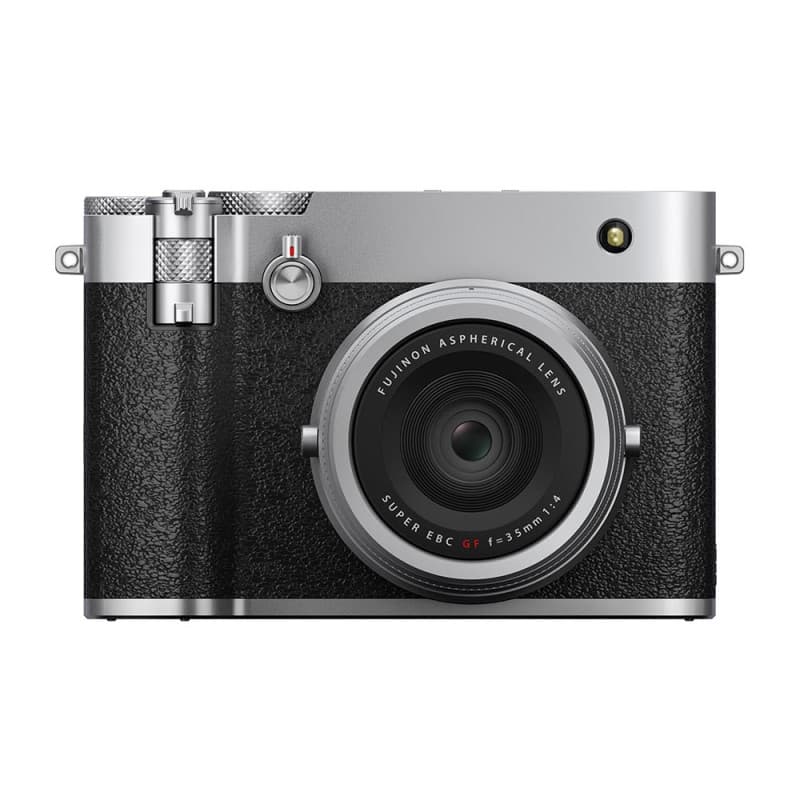
The GFX 100RF is the best tool available for the landscape and travel photographer who wants medium format quality without the bulk of a DSLR system. At $4,899, it has no direct competitor in this positioning.
Verdict
The Fujifilm GFX 100RF succeeds in a difficult challenge: concentrating 102 MP of medium format sensor (43.8 × 32.9 mm) in a 735 g weather-sealed body with an integrated fixed lens. Image quality in landscape and portrait work is unmatched at this size. The concessions are real and deliberate: 3 fps in electronic mode, no IBIS, video capped at 4K/30p. These limits do not penalise the landscape, travel or posed portrait photographer, the three declared target uses. Value for money is defensible against the GFX 100 II at $7,499 and the Hasselblad X2D 100C. Against the Sony A7R V at $3,900, the price difference is justified by the larger sensor area and system compactness. The lack of IBIS is the only real deal-breaker for photographers who often work in low light without a tripod. For all other targeted profiles, it is a justified purchase.
Pros
- Medium format 102 MP sensor (43.8 × 32.9 mm): superior dynamic range and micro-contrast to full-frame
- Compact, weather-sealed body for medium format: 735 g, usable in demanding conditions
- Dual SD UHS-II slots: data security for reportage and travel
- OLED viewfinder 5,760,000 dots at 0.84x magnification: reference in the category
- CIPA battery life 820 shots: comfortable for a full day in the field
- AF with human and animal eye detection, 100 % coverage, down to -3 EV
Cons
- No IBIS: deal-breaker in low light without a tripod
- Electronic burst limited to 3 fps: unsuitable for any moving subject
- Video capped at 4K/30p with no unlimited recording
- Integrated fixed lens: no focal length flexibility without an adapter
- Launch price $4,899: significant investment
Who is it for?
- The landscape photographer who wants medium format quality in the field without carrying a bulky interchangeable-lens system
- The travel photographer who values discretion and compactness without sacrificing resolution for large prints
- The studio or controlled natural-light portrait photographer working on a tripod or in stable conditions
- The wedding photographer shooting posed moments and high-resolution details, without need for fast burst rates
On video
Phototrend · 11 min 16
Test Fujifilm GFX 100RF : du MOYEN FORMAT dans un compact, pari réussi ?
Presentation: the compact medium format wager
Fujifilm positions the GFX 100RF as a personal travel and reportage camera with a medium format sensor. This is a new positioning in the GFX range, and almost unique on the market.
The GFX 100RF was released in 2025 at $4,899. It uses the 102 MP CMOS sensor from the GFX 100S II in a fixed-lens body that is more compact and lighter than any other medium format camera on the market. The positioning is explicit: Fujifilm targets the demanding photographer who wants GFX quality without the bulk of an interchangeable system.
The lineage with the GFX 100 II ($7,499, 1,030 g) is direct on the sensor side. The GFX 100RF inherits the same 102 MP and 43.8 × 32.9 mm area, but drops IBIS, 8K video and high burst rates. These are deliberate concessions to reach 735 g and dimensions of 133.5 × 90.4 × 76.5 mm. Fujifilm made choices. They must be accepted or the camera passed over.
Usage scores: the GFX 100RF excels in landscape and portrait, falls short in sport and video.
In the compact medium format market, competition is scarce. The Hasselblad X2D 100C also offers 100 MP with IBIS, but in a larger body and at a higher price. The Leica SL3 (60.3 MP, full-frame) is less detailed but far more versatile. The Sony A7R V (61 MP, full-frame, $3,900) is the most serious indirect rival on resolution-to-price ratio. None of these cameras combine the sensor area of the GFX 100RF with its compact size.
| Sensor | Medium Format |
|---|---|
| Sensor size | 43.8 × 32.9 mm |
| Resolution | 102 MP |
| Sensor type | CMOS |
| Native ISO range | 80 – 12800 |
| Extended ISO | up to 102400 |
| In-body stabilization | No |
| AF points | 425 |
| AF coverage | 100 % |
| Eye detection (human / animal) | Yes / Yes |
| Mechanical burst | 6 fps |
| Electronic burst | 3 fps |
| RAW buffer | 45 frames |
| Max shutter speed | 1/16000 |
Ergonomics and handling: a compact that owns its size
At 735 g with integrated lens, the GFX 100RF is not a pocket camera. Yet it remains well below the fatigue threshold for a full day in the field.
Build and weather-sealing
Weather-sealing is present. This is a worthwhile point for a camera aimed at travel and landscape work. I have used GFX bodies in sea-spray conditions in Brittany: Fujifilm’s sealing is serious, the gaskets hold up over time. For the GFX 100RF I have no personal field feedback, but the construction follows the documented and reliable standards of the GFX range.
The dimensions 133.5 × 90.4 × 76.5 mm place the body in the same volume category as a compact APS-C DSLR. The 76.5 mm depth is dictated by the optical design of the integrated lens. It is an acceptable compromise for the image quality delivered.
Controls and viewfinder
Fujifilm has retained its characteristic manual controls: dedicated exposure dials, direct access to main parameters without menu diving. This is consistent with the intended field use. The landscape photographer who works slowly and methodically will appreciate this approach.
The OLED viewfinder shows 5,760,000 dots at 0.84x magnification. It is an absolute reference in the category. By comparison, the Sony A7R V offers a 9,440,000-dot OLED viewfinder but at 0.78x magnification. The GFX 100RF provides a larger image, which aids manual focusing and scene reading in difficult conditions.
The rear screen measures 3.2 inches with 2,100,000 dots, is touch-sensitive and tilts vertically. The tilt mechanism covers landscape use at low or high angles. It does not allow selfie or vlogging shooting, which is consistent with the non-video positioning of the body.
| Release year | 2025 |
|---|---|
| Weight (with battery) | 735 g |
| Dimensions | 133.5 x 90.4 x 76.5 |
| Weather sealing | Yes |
| Viewfinder | OLED EVF |
| Viewfinder resolution | 5760000 dots |
| Screen | 3.2 inches |
| Screen articulation | tilt |
| Touchscreen | Yes |
| Battery (CIPA) | 820 frames |
| Dual SD slot | Yes |
| Wi-Fi / Bluetooth | Yes / Yes |
Image quality: what 102 MP on medium format really changes
This is the heart of the matter. The GFX 100RF justifies itself or not by the quality of its files. The numbers are known. The practical interpretation is less so.
Sensor area: the structural advantage
The 43.8 × 32.9 mm CMOS sensor of the GFX 100RF covers an area of roughly 1,440 mm². A full-frame 35 mm sensor covers about 864 mm². The difference is 67 % in surface area. This is not cosmetic. It translates into greater light collection per photosite, higher measured dynamic range and a different micro-contrast rendering, especially in landscape with fine textures (rock, vegetation, water).
The GFX 100 II, which shares the same sensor, shows a measured dynamic range of 12.6 EV according to our database. The Sony A7R V (61 MP, full-frame) is measured at 11.7 EV by DXOMark. The gap of nearly one EV is perceptible in post-processing on highlights and deep shadows.
Resolution and cropping: 102 MP in practice
102 MP produces files of approximately 11,648 × 8,736 pixels. A 300 DPI print reaches 98 × 74 cm without interpolation. For large-format landscape or portrait work intended for printing, this is considerable headroom. Cropping in post-processing is also permissive: removing 50 % of the image still leaves 51 MP, more than most full-frame mirrorless cameras on the market.
This resolution comes at a storage cost. An uncompressed RAW file from the GFX 100RF exceeds 200 MB. The dual SD UHS-II slots are therefore a necessity, not a luxury. Fujifilm was right to include them.
ISO range and high-sensitivity behaviour
Native ISO runs from 80 to 12,800, with an extension to 102,400. The native range is identical to that of the GFX 100 II and the Fujifilm X-T5. It is narrower than that of the Sony A7R V (native ISO max 32,000) or the Leica SL3 (native ISO max 100,000).
In practice, the GFX 100RF is not a low-light body. The photosite size on a 102 MP medium format sensor remains favourable, but the lack of IBIS penalises long handheld exposures. Beyond ISO 3,200, noise becomes visible in flat areas. This is consistent with known measurements on the GFX 100 II sensor. For landscape in natural light or in the studio, the native range is more than sufficient. For indoor reportage without flash, it is a real limitation.
Autofocus: competent for the target use, not universal
The GFX 100RF’s AF system meets the needs of portrait and landscape work. It does not claim to compete with sports bodies.
Coverage and detection
The GFX 100RF has 425 AF points with 100 % sensor coverage. Both human eye detection and animal eye detection are present. AF sensitivity reaches -3 EV, which is adequate for declining natural light but lower than modern full-frame systems such as the Canon EOS R8 (-6.5 EV) or Nikon Zf (-10 EV).
For portraiture in natural light or in the studio, -3 EV is sufficient. For wedding reportage in a dark hall without supplementary flash, it is a limit to anticipate.
Eye detection: what works, what drops out
Human eye detection on GFX bodies has improved with successive firmware updates. On the GFX 100 II, independent reports (DPReview, Imaging Resource) indicate reliable detection in posed portraiture and adequate light. The GFX 100RF inherits the same X-Processor 5 and algorithm.
Where the system drops out: fast-moving subjects, strong backlighting and low-contrast scenes. These situations fall outside the camera’s target use. For a wedding photographer shooting posed portraits and details, AF is near faultless. For a dynamic reportage photographer, it is not the right tool.
- 425 AF points, 100 % sensor coverage
- Human and animal eye detection: operational in normal conditions
- AF sensitivity down to -3 EV: sufficient for declining natural light
- Not suited to fast-moving subjects: the 3 fps burst confirms this positioning
Burst, buffer and stabilisation: the accepted compromises
This is where the GFX 100RF most clearly reveals its priorities. The numbers are low. They are consistent with the target use.
Burst: 6 fps mechanical, 3 fps electronic
Mechanical burst reaches 6 fps, electronic burst 3 fps. These are among the lowest figures on the current mirrorless market. The Canon EOS R6 V reaches 40 fps electronically. The Fujifilm X-T5 (APS-C, 40.2 MP) achieves 20 fps electronically.
For landscape and posed portrait work these figures are irrelevant. For wedding work in motion or wildlife they are prohibitive. Fujifilm does not hide the positioning: the GFX 100RF is not a sports camera.
The RAW buffer holds 45 images in burst. At 6 fps mechanical, that represents 7.5 seconds of continuous shooting. It is sufficient for short sequences in portrait or landscape with moving subjects (wave, cloud, crowd). USB-C transfer at 10 Gbps speeds buffer clearing to a computer.
No IBIS: the real deal-breaker
The GFX 100RF does not include in-body stabilisation (IBIS). This is the most debatable design choice and the only one that genuinely penalises the target use.
In landscape work on a tripod the absence of IBIS is inconsequential. Handheld in travel, in low light (sunset, natural interiors, dense forest), the lack of IBIS forces higher ISO or faster shutter speeds. At 102 MP, motion blur is amplified: each pixel represents a smaller area and is therefore more sensitive to movement. The reciprocal rule applies with less margin than at lower resolutions.
The GFX 100 II includes 8-stop IBIS. Its absence on the GFX 100RF is a choice of size and cost. It is understandable. It is not trivial.
Video: a mode present, not a priority
The GFX 100RF records video. It is not its vocation. The specifications confirm this.
| Max resolution | 4K |
|---|---|
| Max frame rate | 30 fps |
| Codecs | H.264, H.265, ProRes |
| Bit depth | 10 bit |
| Log profile | Yes |
| Unlimited recording | No |
| In-body stabilization | No |
| HDMI output | HDMI Micro HDMI |
| USB connector | USB-C 10Gbps |
What the GFX 100RF offers
Maximum resolution is 4K at 30 frames per second. Available codecs include H.264, H.265 and ProRes. Recording depth reaches 10-bit with a Log profile available. These specifications are honest for a photo-oriented hybrid camera. ProRes recording is a genuine asset for post-production, even at 4K/30p.
Recording is time-limited (not unlimited). The HDMI port is micro HDMI, a practical concession compared with full-size HDMI. For professional video use this is not the right tool. For travel clips integrated into a photo workflow it is functional.
Against video competitors
The Canon EOS R5 Mark II ($4,299) records 8K/60p at 12-bit with 8.5-stop IBIS. The Nikon Z8 ($4,000) reaches 8K/30p at 12-bit. The Sony A7R V ($3,900) offers 8K/60p at 10-bit. On video the GFX 100RF is significantly behind its full-frame rivals at similar price points.
This observation should not influence the purchase decision if use is photographic. It should if video represents more than 10 % of your activity.
Connectivity, storage and battery life
Points often underestimated at purchase, decisive in the field.
Storage: dual SD UHS-II
The GFX 100RF has two SD UHS-II slots. This is a professional configuration that allows real-time redundancy (simultaneous writing to both cards) or automatic overflow. For a wedding or travel photographer whose files are irreplaceable, this is fundamental security.
RAW files from the GFX 100RF exceed 200 MB per image. A 256 GB UHS-II card stores roughly 1,200 uncompressed RAW images. Plan for high-capacity, high-speed cards to avoid slowdowns during bursts.
Connectivity and battery life
The USB-C port operates at 10 Gbps, enabling fast transfer of large files to a computer or portable SSD. USB-C charging is also supported, useful on travel with a power bank.
Wireless connectivity includes Wi-Fi and Bluetooth for transfer and remote control via the Fujifilm app. The HDMI port is micro HDMI, a less robust format than full-size HDMI. This is a compactness concession.
CIPA battery life is rated at 820 shots. This is a comfortable figure, higher than most full-frame hybrids (Canon EOS R5 Mark II: 630 shots CIPA, Sony A7R V: 530 shots CIPA). For a day of landscape or wedding work, a single battery is sufficient in most cases.
- Dual SD UHS-II slots: file redundancy and security
- USB-C 10 Gbps: fast transfer of large RAW files
- CIPA battery life 820 shots: among the best in the category
- Wi-Fi and Bluetooth built-in: wireless transfer and remote control
- Micro HDMI: less robust than full-size HDMI
Against the competition: where the GFX 100RF stands
Four rivals merit head-to-head comparison. Two within the GFX range, two outside.
Against the GFX 100 II: what you lose and what you gain
The GFX 100 II ($7,499, 1,030 g) is the direct elder sibling. It shares the same 102 MP sensor. It adds 8-stop IBIS, 8K/30p video, 8.7 fps electronic burst and an interchangeable-lens system. It costs $2,600 more and weighs 295 g more.
The GFX 100RF is therefore a lighter, simplified, fixed-lens GFX 100 II. If focal flexibility is a priority, the GFX 100 II prevails despite its price. If you mainly work at one fixed focal length and weight matters, the GFX 100RF is the rational choice.
Against the Sony A7R V and the Fujifilm X-T5
The Sony A7R V (61 MP, full-frame, $3,900) is the most credible indirect rival. It offers 61 MP versus 102 MP, measured dynamic range of 11.7 EV versus roughly 12.6 EV for the GFX sensor, 8-stop IBIS absent on the GFX 100RF, and compatibility with the Sony FE lens ecosystem. It is $1,000 cheaper.
The choice between the two comes down to one question: do you need the 41 extra MP and the medium format sensor area? If you print large or crop heavily, yes. If you mainly work for the web or prints under 50 cm, the Sony A7R V is sufficient and more versatile.
The Fujifilm X-T5 (40.2 MP, APS-C, $1,699) is in a different price bracket. It offers 40 MP with 7-stop IBIS and 20 fps electronic burst. It does not compete on raw image quality, but it is $3,200 cheaper and far more versatile.
| Spec | Fujifilm GFX 100RFTested here | Fujifilm GFX 100 II | Sony α7R V | Fujifilm X-T5 |
|---|---|---|---|---|
| Released | 2025 | 2023 | 2022 | 2022 |
| Sensor | Medium Format | Medium Format | Full Frame | APS-C |
| Resolution | 102 MP | 102 MP | 61 MP | 40.2 MP |
| Native ISO max | 12800 | 12800 | 32000 | 12800 |
| Dynamic range | — | 12.6 EV | 11.7 EV | 10.4 EV |
| AF points | 425 | 425 | 693 | 425 |
| Burst (elec.) | 3 fps | 8.7 fps | 10 fps | 20 fps |
| IBIS | No | 8 stops | 8 stops | 7 stops |
| Max video | 4K/30p | 8K/30p | 8K/60p | 6.2K/240p |
| Weather sealing | Yes | Yes | Yes | Yes |
| Dual SD slot | Yes | Yes | Yes | No |
| Weight | 735 g | 1030 g | 723 g | 557 g |
| Launch price | 4899 USD | 7499 USD | 3900 USD | 1699 USD |
GFX 100RF vs GFX 100 II, Sony A7R V and X-T5: resolution, weight and price are the three decision axes.
The angle other tests miss: real cost per megapixel
An angle rarely covered: cost per usable megapixel. The GFX 100RF at $4,899 for 102 MP works out at roughly $48 per megapixel. The Sony A7R V at $3,900 for 61 MP works out at $64 per megapixel. The GFX 100 II at $7,499 for 102 MP works out at $73 per megapixel.
On this criterion alone, the GFX 100RF is the most accessible medium format camera in cost-per-megapixel terms. The calculation does not account for the lens ecosystem (fixed versus interchangeable) or ancillary features (IBIS, video). Yet it illustrates that Fujifilm’s pricing is coherent with the ambition to democratise high-resolution medium format.
Price and value for money
At $4,899 the GFX 100RF is an investment. The question is whether it is justified against the alternatives.
The launch price is $4,899. That is $900 more than the Canon EOS R5 Mark II ($4,299) and $999 more than the Sony A7R V ($3,900). Against these two full-frame bodies the GFX 100RF justifies its premium by the larger sensor area and higher resolution. It does not justify it on versatility, video or speed.
On the used market the first GFX 100RF bodies are beginning to appear. GFX bodies have historically held good resale value, supported by the scarcity of medium format offers. A used GFX 100RF in good condition trades around $3,800 to $4,200 depending on secondary-market sources, narrowing the gap with a new Sony A7R V.
Verdict: for whom, and why
The GFX 100RF is a specialist camera. It deserves a high score because it exactly delivers what it promises.
The photo score of 8.1/10 reflects a body that excels at its mission: delivering medium format image quality in a compact, weather-sealed package. The quality of 102 MP files on a 43.8 × 32.9 mm sensor is unmatched at this size and price. The 5,760,000-dot OLED viewfinder, 820-shot battery life and dual SD UHS-II slots complete a serious field package.
The concessions are real: no IBIS, 3 fps electronic burst, 4K/30p video without unlimited recording, fixed lens. None of these concessions penalise the landscape, posed travel or controlled-light portrait photographer. All penalise the sports, dynamic reportage or video photographer.
The only universal deal-breaker is the lack of IBIS. At 102 MP, motion blur is amplified. If you regularly work handheld in insufficient light, the GFX 100RF will force you to raise ISO or bring out the tripod. It is a design choice. It is not a manufacturing defect. But it is a limit to factor in before purchase.
For the targeted profiles (landscape, travel, posed portrait, wedding details) the GFX 100RF is the best tool available at this size. It has no direct competitor that combines its sensor area, weight and price. That is enough to recommend it without reservation to these profiles.
Frequently asked questions
Does the Fujifilm GFX 100RF have optical or in-body stabilisation?▾
No. The GFX 100RF includes neither IBIS nor optical stabilisation in its fixed lens. This is the most significant compromise of its design. At 102 MP, motion blur is amplified compared with a lower-resolution body. In practice, plan on a tripod for exposures below 1/250 s in low light. The GFX 100 II, at $7,499, includes 8-stop IBIS if this point is a priority for you.
What is the difference between the GFX 100RF and the GFX 100 II?▾
Both bodies share the same 102 MP CMOS sensor (43.8 × 32.9 mm). The GFX 100 II ($7,499, 1,030 g) adds 8-stop IBIS, 8K/30p video, 8.7 fps electronic burst and an interchangeable-lens system. The GFX 100RF ($4,899, 735 g) is more compact, lighter and cheaper, but has a fixed lens, no IBIS and is limited to 4K/30p video. The choice depends on the priority given to lens flexibility and stabilisation.
Is the GFX 100RF suitable for wedding photography?▾
Partially. For posed portraits, details (rings, décor, dresses) and scenes in adequate natural light, the GFX 100RF is excellent. The 102 MP resolution and medium format sensor quality produce files of exceptional quality. However, the 3 fps electronic burst and lack of IBIS make it unsuitable for dynamic sequences (moving ceremony, dancing, church exits in low light). A wedding photographer covering both aspects will need a second body.
Can the lens on the GFX 100RF be changed?▾
No. The GFX 100RF is a fixed-lens camera. It is not possible to mount other GFX optics directly. Third-party adapters exist for certain lenses, but this is not the use intended by Fujifilm. If focal flexibility is a priority, the GFX 100 II with its interchangeable GFX lens system is the correct alternative.
Does the GFX 100RF justify its price against the Sony A7R V?▾
It depends on use. The Sony A7R V ($3,900, 61 MP, full-frame) is $1,000 cheaper, includes 8-stop IBIS, offers compatibility with the Sony FE lens ecosystem and provides 8K/60p video. The GFX 100RF brings 41 extra MP, a 67 % larger sensor area and higher measured dynamic range. For large prints and heavy cropping the GFX 100RF is justified. For mixed photo-video or versatile use, the Sony A7R V is more rational.
Which memory cards should be used with the GFX 100RF?▾
The GFX 100RF has two SD UHS-II slots. Uncompressed RAW files exceed 200 MB per image. Choose SD UHS-II cards with a write speed of at least 250 MB/s to avoid slowdowns during bursts. Capacities of 256 GB or 512 GB are recommended for an intensive day in the field. The dual slots allow real-time redundancy, essential security for irreplaceable files.
Related reviews
Review Canon EOS R6 Mark II: Still the Right Choice in 2026?
The Canon EOS R6 Mark II remains the most balanced general-purpose hybrid in its class for weddings, portraits and travel, provided you accept a RAW buffer limited to 75 images and video capped at 4K/60p.
Read the review
Review: Sony α7 IV – Still the Right Choice in 2026?
Full-frame all-rounder still relevant used for weddings, portraits and occasional video. New, 2023-2024 rivals offer more for the same budget.
Read the review
Nikon Z9 Review: Is the Nikon Flagship Still at the Top?
The Nikon Z9 remains a benchmark for professional sport and reportage thanks to its -8.5 EV AF and 1000 RAW buffer, yet the Z8 delivers the essentials for 1999 USD less.
Read the review