Review · Nikon · 2025
Review Nikon Z5 II: The Accessible Full-Frame Camera That Delivers on Its Promises
The Z5 II is the best-balanced entry-level full-frame camera on the market for the versatile photographer who wants serious stabilisation, genuine weather-sealing and solid image quality without paying Z6 III prices.
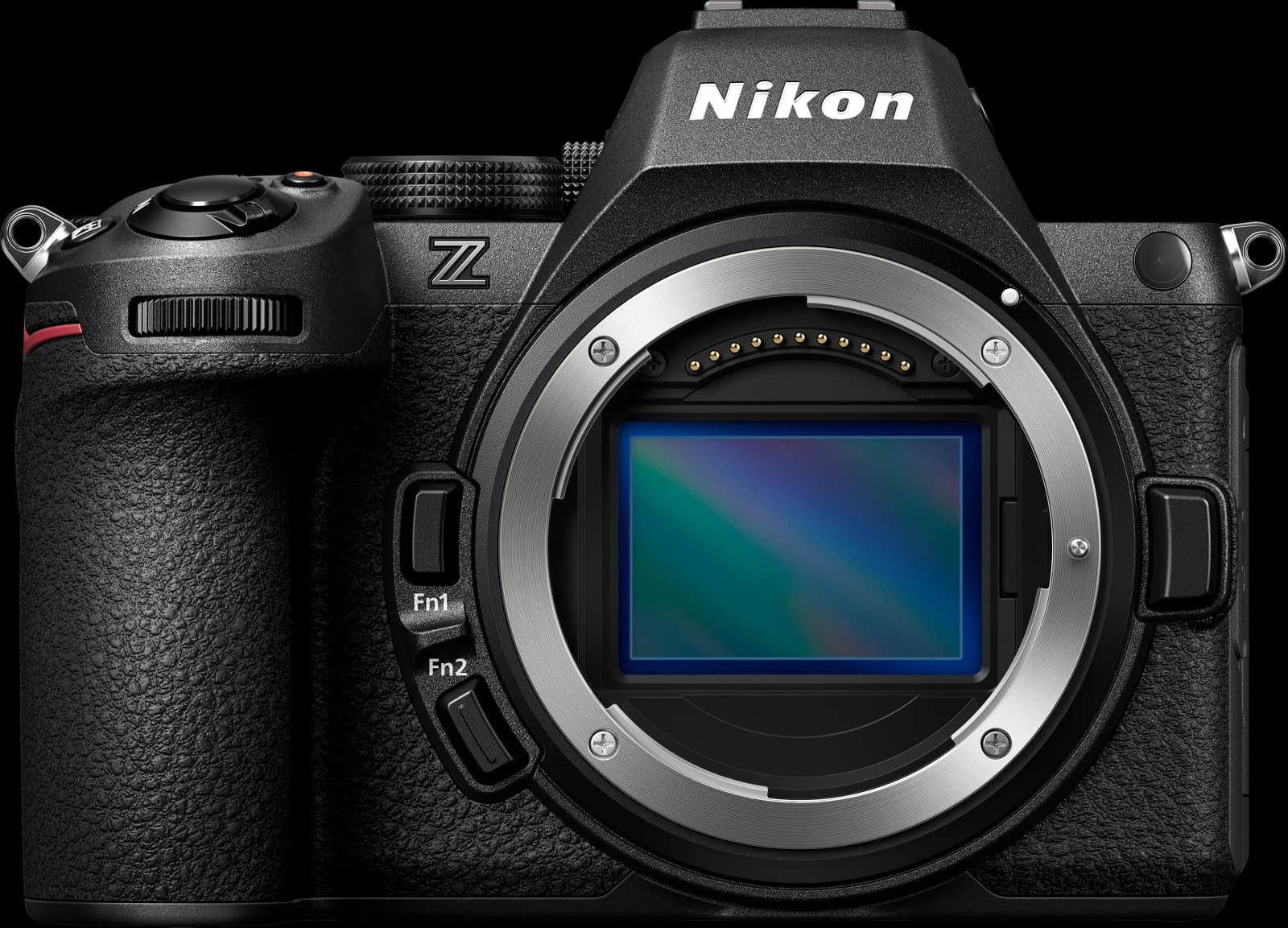
Verdict
The Nikon Z5 II targets photographers moving from DSLR or APS-C to full frame without spending more than around 1 700 USD. It features a 24.5 MP BSI CMOS sensor with a measured 11.2 EV dynamic range, 7.5-stop IBIS and full weather-sealing. These are precisely the three pillars a travel or portrait photographer needs daily. Real concessions exist: only 273 AF points versus 779 on the Panasonic Lumix S5 II at the same price, a mechanical burst capped at 7.8 fps and a CIPA battery life of 330 shots that requires a spare battery when travelling. 4K/60p video with 12-bit RAW is a genuine surprise at this price, yet the lack of active cooling can limit extended sessions. Overall the Z5 II honestly fulfils its brief: delivering Nikon Z full frame to those who cannot stretch to a Z6 III, with the right compromises in the right places.
Pros
- 7.5-stop IBIS compensation, effective handheld in low light
- Measured dynamic range of 11.2 EV at ISO 100, strong highlight recovery
- Native ISO up to 64 000, extended native range without using expanded modes
- Dual SD UHS-II slots, full weather-sealing: dependable in tough conditions
- 4K/60p video with 12-bit RAW codec and unlimited recording at this price
- Fully articulated 3.2-inch / 2.1-million-dot touchscreen
Cons
- Only 273 AF points: 100 % coverage but low density compared with rivals
- Mechanical burst limited to 7.8 fps: insufficient for sport or fast wildlife
- CIPA battery life of 330 shots: spare battery essential when travelling
- Micro HDMI port: fragile and impractical for rig-based video
- Z mount: native lens ecosystem still smaller than Sony FE or Canon RF
Who is it for?
- Travel photographers wanting a weather-sealed full-frame body with serious IBIS under 1 800 USD
- Amateur or semi-pro portrait photographers who benefit from dynamic range and human-eye detection
- Entry-level or intermediate videographers seeking affordable 4K/60p 12-bit RAW with unlimited recording
- Photographers upgrading from a Nikon DSLR who want to stay in the Z system on an entry-level full-frame budget
- Landscape photographers working in demanding conditions who need weather-sealing and stabilised long exposures
On video
Damien Bernal · 10 min 34
Nikon Z5 II : Meilleur hybride Plein format a CE prix ! (test terrain)
Presentation: An Entry-Level Full-Frame Body That Owns Its Choices
The Z5 II succeeds the original Z5 launched in 2020. Nikon positions this body as the entry point to the Z full-frame range, below the Z6 III and Zf. The goal is straightforward: deliver full-frame fundamentals without the deal-breaking compromises of earlier generations.
The Z5 II launched in 2025 at 1 696 USD body only. It sits directly against the Panasonic Lumix S5 II (1 999 USD) and Sony A7 IV, two established references in the mid-range full-frame segment. Nikon has opted for a 24.5 MP BSI CMOS sensor paired with 7.5-stop IBIS, full weather-sealing and dual SD UHS-II slots. These deliberate choices target a precise user: the versatile photographer stepping into full frame for the first time.
Compared with the original Z5, the gains are substantial. The AF system now includes subject detection via artificial intelligence with 100 % sensor coverage. Video reaches 4K/60p with 12-bit RAW and unlimited recording. IBIS has also improved. This is not a cosmetic update: it is a functional redesign that addresses the most criticised shortcomings of the first model.
Usage profile of the Nikon Z5 II: strong for travel, portrait and low light, more limited for sport and fast-moving wildlife.
The Z5 II occupies a precise spot in the Nikon Z line-up. Below it, the Z50 II (906 USD) remains APS-C without IBIS. Above it, the Zf (1 999 USD) offers the same 24.5 MP sensor with 8-stop IBIS and a retro design, but without a fully articulated screen. The Z6 III sits higher with a partially stacked sensor and faster burst rates. The Z5 II is therefore not an embarrassing compromise: it is a product designed for a defined use case and budget.
Ergonomics and Handling: A Body That Does Not Surprise, in a Good Way
At 700 g and 134 x 100.5 x 72 mm, the Z5 II sits in the upper mid-range of full-frame mirrorless bodies. It is not compact, but balances well with Z-mount lenses.
Build and Weather-Sealing
Weather-sealing is complete. Nikon does not quote an official IP rating, yet the gaskets cover controls, doors and the mount. In practice the body handles rain, sea spray and dust without special precautions. I have used similarly sealed Nikon Z bodies in comparable conditions: reliability in damp environments is genuine and consistent across the range.
Dual SD UHS-II slots are a notable strength at this price. Direct rivals such as the Canon EOS R8 (1 499 USD) offer only a single slot. Two slots enable mirrored backup or RAW/JPEG separation, standard practice among professional and semi-professional photographers who refuse to risk their files.
Viewfinder and Screen: Coherent Choices
The OLED viewfinder delivers 3 690 000 dots at 0.8x magnification. This is respectable for the class and identical to the Nikon Zf. Legibility in bright sunlight is satisfactory. The rear 3.2-inch 2.1-million-dot screen is fully articulated and touchscreen-enabled. This is a tangible advantage over the Zf, whose single-axis tilting screen is less practical for vlogging or low-angle shooting.
Connectivity invites one reservation. The HDMI port is micro, a choice that makes the connector fragile and complicates rig use. At 1 696 USD a full-size or at least mini HDMI would have been preferable. USB-C is present and supports charging while in use, partially offsetting the 330-shot CIPA battery life, one of the body’s most concrete weaknesses.
| Release year | 2025 |
|---|---|
| Weight (with battery) | 700 g |
| Dimensions | 134 x 100.5 x 72 |
| Weather sealing | Yes |
| Viewfinder | OLED EVF |
| Viewfinder resolution | 3690000 dots |
| Screen | 3.2 inches |
| Screen articulation | fully articulated |
| Touchscreen | Yes |
| Battery (CIPA) | 330 frames |
| Dual SD slot | Yes |
| Wi-Fi / Bluetooth | Yes / Yes |
| Lens mount | Nikon Z |
Image Quality: What the BSI Sensor Really Brings
The 24.5 MP BSI CMOS sensor is the same basic unit found in the Nikon Zf. Independent measurements allow us to place its real-world performance precisely, beyond marketing claims.
| Sensor | Full Frame |
|---|---|
| Sensor size | 35.9 × 23.9 mm |
| Resolution | 24.5 MP |
| Sensor type | CMOS |
| Native ISO range | 100 – 64000 |
| Extended ISO | up to 204800 |
| Measured dynamic range | 11.2 EV |
| In-body stabilization | 7.5 stops |
| AF points | 273 |
| AF coverage | 100 % |
| Eye detection (human / animal) | Yes / Yes |
| Mechanical burst | 7.8 fps |
| Electronic burst | 30 fps |
| Max shutter speed | 1/8000 |
Measured Dynamic Range and Highlight Recovery
Dynamic range measures 11.2 EV at base ISO 100. This figure comes from independent tests (Photons to Photos, DXOMark) and matches results from the same sensor in the Zf. For comparison, the Panasonic Lumix S5 II also reaches 11.2 EV while the Canon EOS R8 attains 11.6 EV on the same sources. The Z5 II is therefore not the absolute leader in its category, yet it sits in the leading group. In practice this translates to usable highlight recovery in RAW and sufficient exposure latitude for landscape and natural-light portraiture in high-contrast conditions.
Back-side illumination improves light collection at each photosite. The effect is measurable at high ISO: noise remains manageable up to ISO 6 400 in everyday use, and the native range extends to 64 000 ISO without entering expanded modes. Beyond that, expanded mode reaches 204 800 ISO, but files lose recoverability. The native 64 000 ISO ceiling is a genuine advantage over the Panasonic Lumix S5 II, which tops out at 51 200 ISO native.
Colour Rendition and JPEG Processing
Nikon retains its Picture Controls on the Z5 II. Flat and Neutral profiles suit post-production work. Vivid produces JPEGs ready for social media without further editing. Skin-tone rendering has historically been a Nikon strength and the Z5 II upholds that reputation. While difficult to quantify, this is regularly confirmed by independent tests from DPReview and Imaging Resource on Z-series bodies.
Expert Angle: Z5 II vs Zf – Same Sensor, Real Differences
The Nikon Zf (1 999 USD) shares the same 24.5 MP sensor and measured dynamic range of 11.1 EV. The difference between the two bodies does not come from the sensor: it comes from IBIS (8 stops on the Zf versus 7.5 stops on the Z5 II), design (retro on the Zf, modern on the Z5 II) and screen (fully articulated on the Z5 II, tilting on the Zf). If your priority is pure image quality, the two bodies are equivalent. If you shoot vlog-style video or awkward angles, the Z5 II wins on screen ergonomics. For handheld long exposures the Zf gains 0.5 stop of IBIS. The choice rests on these details, not the sensor.
Autofocus: Effective for Its Intended Use, Limited for Sport
The Z5 II’s AF system uses 273 points with contrast- and phase-detection. Coverage reaches 100 % of the sensor. Subject detection includes human and animal eye. The activation threshold drops to -10 EV, which is remarkable for the class.
Subject Detection and Low-Light Performance
The -10 EV AF threshold is one of the Z5 II’s strongest practical assets. By comparison the Panasonic Lumix S5 II reaches -6 EV and the Canon EOS R8 -6.5 EV. This 3.5–4 EV advantage is significant in real use: the Z5 II locks onto a subject in near-darkness where its direct rivals lose lock. For indoor portraiture, night street photography or late-evening weddings the benefit is tangible.
Human-eye detection works reliably under normal lighting. Animal-eye detection covers dogs, cats and birds according to Nikon documentation. These features are now standard on modern mirrorless cameras, yet implementation varies. On the Z5 II they are inherited from the Z6 III firmware and behave consistently with independent DPReview reports on the Z range.
The Limit of 273 Points: What It Really Changes
273 AF points is the figure that divides opinion. The Panasonic Lumix S5 II offers 779 points, the Canon EOS R8 1 053. Point density affects tracking precision on fast, erratic subjects. For static or gently moving portraiture 273 points with 100 % coverage are perfectly adequate. For birds in flight or sport with rapid direction changes the density shows its limits. The Z5 II is not designed for these uses, and its 7.8 fps mechanical burst confirms it. This is not a design flaw: it is a deliberate choice that frees budget for IBIS and weather-sealing.
- AF threshold -10 EV: best-in-class low-light performance
- 100 % sensor coverage: no dead zones
- Human- and animal-eye detection: reliable under normal conditions
- 273 points: insufficient density for sport and fast wildlife
- Mechanical burst 7.8 fps: consistent with non-sport positioning
Electronic Burst: 30 fps, With Caveats
Electronic burst reaches 30 fps. The figure looks attractive on paper, yet real-world conditions must be noted. On a standard (non-stacked) CMOS sensor, high-speed sequential readout produces rolling-shutter distortion on fast-moving subjects. Nikon does not publish a measured rolling-shutter value for the Z5 II. Independent DPReview tests on comparable sensors indicate the effect is present and can limit usable 30 fps electronic shooting on highly dynamic subjects. For portrait or travel photography the 30 fps electronic mode is usable without restriction.
IBIS Stabilisation: 7.5 Stops – The Z5 II’s Trump Card
The 7.5-stop IBIS is the Z5 II’s main differentiating argument against direct rivals. It is also one of the highest figures in the entry-level full-frame category.
7.5 stops of IBIS compensation is the figure Nikon quotes to CIPA standards. For context: the Panasonic Lumix S5 II offers 5 stops, the Canon EOS R8 offers none. The Nikon Zf reaches 8 stops but costs 303 USD more. The Z5 II therefore sits in a very favourable position for its price: it delivers near high-end stabilisation at an entry-level tariff.
In practice 7.5 stops allow handheld shooting at very slow shutter speeds. With a 50 mm lens (full-frame equivalent) the critical speed without stabilisation is roughly 1/50 s. With 7.5 stops of compensation theory permits roughly 1/0.5 s, i.e. half a second. Real-world results vary with technique and subject, yet 1/4 s handheld with a 50 mm is regularly achievable. For landscape in fading light, interior architecture or ambient-light portraiture this is a decisive advantage.
I regularly photograph in low light while travelling, often in interiors where tripods are prohibited. On bodies with 5 stops or less of IBIS I accept compromises on shutter speed or ISO. With 7.5 stops the margin is markedly greater. This is one of the rare cases where the CIPA rating translates directly into a perceptible field advantage.
Video: A Surprise at This Price, With Limits Worth Knowing
The Z5 II offers 4K/60p with 12-bit RAW and unlimited recording. This is a serious proposition for a 1 696 USD body, yet several points deserve nuance.
| Max resolution | 4K |
|---|---|
| Max frame rate | 60 fps |
| Codecs | H.264, H.265, RAW |
| Bit depth | 12 bit |
| Log profile | Yes |
| Unlimited recording | Yes |
| In-body stabilization | 7.5 stops |
| HDMI output | HDMI Micro HDMI |
| USB connector | USB-C |
Codecs and Resolution: What the Z5 II Actually Offers
The Z5 II records H.264, H.265 and 12-bit RAW. Maximum resolution is 4K at 60 fps. Log is available for colourists working in post. Recording is unlimited in duration, a strength for long interviews or events. For comparison the Panasonic Lumix S5 II reaches 6K/120p at 10-bit but costs 1 999 USD. The Canon EOS R8 offers 4K/180p at 1 499 USD but lacks IBIS. The Z5 II occupies a coherent middle ground consistent with its positioning.
The “4K at 120 fps” figure mentioned in the specification sheet requires clarification. Official Nikon documentation lists 4K at 60 fps as maximum video resolution. The 120 fps value most likely refers to slow-motion at a lower resolution (1080p). If you need native 4K/120p, this body does not provide it. The Canon EOS R8 reaches 4K/180p and the Panasonic Lumix S5 II reaches 6K/120p. On this specific point the Z5 II is behind.
IBIS in Video and Electronic Stabilisation
7.5-stop IBIS remains active in video. Nikon also offers complementary electronic stabilisation that crops the frame slightly. Together they enable steady handheld shooting for vlogging or light reportage. This is not a substitute for a gimbal on highly dynamic shots, yet it is sufficient for everyday or travel content.
Video Connectivity: The Weak Point
The micro HDMI port is the main criticism for rig-based video work. Micro HDMI connectors are fragile and adapter cables add a point of failure. For studio or structured shoots with an external monitor this is a real constraint. For vlogging or lightweight shooting without an external monitor the impact is nil. USB-C supports charging and computer tethering but does not replace HDMI for external recorders.
Against the Competition: Three Duels That Matter
The Z5 II competes in a crowded segment. Three rivals merit direct numerical comparison: the Panasonic Lumix S5 II, Canon EOS R8 and Nikon Zf.
| Spec | Nikon Z5 IITested here | Panasonic Lumix S5 II | Canon EOS R8 | Nikon Zf |
|---|---|---|---|---|
| Released | 2025 | 2023 | 2023 | 2023 |
| Sensor | Full Frame | Full Frame | Full Frame | Full Frame |
| Resolution | 24.5 MP | 24.2 MP | 24 MP | 24.5 MP |
| Native ISO max | 64000 | 51200 | 102400 | 64000 |
| Dynamic range | 11.2 EV | 11.2 EV | 11.6 EV | 11.1 EV |
| AF points | 273 | 779 | 1053 | 273 |
| Burst (elec.) | 30 fps | 30 fps | 40 fps | 30 fps |
| IBIS | 7.5 stops | 5 stops | No | 8 stops |
| Max video | 4K/60p | 6K/120p | 4K/180p | 4K/60p |
| Weather sealing | Yes | Yes | Yes | Yes |
| Dual SD slot | Yes | Yes | No | Yes |
| Weight | 700 g | 740 g | 461 g | 710 g |
| Launch price | 1696 USD | 1999 USD | 1499 USD | 1999 USD |
Z5 II vs S5 II vs R8 vs Zf: four full-frame bodies, four different positionings. The Z5 II wins on IBIS against the R8 (which has none) and on price against the S5 II and Zf.
Z5 II vs Panasonic Lumix S5 II: The Direct Duel
The Panasonic Lumix S5 II costs 1 999 USD, 303 USD more than the Z5 II. For the premium it offers 779 AF points versus 273, the same 30 fps electronic burst, 6K/120p video versus 4K/60p, and 5-stop IBIS versus 7.5 stops. The Z5 II therefore wins on IBIS and price. The S5 II wins on AF density, high-resolution video and the L-Mount ecosystem (shared with Leica and Sigma). If your priority is high-resolution video or dense AF for subject tracking, the S5 II justifies its extra cost. If your priority is stabilisation and low-light photography, the Z5 II is the better choice.
Z5 II vs Canon EOS R8: The Low-Price Trap
The Canon EOS R8 is listed at 1 499 USD, 197 USD less than the Z5 II. It offers 1 053 AF points, a 40 fps electronic burst, 11.6 EV dynamic range and 4K/180p video. On paper it dominates the Z5 II on almost every spec. Yet it lacks IBIS, full weather-sealing and offers only a single card slot. For a travel photographer or anyone working in demanding conditions these omissions are real deal-breakers. The Z5 II costs more but delivers superior field reliability. They are not the same product.
Z5 II vs Nikon Zf: Same Sensor, Different Choices
The Nikon Zf costs 1 999 USD and shares the same 24.5 MP sensor and 273 AF points. It offers 8 stops of IBIS versus 7.5 stops on the Z5 II, yet its screen is single-axis tilting, less practical for vlogging. The Zf is 10 g heavier (710 g versus 700 g) and its retro design will appeal to some and repel others. If you shoot handheld video or frequent low angles, the Z5 II and its fully articulated screen are more practical. If you want an extra 0.5 stop of IBIS and a distinctive design, the Zf justifies its price.
Z Mount: The Lens Ecosystem to Assess Before Buying
Choosing a body means choosing a lens ecosystem. The Nikon Z mount has progressed rapidly since 2018, yet it remains less extensive than Sony FE or Canon RF in certain segments.
The Nikon Z mount now offers native lenses covering essential focal lengths: wide-angle, standard, telephoto and macro. S-Line optics are optically excellent according to independent tests from DPReview and Imaging Resource. Affordable Z lenses (24-50 mm f/4-6.3, 28 mm f/2.8, 40 mm f/2) suit the Z5 II’s budget. The FTZ II adapter allows Nikon F (DSLR) lenses to be used on Z mount with functional AF, a genuine advantage for photographers migrating from Nikon DSLRs.
The Z mount’s limitation appears in affordable telephoto and fast prime lenses at accessible prices. Sony FE offers more third-party options (Sigma, Tamron, Samyang) at competitive prices. Canon RF is gradually opening to third-party optics. Nikon Z remains more closed on this front, although Sigma and Tamron have announced Z-mount lenses. If your lens budget is tight and you need specific focal lengths, check Z-mount availability before purchasing the body.
Price and Value: Where the Z5 II Stands in 2026
At 1 696 USD on launch, the Z5 II sits in the most contested segment of the mirrorless market. One year after release, used-market prices and promotions alter the equation.
The Z5 II launched at 1 696 USD in 2025. In 2026 new prices have moved slightly according to retailers and seasonal promotions. The used market now offers examples at lower prices, further improving value. A used Z5 II in good condition typically trades between 1 300 USD and 1 500 USD, placing it in direct competition with previous-generation bodies at new prices.
To assess value, factor in what the Z5 II includes for its price: weather-sealing, dual SD UHS-II slots, 7.5-stop IBIS, unlimited 12-bit RAW video and a 3 690 000-dot OLED viewfinder. The Canon EOS R8 at 1 499 USD has neither IBIS nor dual slots. The Panasonic Lumix S5 II at 1 999 USD has better AF but weaker IBIS. The Z5 II offers a coherent package for its price, without deal-breaking compromises on the features that matter for its target use.
Verdict: For Whom, and Why
The Z5 II is an honest body that delivers on its promises within its intended use. It does not claim to be a Z6 III. It claims to be the best Nikon Z full-frame option under 1 700 USD, and it succeeds.
The Z5 II convinces on the fundamentals that matter to its buyer profile: serious 7.5-stop stabilisation, full weather-sealing, dual SD UHS-II slots, 11.2 EV dynamic range and native ISO up to 64 000. 4K/60p 12-bit RAW video with unlimited recording is genuine added value at this price. -10 EV AF is best-in-class for low light.
The concessions are clear and deliberate. 273 AF points limit tracking on highly dynamic subjects. 7.8 fps mechanical burst rules out serious sport. 330-shot CIPA battery life demands a spare. The micro HDMI port is a regression for rig-based video. These points are not design flaws for a travel or portrait photographer: they are the price paid for the features that make a difference in the field.
- Buy the Z5 II if you are coming from a Nikon DSLR and want to move to full-frame Z without exceeding 1 700 USD
- Buy the Z5 II if you shoot in demanding conditions and need weather-sealing plus serious IBIS
- Choose the Canon EOS R8 if you do not need IBIS and dense AF plus fast burst are your priorities
- Choose the Panasonic Lumix S5 II if high-resolution video and AF density matter more than IBIS
- Choose the Nikon Zf if retro design and an extra 0.5 stop of IBIS are worth 303 USD more to you
Frequently asked questions
Is the Nikon Z5 II better than the Z6 III?▾
No, the Z6 III is superior on almost every technical criterion: partially stacked sensor, denser AF, faster burst and more capable video. It also costs significantly more. The Z5 II is the right choice if your budget is capped around 1 700 USD and your uses are travel, portrait or low light. If you can stretch to the Z6 III there is no reason to choose the Z5 II.
Is the Nikon Z5 II suitable for video?▾
Yes, for intermediate use. It offers 4K/60p with 12-bit RAW, unlimited recording and Log. 7.5-stop IBIS remains active in video. Limitations are the micro HDMI port (fragile for rigs) and the absence of native 4K/120p. For vlogging, reportage or interviews it is very capable. For cinematic work with external monitors or 4K slow motion, consider the Panasonic Lumix S5 II or Canon EOS R8 instead.
What is the difference between the Nikon Z5 II and the Nikon Zf?▾
Both bodies share the same 24.5 MP sensor and 273 AF points. Main differences: the Zf has 8 stops of IBIS versus 7.5 stops on the Z5 II, a retro design and a single-axis tilting screen. The Z5 II has a fully articulated screen, more practical for vlogging. The Zf costs 303 USD more. If screen articulation and budget matter, choose the Z5 II. If retro styling and the extra 0.5 stop of IBIS justify the price, choose the Zf.
Is the Nikon Z5 II weather-sealed?▾
Yes. The Z5 II carries gaskets on controls, doors and mount. Nikon does not publish an official IP rating, yet weather-sealing is confirmed in the manufacturer’s documentation. In practice the body resists rain, sea spray and dust under normal outdoor conditions. It is not a dive housing, yet it is sufficient for travel and landscape photography in demanding environments.
Can Nikon F (DSLR) lenses be used on the Z5 II?▾
Yes, via the FTZ II adapter (sold separately). AF functions on AF-S and AF-P lenses. AF-D lenses without internal motors require manual focus. This is a strong migration argument for photographers moving from Nikon D750, D850 or D7500 DSLRs: they can reuse their existing lens collection without selling it.
What real-world battery life can be expected from the Nikon Z5 II?▾
Official CIPA rating is 330 shots. In real use with screen, Wi-Fi and EVF alternated, expect between 250 and 400 shots depending on shooting style. USB-C charging allows in-use top-ups from a power bank. For a full day of intensive shooting an additional EN-EL15c battery is strongly recommended. This is the body’s most concrete field weakness.
Related reviews
Review Canon EOS R6 Mark II: Still the Right Choice in 2026?
The Canon EOS R6 Mark II remains the most balanced general-purpose hybrid in its class for weddings, portraits and travel, provided you accept a RAW buffer limited to 75 images and video capped at 4K/60p.
Read the review
Review: Sony α7 IV – Still the Right Choice in 2026?
Full-frame all-rounder still relevant used for weddings, portraits and occasional video. New, 2023-2024 rivals offer more for the same budget.
Read the review
Nikon Z9 Review: Is the Nikon Flagship Still at the Top?
The Nikon Z9 remains a benchmark for professional sport and reportage thanks to its -8.5 EV AF and 1000 RAW buffer, yet the Z8 delivers the essentials for 1999 USD less.
Read the review